
心理与行为研究 ›› 2025, Vol. 23 ›› Issue (5): 635-644.DOI: 10.12139/j.1672-0628.2025.05.008
张润竹*,1( ), 马燕2, 徐梦思*,3()
收稿日期:2025-01-13
出版日期:2025-09-20
发布日期:2025-09-20
通讯作者:
张润竹, 徐梦思
基金资助:
Runzhu ZHANG*,1(), Yan MA2, Mengsi XU*,3()
Received:2025-01-13
Online:2025-09-20
Published:2025-09-20
Contact:
Runzhu ZHANG, Mengsi XU
摘要:
为探讨自恋在亲子依恋与儿童反应性攻击和主动性攻击间的中介及感觉加工敏感性(sensory processing sensitivity, SPS)的调节作用,采用反应性−主动性攻击问卷、亲子与同伴依恋量表中亲子依恋维度、儿童自恋量表和高敏感儿童量表,对643名9~14岁儿童进行调查。结果显示,隐性自恋中介亲子信任和亲子疏离对两类攻击行为的影响,显性自恋中介亲子沟通和亲子疏离对反应性攻击的影响;高SPS增强了亲子疏离、隐性自恋和反应性攻击的正向关联。研究更全面地揭示了亲子依恋、不同自恋类型和儿童反应性攻击与主动性攻击的关系,揭示了高SPS儿童对反应性攻击的易感性。
张润竹, 马燕, 徐梦思. 亲子依恋与儿童攻击行为:自恋的中介及感觉加工敏感性的调节[J]. 心理与行为研究, 2025, 23(5): 635-644.
Runzhu ZHANG, Yan MA, Mengsi XU. Parent-Child Attachment and Children’s Aggressive Behaviors: The Mediating Role of Narcissism and the Moderating Role of Sensory Processing Sensitivity[J]. Studies of Psychology and Behavior, 2025, 23(5): 635-644.
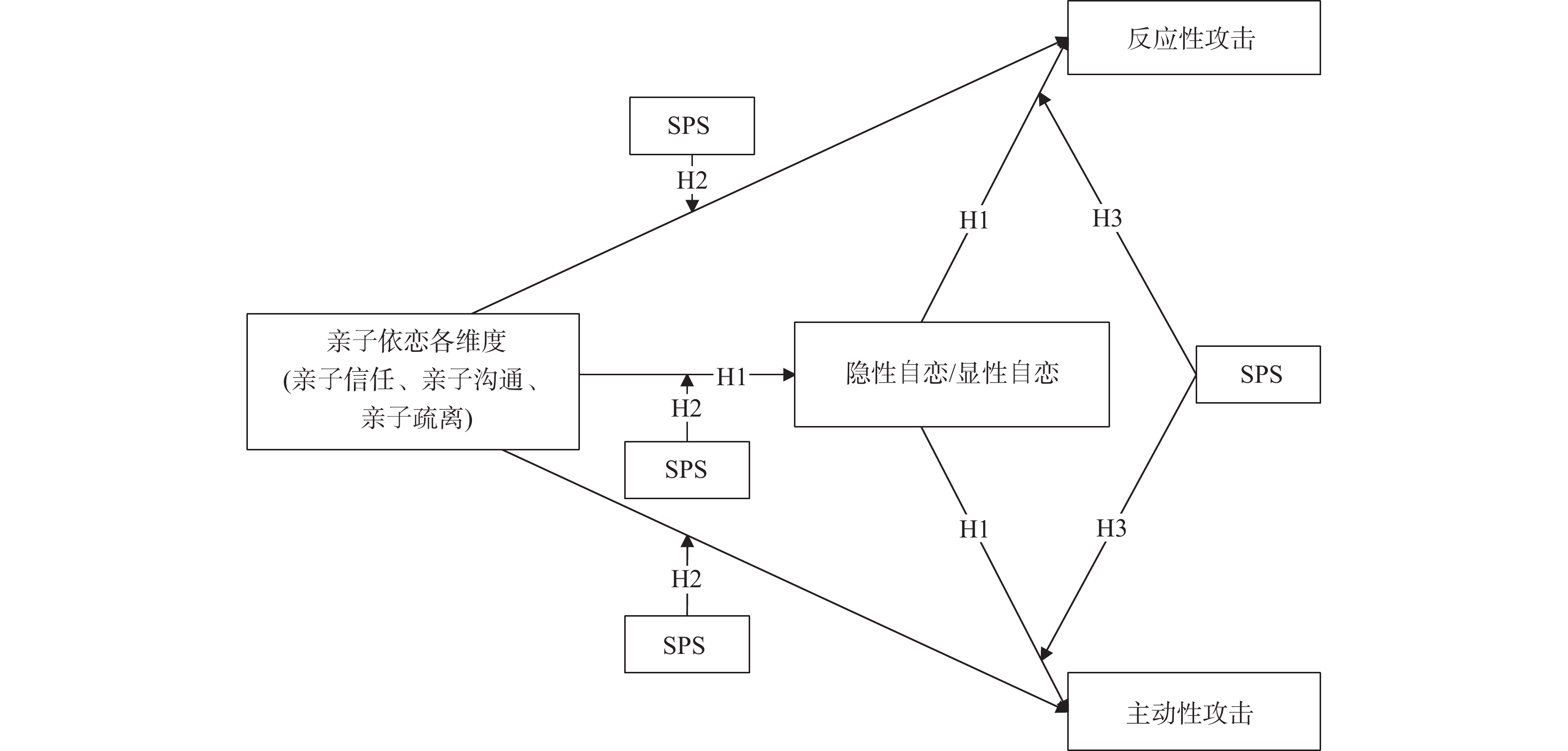
图1 假设模型
| M±SD | 1 | 2 | 3 | 4 | 5 | 6 | 7 | 8 | 9 | 10 | |
| 1. 性别 | |||||||||||
| 2. 年龄 | 10.83±0.70 | 0.06 | |||||||||
| 3. SES | 0.00±2.52 | 0.04 | 0.02 | ||||||||
| 4. 反应性攻击 | 7.54±2.66 | 0.06 | 0.06 | 0.07 | |||||||
| 5. 主动性攻击 | 4.54±2.69 | 0.09* | −0.01 | −0.05 | 0.47*** | ||||||
| 6. 亲子信任 | 37.07±9.45 | 0.06 | 0.06 | 0.18*** | −0.14** | −0.37*** | |||||
| 7. 亲子沟通 | 32.71±8.77 | 0.09* | 0.04 | 0.20*** | −0.12** | −0.32*** | 0.88*** | ||||
| 8. 亲子疏离 | 13.29±4.85 | 0.01 | 0.02 | −0.04 | 0.20*** | 0.23*** | −0.24*** | −0.25*** | |||
| 9. 隐性自恋 | 1.97±0.71 | −0.02 | −0.002 | 0.02 | 0.36*** | 0.30*** | −0.34*** | −0.28*** | 0.33*** | ||
| 10. 显性自恋 | 2.38±0.67 | 0.03 | 0.08 | 0.16*** | 0.22*** | 0.07 | 0.11* | 0.15*** | 0.05 | 0.47*** | |
| 11. 感觉加工敏感性 | 57.22±13.72 | −0.04 | 0.07 | 0.14*** | 0.16*** | −0.23*** | 0.20*** | 0.17*** | −0.003 | 0.10* | 0.08 |
表1 变量的描述性统计和相关分析结果(n=643)
| M±SD | 1 | 2 | 3 | 4 | 5 | 6 | 7 | 8 | 9 | 10 | |
| 1. 性别 | |||||||||||
| 2. 年龄 | 10.83±0.70 | 0.06 | |||||||||
| 3. SES | 0.00±2.52 | 0.04 | 0.02 | ||||||||
| 4. 反应性攻击 | 7.54±2.66 | 0.06 | 0.06 | 0.07 | |||||||
| 5. 主动性攻击 | 4.54±2.69 | 0.09* | −0.01 | −0.05 | 0.47*** | ||||||
| 6. 亲子信任 | 37.07±9.45 | 0.06 | 0.06 | 0.18*** | −0.14** | −0.37*** | |||||
| 7. 亲子沟通 | 32.71±8.77 | 0.09* | 0.04 | 0.20*** | −0.12** | −0.32*** | 0.88*** | ||||
| 8. 亲子疏离 | 13.29±4.85 | 0.01 | 0.02 | −0.04 | 0.20*** | 0.23*** | −0.24*** | −0.25*** | |||
| 9. 隐性自恋 | 1.97±0.71 | −0.02 | −0.002 | 0.02 | 0.36*** | 0.30*** | −0.34*** | −0.28*** | 0.33*** | ||
| 10. 显性自恋 | 2.38±0.67 | 0.03 | 0.08 | 0.16*** | 0.22*** | 0.07 | 0.11* | 0.15*** | 0.05 | 0.47*** | |
| 11. 感觉加工敏感性 | 57.22±13.72 | −0.04 | 0.07 | 0.14*** | 0.16*** | −0.23*** | 0.20*** | 0.17*** | −0.003 | 0.10* | 0.08 |
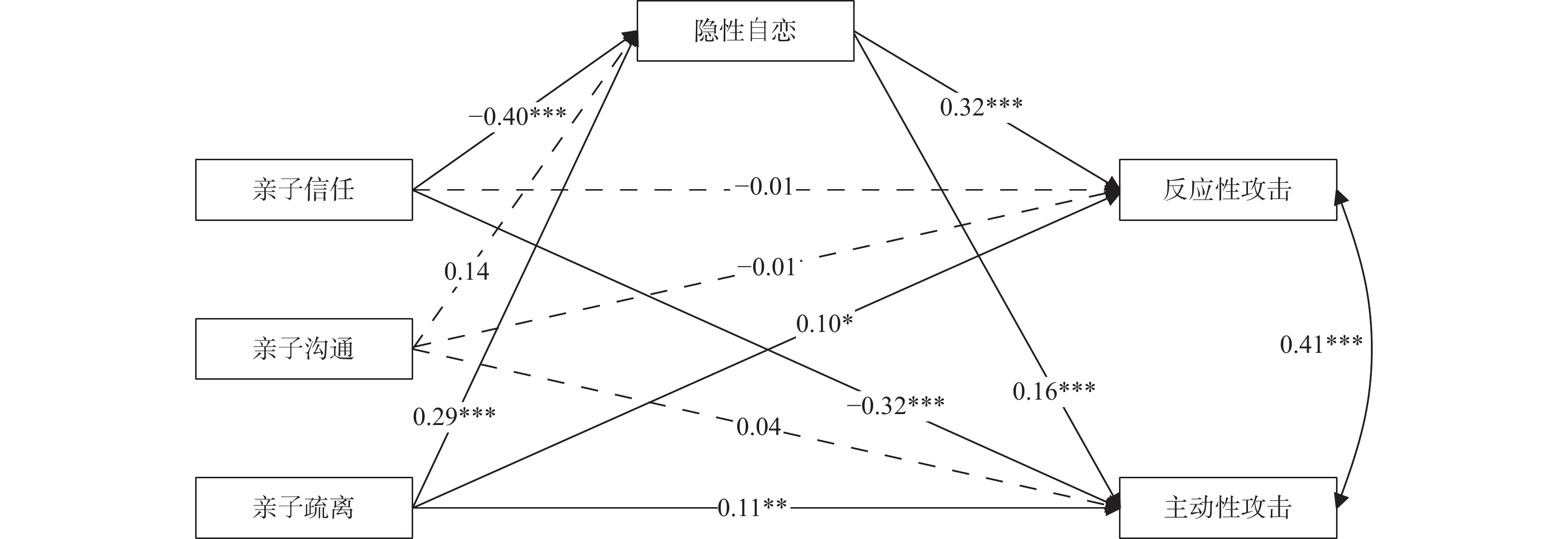
图2 亲子依恋影响儿童反应性攻击和主动性攻击:隐性自恋的中介 注:实线表示显著路径,虚线表示不显著路径,以下同。
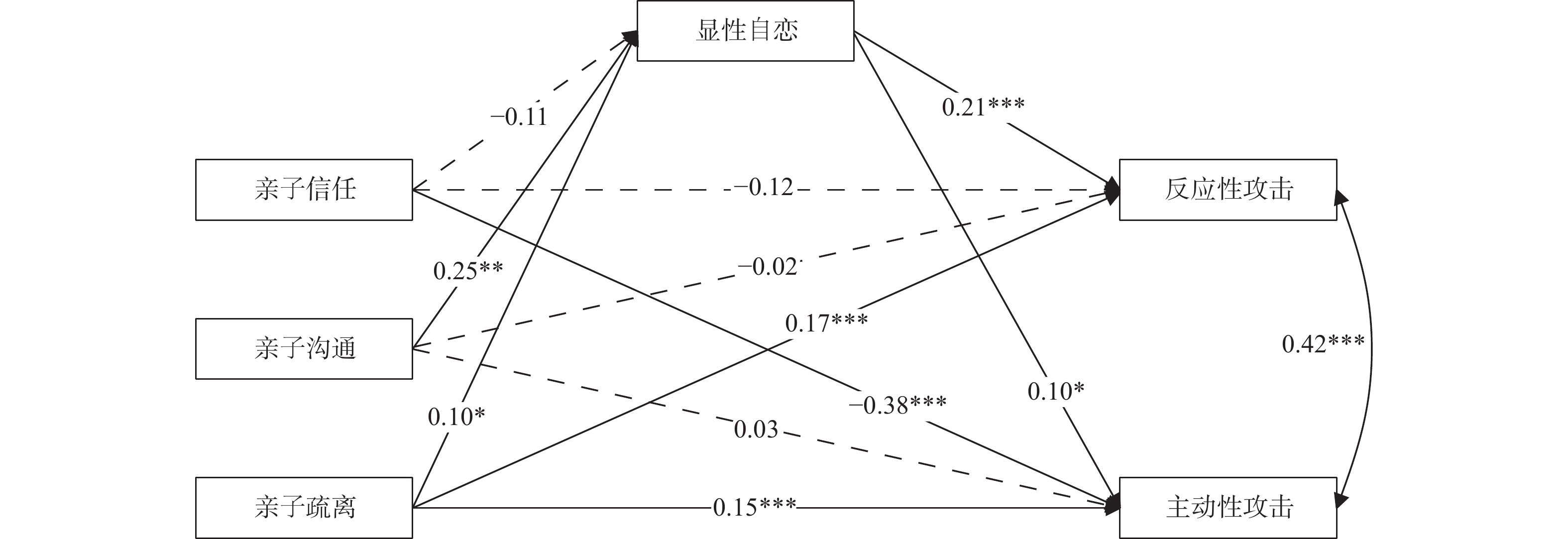
图3 亲子依恋影响儿童反应性攻击和主动性攻击:显性自恋的中介
| 中介路径 | 中介效应 | 95%CI下限 | 95%CI上限 |
| 亲子信任→隐性自恋→反应性攻击 | −0.13*** | −0.19 | −0.07 |
| 亲子沟通→隐性自恋→反应性攻击 | 0.05 | −0.01 | 0.10 |
| 亲子疏离→隐性自恋→反应性攻击 | 0.09*** | 0.06 | 0.13 |
| 亲子信任→隐性自恋→主动性攻击 | −0.06** | −0.11 | −0.02 |
| 亲子沟通→隐性自恋→主动性攻击 | 0.02 | −0.01 | 0.05 |
| 亲子疏离→隐性自恋→主动性攻击 | 0.05** | 0.02 | 0.07 |
| 亲子信任→显性自恋→反应性攻击 | −0.02 | −0.06 | 0.01 |
| 亲子沟通→显性自恋→反应性攻击 | 0.05* | 0.01 | 0.10 |
| 亲子疏离→显性自恋→反应性攻击 | 0.02* | 0.002 | 0.04 |
| 亲子信任→显性自恋→主动性攻击 | −0.01 | −0.03 | 0.01 |
| 亲子沟通→显性自恋→主动性攻击 | 0.03 | −0.002 | 0.05 |
| 亲子疏离→显性自恋→主动性攻击 | 0.01 | −0.002 | 0.02 |
表2 中介效应分析
| 中介路径 | 中介效应 | 95%CI下限 | 95%CI上限 |
| 亲子信任→隐性自恋→反应性攻击 | −0.13*** | −0.19 | −0.07 |
| 亲子沟通→隐性自恋→反应性攻击 | 0.05 | −0.01 | 0.10 |
| 亲子疏离→隐性自恋→反应性攻击 | 0.09*** | 0.06 | 0.13 |
| 亲子信任→隐性自恋→主动性攻击 | −0.06** | −0.11 | −0.02 |
| 亲子沟通→隐性自恋→主动性攻击 | 0.02 | −0.01 | 0.05 |
| 亲子疏离→隐性自恋→主动性攻击 | 0.05** | 0.02 | 0.07 |
| 亲子信任→显性自恋→反应性攻击 | −0.02 | −0.06 | 0.01 |
| 亲子沟通→显性自恋→反应性攻击 | 0.05* | 0.01 | 0.10 |
| 亲子疏离→显性自恋→反应性攻击 | 0.02* | 0.002 | 0.04 |
| 亲子信任→显性自恋→主动性攻击 | −0.01 | −0.03 | 0.01 |
| 亲子沟通→显性自恋→主动性攻击 | 0.03 | −0.002 | 0.05 |
| 亲子疏离→显性自恋→主动性攻击 | 0.01 | −0.002 | 0.02 |
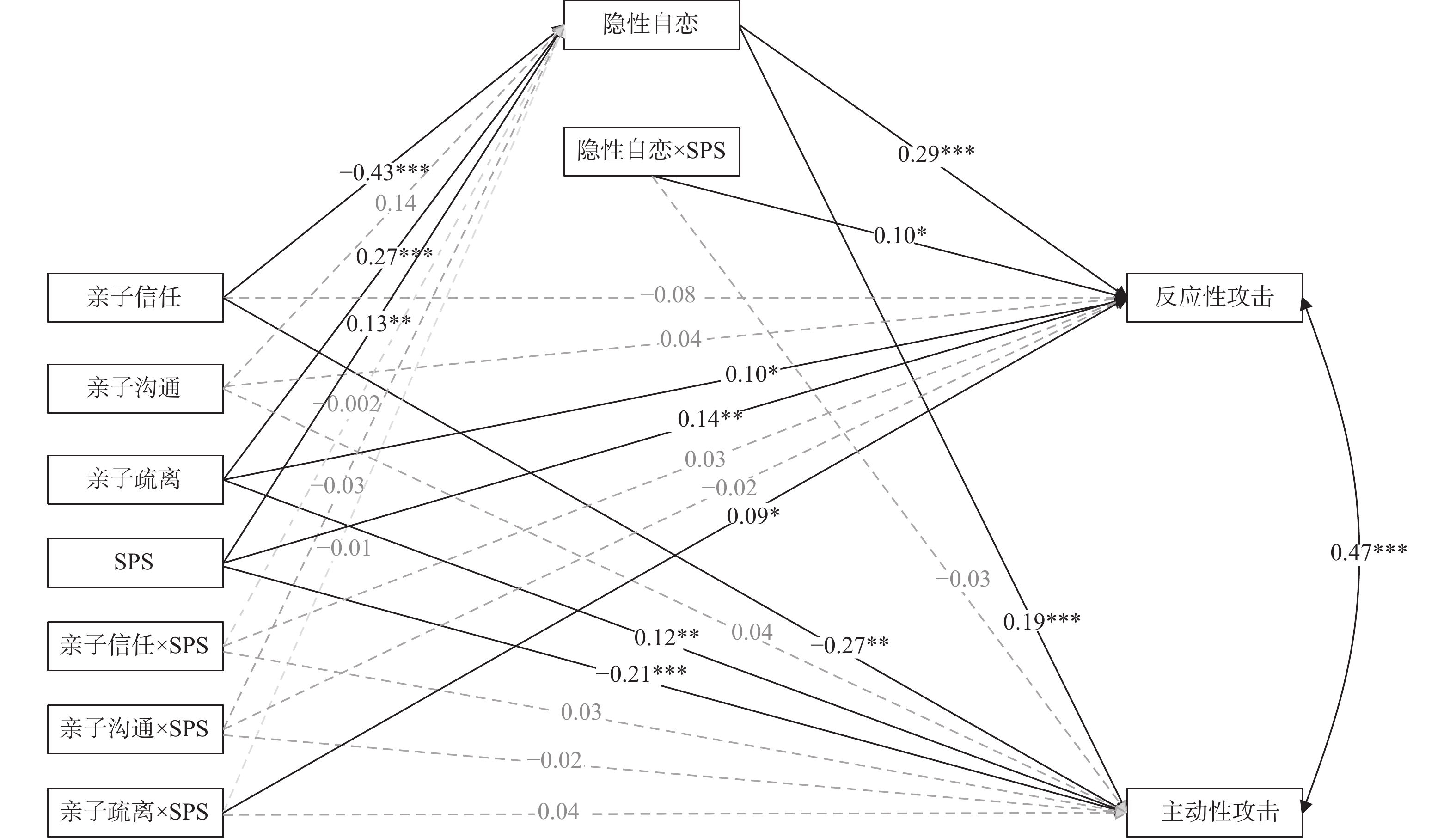
图4 亲子依恋影响儿童反应性攻击和主动性攻击:隐性自恋的中介和SPS的调节
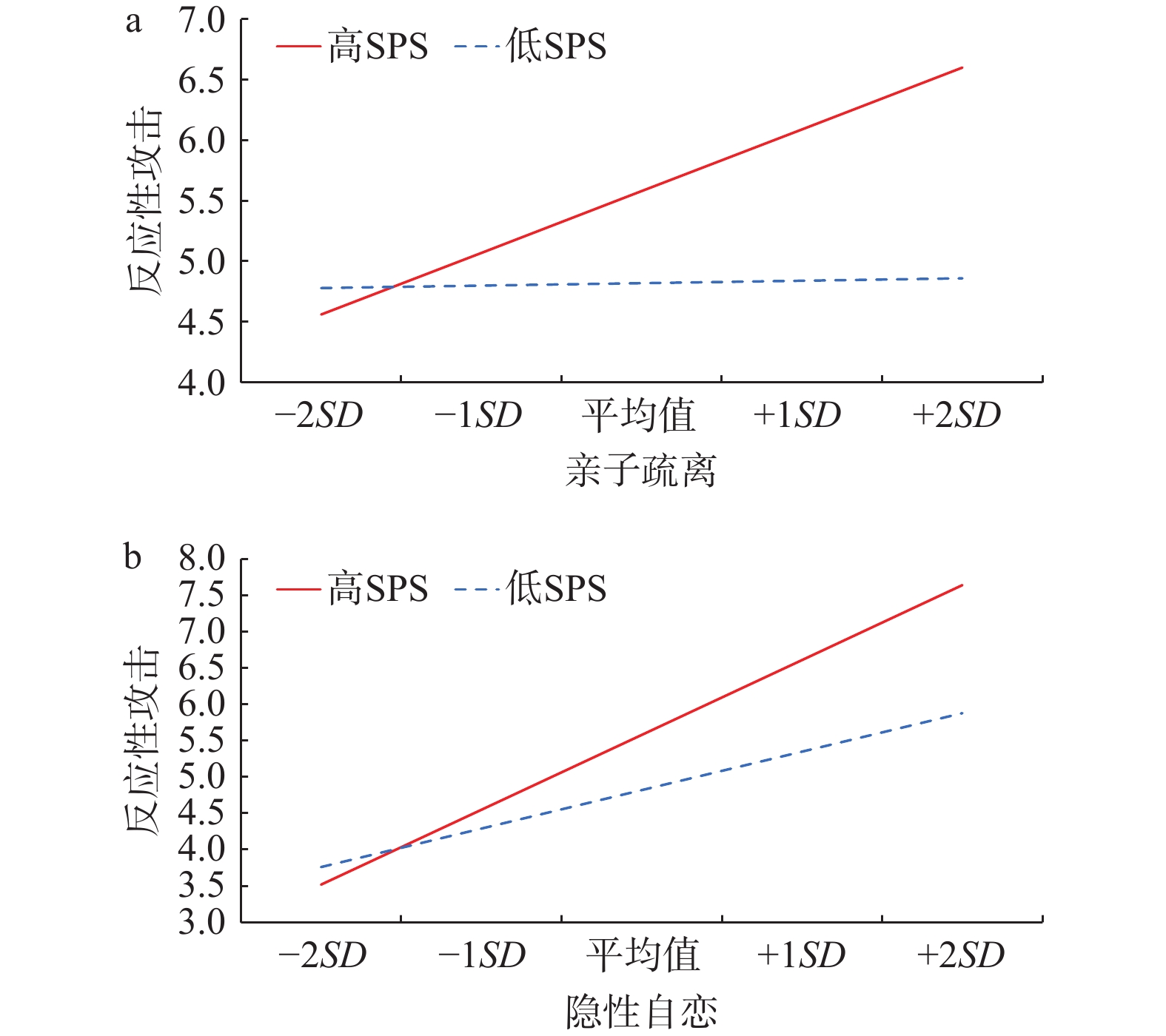
图5 亲子疏离与SPS(a)、隐性自恋与SPS(b)对儿童反应性攻击的交互影响
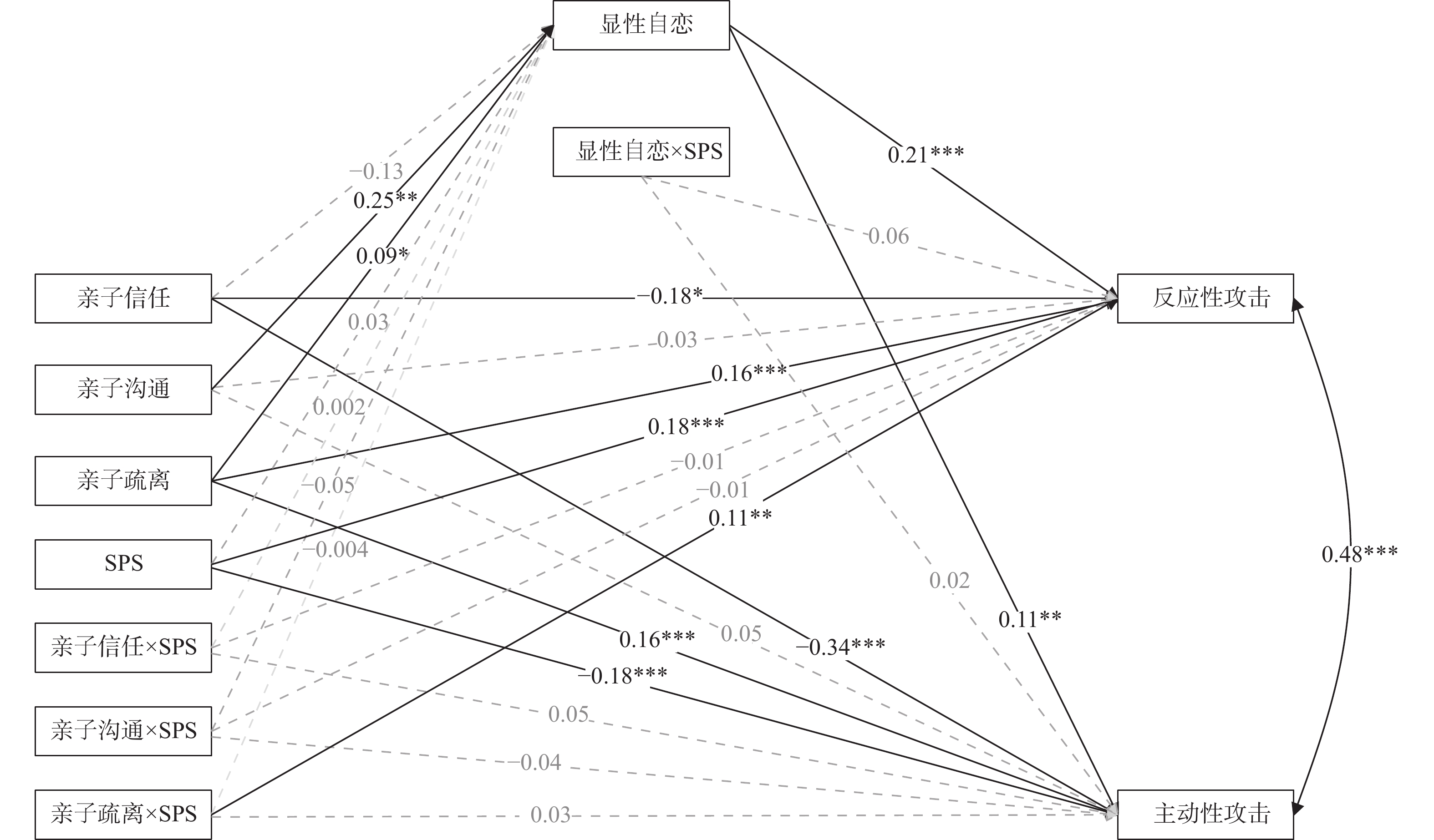
图6 亲子依恋影响儿童反应性攻击和主动性攻击:显性自恋的中介和SPS的调节
|
张丽华, 朱贺. 自恋与攻击性关系的元分析. 心理学报, 2021, 53 (11): 1228- 1243.
|
|
|
张迎黎, 张亚林, 张迎新, 王杰利, 黄存云. 修订版青少年依恋问卷中文版在初中生中应用的信效度. 中国心理卫生杂志, 2011, 25 (1): 66- 70.
|
|
|
张振. 自恋与攻击行为的关系: 观点采择和共情关注的调节作用. 心理与行为研究, 2021, 19 (1): 131- 136.
|
|
|
周广东, 周广敏. 同伴关系与儿童的反应性和主动性攻击: 交叉滞后分析. 心理与行为研究, 2021, 19 (5): 620- 627.
|
|
|
周浩, 龙立荣. 共同方法偏差的统计检验与控制方法. 心理科学进展, 2004, 12 (6): 942- 950.
|
|
|
Aiken, L. S, & West, S. G. (1991). Multiple regression: Testing and interpreting interactions. Thousand Oaks, CA: Sage Publications, Inc.
|
|
|
Anderson, C. A., & Bushman, B. J. Human aggression. Annual Review of Psychology, 2002, 53, 27- 51.
DOI |
|
|
Armsden, G. C., & Greenberg, M. T. The inventory of parent and peer attachment: Individual differences and their relationship to psychological well-being in adolescence. Journal of Youth and Adolescence, 1987, 16 (5): 427- 454.
DOI |
|
|
Aron, E. N., Aron, A., & Jagiellowicz, J. Sensory processing sensitivity: A review in the light of the evolution of biological responsivity. Personality and Social Psychology Review, 2012, 16 (3): 262- 282.
DOI |
|
|
Booth, C., Standage, H., & Fox, E. Sensory-processing sensitivity moderates the association between childhood experiences and adult life satisfaction. Personality and Individual Differences, 2015, 87, 24- 29.
DOI |
|
|
Chen, Y. M., Liu, K., Zhu, Y., Fang, X. Q., Ding, Y. T., & Jiang, W. J. Parental attachment and mental health in Chinese early adolescents: The mediation role of narcissism. Children and Youth Services Review, 2024, 166, 107966.
DOI |
|
|
Derry, K. L., Bayliss, D. M., & Ohan, J. L. Measuring grandiose and vulnerable narcissism in children and adolescents: The Narcissism Scale for Children. Assessment, 2019, 26 (4): 645- 660.
DOI |
|
|
Derry, K. L., Ohan, J. L., & Bayliss, D. M. Fearing failure: Grandiose narcissism, vulnerable narcissism, and emotional reactivity in children. Child Development, 2020, 91 (3): e581- e596.
|
|
|
Ebbert, A. M., Infurna, F. J., & Luthar, S. S. Mapping developmental changes in perceived parent-adolescent relationship quality throughout middle school and high school. Development and Psychopathology, 2019, 31 (4): 1541- 1556.
DOI |
|
|
Evans, S. C., Dίaz, K. I., Callahan, K. P., Wolock, E. R., & Fite, P. J. Parallel trajectories of proactive and reactive aggression in middle childhood and their outcomes in early adolescence. Research on Child and Adolescent Psychopathology, 2021, 49 (2): 211- 226.
DOI |
|
|
Graham, J. W. Missing data analysis: Making it work in the real world. Annual Review of Psychology, 2009, 60, 549- 576.
DOI |
|
|
Groh, A. M., Fearon, R. M. P., van IJzendoorn, M. H., Bakermans-Kranenburg, M. J., & Roisman, G. I. Attachment in the early life course: Meta-analytic evidence for its role in socioemotional development. Child Development Perspectives, 2017, 11 (1): 70- 76.
DOI |
|
|
Hubbard, J. A., McAuliffe, M. D., Morrow, M. T., & Romano, L. J. Reactive and proactive aggression in childhood and adolescence: Precursors, outcomes, processes, experiences, and measurement. Journal of Personality, 2010, 78 (1): 95- 118.
DOI |
|
|
Jauk, E., Knödler, M., Frenzel, J., & Kanske, P. Do highly sensitive persons display hypersensitive narcissism? Similarities and differences in the nomological networks of sensory processing sensitivity and vulnerable narcissism. Journal of Clinical Psychology, 2023, 79 (1): 228- 254.
DOI |
|
|
Kjærvik, S. L., & Bushman, B. J. The link between narcissism and aggression: A meta-analytic review. Psychological Bulletin, 2021, 147 (5): 477- 503.
DOI |
|
|
Kline, R. B. (2015). Principles and practice of structural equation modeling(4th ed). New York: The Guilford Press.
|
|
|
Krizan, Z., & Herlache, A. D. The narcissism spectrum model: A synthetic view of narcissistic personality. Personality and Social Psychology Review, 2018, 22 (1): 3- 31.
DOI |
|
|
Li, Q. Q., Gao, M., Deng, Y. F., Zhou, Z. K., & Wang, J. Parental attachment and proactive-reactive aggression in adolescence: The mediating role of self-control and perspective taking. Psychology Research and Behavior Management, 2023, 16, 3437- 3446.
DOI |
|
|
Li, Z., Sturge-Apple, M. L., Jones-Gordils, H. R., & Davies, P. T. Sensory processing sensitivity behavior moderates the association between environmental harshness, unpredictability, and child socioemotional functioning. Development and Psychopathology, 2022, 34 (2): 675- 688.
DOI |
|
|
Liss, M., Timmel, L., Baxley, K., & Killingsworth, P. Sensory processing sensitivity and its relation to parental bonding, anxiety, and depression. Personality and Individual Differences, 2005, 39 (8): 1429- 1439.
DOI |
|
|
Liu, Q. X., Huang, J. J., & Zhou, Z. K. Self-expansion via smartphone and smartphone addiction tendency among adolescents: A moderated mediation model. Children and Youth Services Review, 2020, 119, 105590.
DOI |
|
|
Marcus, R. F., & Kramer, C. Reactive and proactive aggression: Attachment and social competence predictors. The Journal of Genetic Psychology, 2001, 162 (3): 260- 275.
DOI |
|
|
Meter, D. J., Ehrenreich, S. E., Beron, K., & Underwood, M. K. Listening in: How parent-child communication relates to social and physical aggression. Journal of Child and Family Studies, 2021, 30 (6): 1540- 1553.
DOI |
|
|
Meyer, B., & Pilkonis, P. A. (2011). Attachment theory and narcissistic personality disorder. In W. K. Campbell & J. D. Miller (Eds.), The handbook of narcissism and narcissistic personality disorder: Theoretical approaches, empirical findings, and treatments (pp. 434–444). New York: John Wiley & Sons, Inc.
|
|
|
Miller, J. D., & Campbell, W. K. Comparing clinical and social-personality conceptualizations of narcissism. Journal of Personality, 2008, 76 (3): 449- 476.
|
|
|
Savage, J. The association between attachment, parental bonds and physically aggressive and violent behavior: A comprehensive review. Aggression and Violent Behavior, 2014, 19 (2): 164- 178.
DOI |
|
|
Slagt, M., Dubas, J. S., van Aken, M. A. G., Ellis, B. J., & Deković, M. Sensory processing sensitivity as a marker of differential susceptibility to parenting. Developmental Psychology, 2018, 54 (3): 543- 558.
DOI |
|
|
Tackett, J. L., Herzhoff, K., Smack, A. J., Reardon, K. W., & Adam, E. K. Does socioeconomic status mediate racial differences in the cortisol response in middle childhood. Health Psychology, 2017, 36 (7): 662- 672.
DOI |
|
|
van Den Boogert, F., Sizoo, B., Spaan, P., Tolstra, S., Bouman, Y. H. A., Hoogendijk, W. J. G., & Roza, S. J. Sensory processing and aggressive behavior in adults with autism spectrum disorder. Brain Sciences, 2021, 11 (1): 95.
DOI |
|
|
van Schie, C. C., Jarman, H. L., Huxley, E., & Grenyer, B. F. S. Narcissistic traits in young people: Understanding the role of parenting and maltreatment. Borderline Personality Disorder and Emotion Dysregulation, 2020, 7, 10.
DOI |
|
|
Wink P. Two faces of narcissism. Journal of Personality and Social Psychology, 1991, 61 (4): 590- 597.
DOI |
| [1] | 张文海, 沙晶莹. 消极评价来源对网络集群攻击行为的影响:基于群际敏感效应的研究[J]. 心理与行为研究, 2025, 23(6): 822-829. |
| [2] | 曾萱萱, 余俐珍, 王小桃. 父母自恋与幼儿身体攻击行为的关系:父母身体攻击行为和子女教育心理控制源的中介作用[J]. 心理与行为研究, 2025, 23(4): 513-519. |
| [3] | 刘洁, 崔维维, 王澍. 人格和攻击行为:对近20年学生群体的元分析[J]. 心理与行为研究, 2025, 23(2): 168-176. |
| [4] | 张丽华, 杨博, 刘欣. 社会排斥对不同类型自恋者敌意解释偏向的影响[J]. 心理与行为研究, 2025, 23(2): 257-264. |
| [5] | 罗鹤旋, 朱海东, 邱鑫. 家庭社会经济地位与青少年亲社会行为的关系:链式中介效应及独生状况差异[J]. 心理与行为研究, 2025, 23(1): 130-137. |
| [6] | 孙姗, 陈翩, 杨阳, 黄奥迪, 王美萍. 父母冲突与青少年早期攻击行为:情绪不安全感和自我控制的链式中介作用[J]. 心理与行为研究, 2024, 22(6): 784-790. |
| [7] | 闫佳慈, 王兴超. 父母低头行为与青少年孤独感:亲子沟通的中介作用和亲子依恋的调节作用[J]. 心理与行为研究, 2024, 22(6): 806-813. |
| [8] | 马跃, 吴捷, 查世琦, 杨春. 青少年人际困扰的核心症状及其与亲子依恋和心理边界的网络关系[J]. 心理与行为研究, 2024, 22(4): 478-485. |
| [9] | 邹孟芮, 刘舒野, 程诚, 王友碧. 心理虐待与青少年攻击行为的关系:有调节的中介模型[J]. 心理与行为研究, 2024, 22(2): 282-288. |
| [10] | 吴明证, 陈迪, 严梦瑶, 倪苏杭, 王士祺, 尹金荣, 孙晓玲. 家庭仪式与青少年自我控制的关系:亲子依恋与生命意义感的链式中介作用[J]. 心理与行为研究, 2023, 21(6): 832-838. |
| [11] | 高阳, 倪士光, 夏志远, 田午林. 群体夸耀方式对旁观者网络攻击行为的影响:旁观者的被挑衅感和群体认同的作用[J]. 心理与行为研究, 2023, 21(4): 471-478. |
| [12] | 李娇娇, 刘晓冰, 裴丹丹, 徐碧波, 尹锡杨. 情绪智力对大学生恶意创造力的影响:一个有调节的中介模型[J]. 心理与行为研究, 2022, 20(4): 563-569. |
| [13] | 李晓玫, 姜英杰, 于明阳, 袁媛, 刘芳芳. 留守儿童心理虐待与攻击行为:心理弹性和人际敏感的链式中介作用[J]. 心理与行为研究, 2022, 20(3): 353-360. |
| [14] | 丁倩, 罗星雨. 歧视知觉对留守青少年攻击行为的影响:多重中介效应分析[J]. 心理与行为研究, 2022, 20(3): 346-352. |
| [15] | 谭德琴, 谢瑞波, 丁菀, 吴伟, 宋省成, 李伟健. 亲子依恋和师生关系对留守儿童内化问题的影响:同伴依恋的中介作用[J]. 心理与行为研究, 2022, 20(3): 339-345. |
| 阅读次数 | ||||||
|
全文 |
|
|||||
|
摘要 |
|
|||||
