
心理与行为研究 ›› 2026, Vol. 24 ›› Issue (1): 87-94.DOI: 10.12139/j.1672-0628.2026.01.010
谢开圣1, 陈欣欣2, 袁丹3, 黄伟康4, 方杰*,5( )
)
收稿日期:2025-02-21
出版日期:2026-01-20
发布日期:2026-01-20
通讯作者:
方杰
基金资助:
Kaisheng XIE1, Xinxin CHEN2, Dan YUAN3, Weikang HUANG4, Jie FANG*,5()
Received:2025-02-21
Online:2026-01-20
Published:2026-01-20
Contact:
Jie FANG
摘要:
为了探讨父母心理控制对中职生恶意创造力的作用及其心理机制,采用问卷法对623名中职生进行了调查。结果发现:(1)父母心理控制对中职生恶意创造力具有显著的正向预测作用;(2)愤怒反刍在父母心理控制与恶意创造力之间起部分中介作用;(3)心理韧性调节了愤怒反刍中介效应的前半路径(父母心理控制→愤怒反刍)和直接路径(父母心理控制→恶意创造力)。结果表明,降低父母心理控制,减少中职生的愤怒反刍和增强中职生的心理韧性都是降低恶意创造力的有效途径。
谢开圣, 陈欣欣, 袁丹, 黄伟康, 方杰. 父母心理控制对中职生恶意创造力的影响:愤怒反刍的中介作用和心理韧性的调节作用[J]. 心理与行为研究, 2026, 24(1): 87-94.
Kaisheng XIE, Xinxin CHEN, Dan YUAN, Weikang HUANG, Jie FANG. The Effect of Parental Psychological Control on Malevolent Creativity: The Role of Anger Rumination and Resilience[J]. Studies of Psychology and Behavior, 2026, 24(1): 87-94.
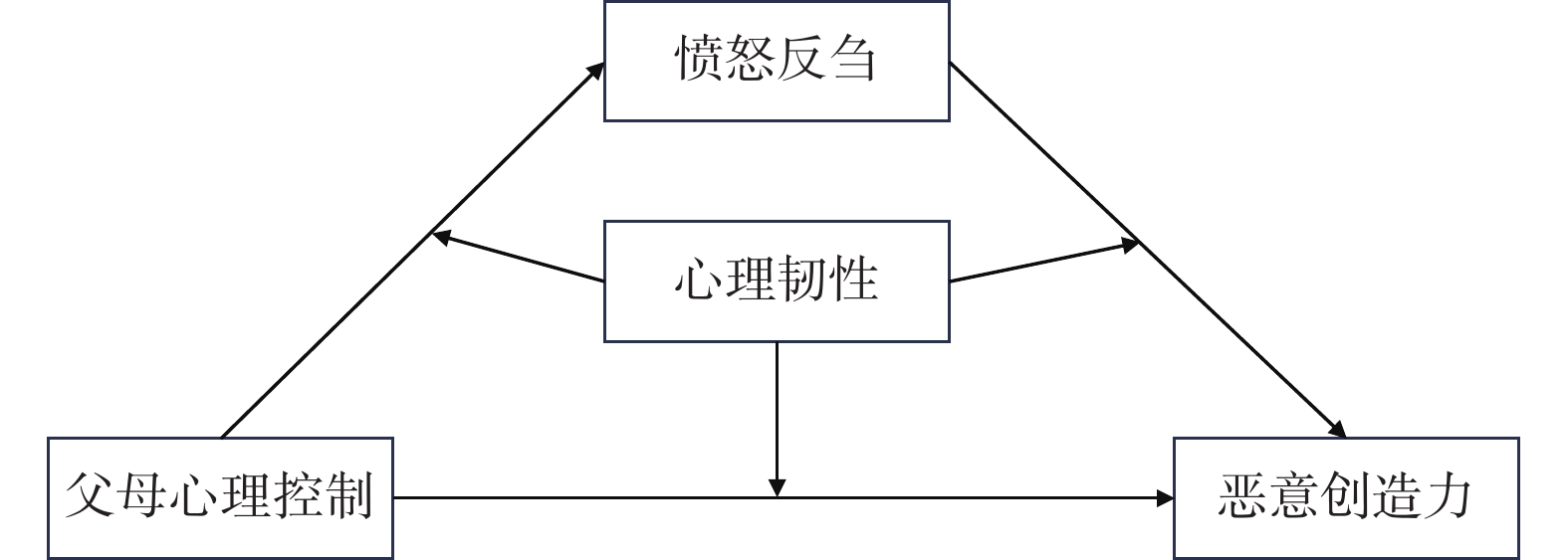
图1 假设模型
| 1 | 2 | 3 | 4 | 5 | 6 | |
| 1.性别 | ||||||
| 2.年龄 | –0.02 | |||||
| 3.父母心理控制 | 0.08* | –0.02 | ||||
| 4.恶意创造力 | –0.02 | 0.04 | 0.36*** | |||
| 5.愤怒反刍 | 0.19*** | 0.08 | 0.36*** | 0.57*** | ||
| 6.心理韧性 | –0.25*** | 0.03 | –0.45*** | –0.32*** | –0.49*** | |
| M | 16.01 | 2.87 | 1.71 | 2.05 | 3.15 | |
| SD | 0.87 | 0.66 | 0.54 | 0.56 | 0.48 |
表1 描述性统计与相关分析结果
| 1 | 2 | 3 | 4 | 5 | 6 | |
| 1.性别 | ||||||
| 2.年龄 | –0.02 | |||||
| 3.父母心理控制 | 0.08* | –0.02 | ||||
| 4.恶意创造力 | –0.02 | 0.04 | 0.36*** | |||
| 5.愤怒反刍 | 0.19*** | 0.08 | 0.36*** | 0.57*** | ||
| 6.心理韧性 | –0.25*** | 0.03 | –0.45*** | –0.32*** | –0.49*** | |
| M | 16.01 | 2.87 | 1.71 | 2.05 | 3.15 | |
| SD | 0.87 | 0.66 | 0.54 | 0.56 | 0.48 |
| 方程1:恶意创造力 | 方程2:愤怒反刍 | 方程3:恶意创造力 | ||||||
| β | t | β | t | β | t | |||
| 性别 | –0.10 | –1.18 | 0.35 | 4.45*** | –0.28 | –4.01*** | ||
| 年龄 | 0.05 | 1.21 | 0.09 | 2.31* | <0.01 | 0.02 | ||
| 父母心理控制 | 0.36 | 9.67*** | 0.34 | 9.29*** | 0.18 | 5.31*** | ||
| 愤怒反刍 | 0.53 | 15.04*** | ||||||
| R2 | 0.13 | 0.16 | 0.37 | |||||
| F | 31.53*** | 39.32*** | 88.82*** | |||||
表2 愤怒反刍的中介效应检验
| 方程1:恶意创造力 | 方程2:愤怒反刍 | 方程3:恶意创造力 | ||||||
| β | t | β | t | β | t | |||
| 性别 | –0.10 | –1.18 | 0.35 | 4.45*** | –0.28 | –4.01*** | ||
| 年龄 | 0.05 | 1.21 | 0.09 | 2.31* | <0.01 | 0.02 | ||
| 父母心理控制 | 0.36 | 9.67*** | 0.34 | 9.29*** | 0.18 | 5.31*** | ||
| 愤怒反刍 | 0.53 | 15.04*** | ||||||
| R2 | 0.13 | 0.16 | 0.37 | |||||
| F | 31.53*** | 39.32*** | 88.82*** | |||||
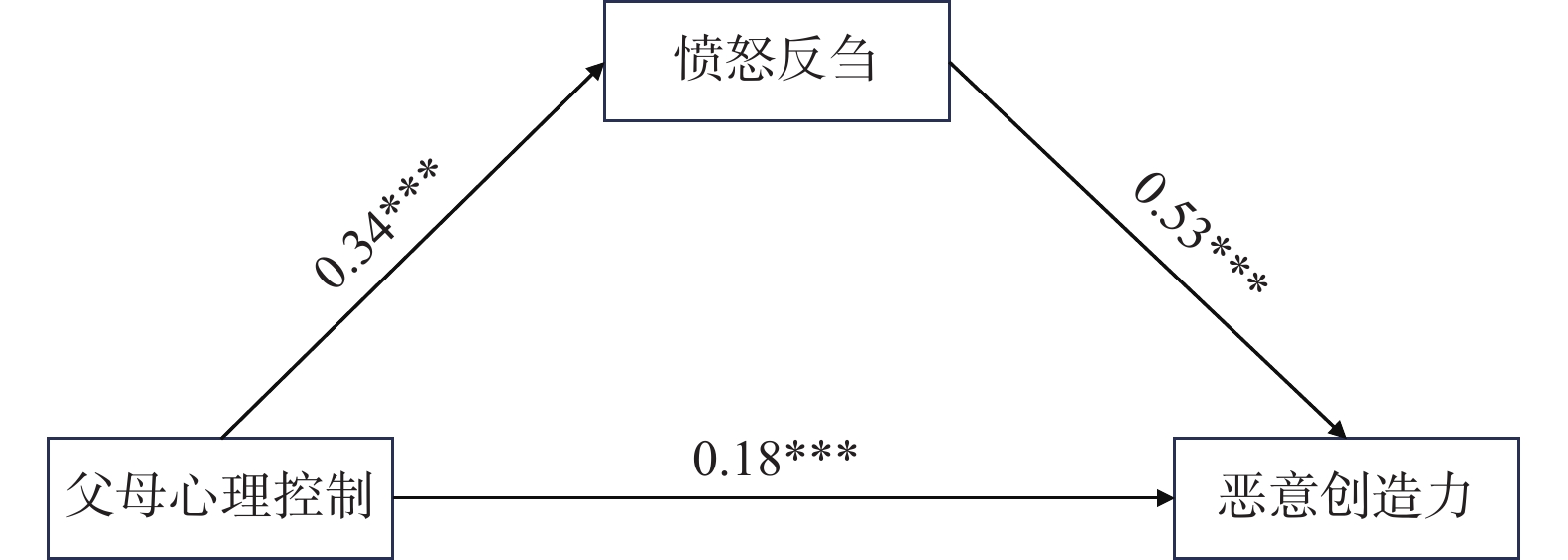
图2 中介效应模型
| 方程1:愤怒反刍 | 方程2:恶意创造力 | ||||
| β | t | β | t | ||
| 性别 | 0.17 | 2.27* | –0.29 | –4.10*** | |
| 年龄 | 0.09 | 2.73** | 0.01 | 0.15 | |
| 父母心理控制 | 0.16 | 4.17*** | 0.16 | 4.44*** | |
| 心理韧性 | –0.39 | –9.82*** | –0.03 | –0.77 | |
| 父母心理控制×心理韧性 | –0.07 | –2.55* | –0.07 | –2.54* | |
| 愤怒反刍 | 0.51 | 13.43*** | |||
| 愤怒反刍×心理韧性 | 0.03 | 0.88 | |||
| R2 | 0.28 | 0.37 | |||
| F | 48.10*** | 52.08*** | |||
表3 心理韧性的调节效应检验
| 方程1:愤怒反刍 | 方程2:恶意创造力 | ||||
| β | t | β | t | ||
| 性别 | 0.17 | 2.27* | –0.29 | –4.10*** | |
| 年龄 | 0.09 | 2.73** | 0.01 | 0.15 | |
| 父母心理控制 | 0.16 | 4.17*** | 0.16 | 4.44*** | |
| 心理韧性 | –0.39 | –9.82*** | –0.03 | –0.77 | |
| 父母心理控制×心理韧性 | –0.07 | –2.55* | –0.07 | –2.54* | |
| 愤怒反刍 | 0.51 | 13.43*** | |||
| 愤怒反刍×心理韧性 | 0.03 | 0.88 | |||
| R2 | 0.28 | 0.37 | |||
| F | 48.10*** | 52.08*** | |||
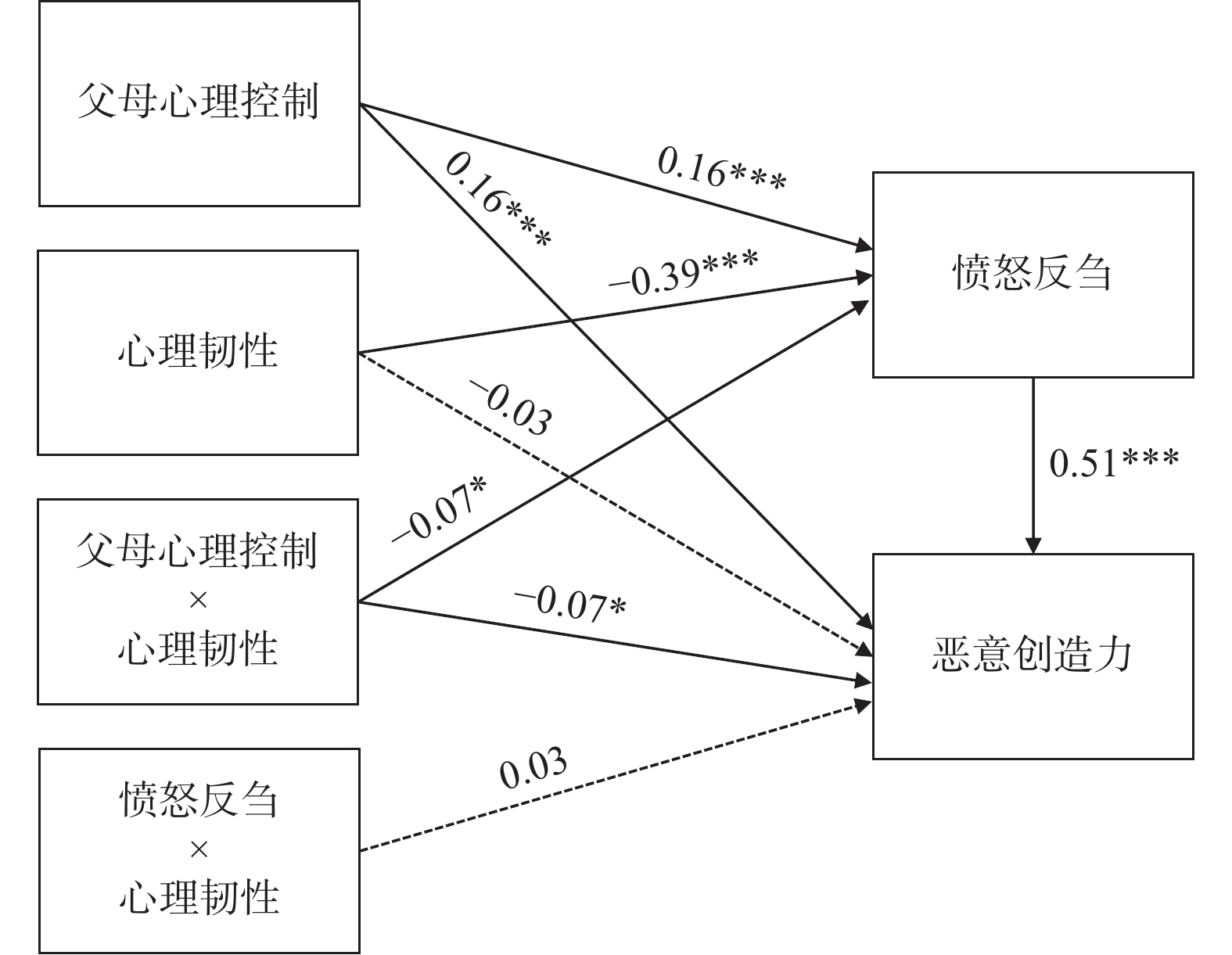
图3 有调节的中介模型
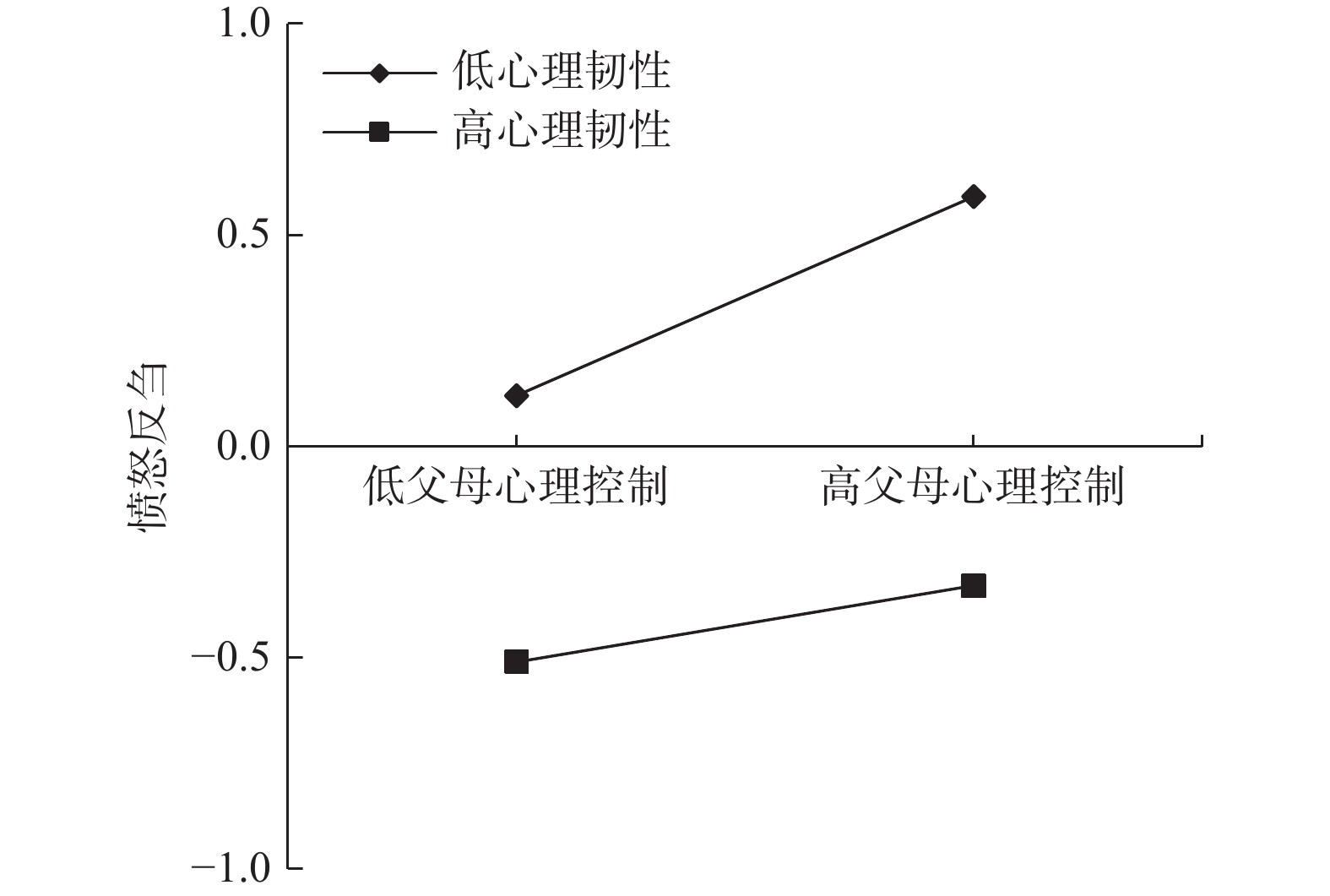
图4 心理韧性在父母心理控制与愤怒反刍之间的调节作用
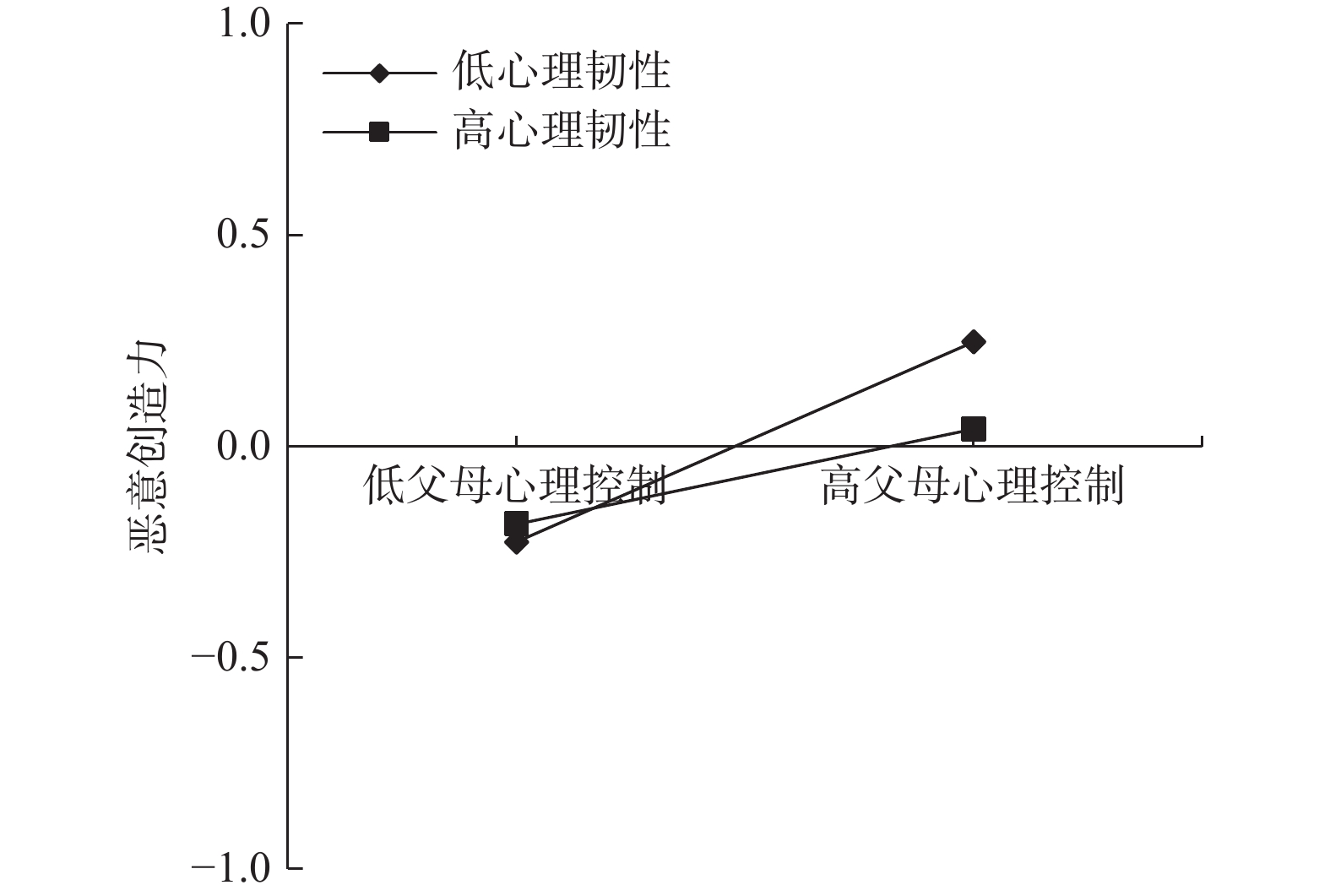
图5 心理韧性在父母心理控制与恶意创造力之间的调节作用
|
胡月琴, 甘怡群. 青少年心理韧性量表的编制和效度验证. 心理学报, 2008, 40 (8): 902- 912.
|
|
|
贾倩楠, 黄垣成, 马婧, 李彩娜. 父母心理控制与青少年内外化问题的纵向关联: 悲伤与愤怒反刍的中介. 心理科学, 2024, 47 (1): 70- 79.
|
|
|
教育部. (2024). 教育部: 全国共有各级各类学历教育在校生2.91亿人. 2024-03-01 取自http://www.moe.gov.cn/fbh/live/2024/55831/mtbd/202403/t20240301_1117755.html
|
|
|
李方, 张玉洁, 王路石, 方圆, 陈祉妍. 中职生个体受欺负与心理健康的关系: 班级受欺负的调节作用. 中国临床心理学杂志, 2025, 33 (2): 288- 292.
|
|
|
李娇娇, 刘晓冰, 裴丹丹, 徐碧波, 尹锡杨. 情绪智力对大学生恶意创造力的影响: 一个有调节的中介模型. 心理与行为研究, 2022, 20 (4): 563- 569.
|
|
|
梁晓燕, 高志旭, 高小丽, 施露露. 中职生父母心理控制、越轨同伴交往与社会适应的关系研究. 中国特殊教育, 2015 (11): 83- 88.
|
|
|
刘艾祎, 伍新春. 创伤后应激障碍对震后青少年反社会行为的影响: 复原力的调节作用. 心理与行为研究, 2021, 19 (2): 244- 251.
|
|
|
罗亚莉, 刘云波. 愤怒反刍思维量表中文版大学生人群信效度检验. 中国临床心理学杂志, 2017, 25 (4): 667- 670.
|
|
|
秦瑶, 彭运石. 父母教养方式对初中生社交焦虑的影响: 同伴接纳和反刍思维的链式中介作用. 心理发展与教育, 2024, 40 (1): 103- 113.
|
|
|
史滋福, 周志豪, 许磊, 陈火红, 管锦亮, 刘承珍. 父母消极教养方式与大学生恶意创造性行为的关系: 有调节的中介模型. 心理发展与教育, 2024, 40 (6): 808- 815.
|
|
|
王丹, 王典慧, 陈文锋. 青少年心理韧性与恶意创造性行为倾向的关系. 心理学报, 2022, 54 (2): 154- 167.
|
|
|
王璐. 中职生的问题行为及其与心理弹性、应对方式的关系. 中国健康心理学杂志, 2017, 25 (4): 599- 603.
|
|
|
王兴超, 史浩凌. 负性生活事件与青少年网络欺凌行为的关系——愤怒反刍的中介作用和网络去抑制的调节作用. 华南师范大学学报(社会科学版), 2024 (1): 93- 104, 206.
|
|
|
王艳辉, 沈梓锋, 赖雪芬. 父母心理控制与青少年外化问题行为的关系: 意志控制和越轨同伴交往的链式中介作用. 心理发展与教育, 2024, 40 (2): 248- 256.
|
|
|
王玉龙, 王丹云, 舒梓玥, 贺娟. 父母粗暴养育对早期青少年自杀意念的影响: 心理韧性的纵向调节作用. 中国临床心理学杂志, 2024, 32 (3): 549- 554.
|
|
|
伍嘉麒, 任枭, 贡喆. 攻击性对恶意创造力的影响: 有调节的中介模型. 心理科学, 2024, 47 (2): 367- 374.
|
|
|
肖飒, 郭英, 谭小宏, 吴映雄, 林群. 大学生公正世界信念对恶意创造力的影响: 相对剥夺感和愤怒反刍的链式中介作用. 心理与行为研究, 2024, 22 (6): 854- 860.
|
|
|
薛严, 郑闽, 张雪, 徐伟. 愤怒反刍思维与网络欺负之间的关系: 特质愤怒和敌意认知的中介作用. 心理技术与应用, 2022, 10 (4): 238- 246.
|
|
|
严培荣, 孙圣涛. 愤怒反刍: 内涵、影响因素及其神经机制. 心理技术与应用, 2021, 9 (12): 760- 768.
|
|
|
杨娃, 邢禹, 关梅林, 李永娟. 积极心理健康教育视角下心理资源对中职生亲社会和攻击行为的影响——情绪的中介作用. 中国特殊教育, 2017 (5): 30- 35.
|
|
|
姚海娟, 杨梦瑶, 李芃漪, 郝一凡, 张珊珊. 心理虐待和忽视与恶意创造力: 攻击性的中介作用. 中国临床心理学杂志, 2024, 32 (3): 650- 653, 548.
|
|
|
张丹, 胡雪庆, 刘勤学. 大学生压力和睡眠质量: 反刍思维和心理韧性的链式中介作用. 心理科学, 2021, 44 (1): 90- 96.
|
|
|
赵京伟, 陈晓旭, 任立文, 耿喆, 徐夫真. 父母心理控制与小学儿童焦虑: 一个有调节的中介模型. 心理发展与教育, 2024, 40 (1): 93- 102.
|
|
|
赵泰格, 张一林, 徐柳青, 辛素飞. 反刍思维与中学生学习倦怠的关系: 有调节的中介模型. 心理技术与应用, 2024, 12 (7): 403- 411.
|
|
|
Aunola, K., Tolvanen, A., Viljaranta, J., & Nurmi, J. E. Psychological control in daily parent-child interactions increases children’s negative emotions. Journal of Family Psychology, 2013, 27 (3): 453- 462.
DOI |
|
|
Baas, M., Roskes, M., Koch, S., Cheng, Y. J., & De Dreu, C. K. W. Why social threat motivates malevolent creativity. Personality and Social Psychology Bulletin, 2019, 45 (11): 1590- 1602.
DOI |
|
|
Barber, B. K. Parental psychological control: Revisiting a neglected construct. Child Development, 1996, 67 (6): 3296- 3319.
DOI |
|
|
Choe, S. Y., Lee, J. O., & Read, S. J. Self-concept as a mechanism through which parental psychological control impairs empathy development from adolescence to emerging adulthood. Social Development, 2020, 29 (3): 713- 731.
DOI |
|
|
Cropley, D. H., Cropley, A. J., Kaufman, J. C., & Runco, M. A. (2010). The dark side of creativity. Cambridge: Cambridge University Press.
|
|
|
Cropley, D. H., Kaufman, J. C., & Cropley, A. J. Rejoinder to commentaries on malevolent creativity: A functional model of creativity in terrorism and crime, Cropley, Kaufman, and Cropley. Creativity Research Journal, 2008, 20 (2): 134- 136.
DOI |
|
|
Cui, L. X., Morris, A. S., Criss, M. M., Houltberg, B. J., & Silk, J. S. Parental psychological control and adolescent adjustment: The role of adolescent emotion regulation. Parenting: Science and Practice, 2014, 14 (1): 47- 67.
DOI |
|
|
Denson, T. F. The multiple systems model of angry rumination. Personality and Social Psychology Review, 2013, 17 (2): 103- 123.
DOI |
|
|
Fergus, S., & Zimmerman, M. A. Adolescent resilience: A framework for understanding healthy development in the face of risk. Annual Review of Public Health, 2005, 26, 399- 419.
DOI |
|
|
Hao, N., Tang, M. Y., Yang, J., Wang, Q. F., & Runco, M. A. A new tool to measure malevolent creativity: The malevolent creativity behavior scale. Frontiers in Psychology, 2016, 7, 682.
|
|
|
Hayes, A. F. (2013). Introduction to mediation, moderation, and conditional process analysis: a regression-based approach. New York: The Guilford Press.
|
|
|
He, Y., Yuan, K. M., Sun, L. P., & Bian, Y. F. A cross-lagged model of the link between parental psychological control and adolescent aggression. Journal of Adolescence, 2019, 74 (1): 103- 112.
DOI |
|
|
Herrman, H., Stewart, D. E., Diaz-Granados, N., Berger, E. L., Jackson, B., & Yuen, T. What is resilience. Canadian Journal of Psychiatry, 2011, 56 (5): 258- 265.
DOI |
|
|
Hunter, A. J., & Chandler, G. E. Adolescent resilience. Image: The Journal of Nursing Scholarship, 1999, 31 (3): 243- 247.
DOI |
|
|
Ji, L. K. Childhood emotional abuse and depression among Chinese adolescent sample: A mediating and moderating dual role model of rumination and resilience. Child Abuse & Neglect, 2024, 149, 106607.
|
|
|
Jia, X. J., Wang, Q. J., & Lin, L. The relationship between childhood neglect and malevolent creativity: The mediating effect of the dark triad personality. Frontiers in Psychology, 2020, 11, 613695.
DOI |
|
|
Li, X., Li, D. P., & Newman, J. (2013). Parental behavioral and psychological control and problematic internet use among Chinese adolescents: The mediating role of self-control. Cyberpsychology, Behavior, and Social Networking, 16(6), 442–447.
|
|
|
Perchtold-Stefan, C. M., Rominger, C., & Fink, A. Depressive symptoms are positively linked to malevolent creativity: A novel perspective on the maladaptive nature of revenge ideation. The Journal of Creative Behavior, 2023, 57 (2): 319- 330.
DOI |
|
|
Ruddle, A., Pina, A., & Vasquez, E. Domestic violence offending behaviors: A review of the literature examining childhood exposure, implicit theories, trait aggression and anger rumination as predictive factors. Aggression and Violent Behavior, 2017, 34, 154- 165.
DOI |
|
|
Suhr, K. A., & Nesbit, S. M. Dwelling on ‘road rage’: The effects of trait rumination on aggressive driving. Transportation Research Part F: Traffic Psychology and Behaviour, 2013, 21, 207- 218.
DOI |
|
|
Tong, D. D., Shi, Y. N., Gu, X. J., & Lu, P. (2024). Bullying victimization and malevolent creativity in rural adolescents: The longitudinal mediational role of hostile attribution. Cyberpsychology, Behavior, and Social Networking, 27(6), 420–425.
|
|
|
Tran, T., & Liu, Q. M. Intraindividual coupling of rumination and depressed affect in adults: Effects of perceived parental warmth and psychological control during adolescence. Journal of Affective Disorders, 2025, 376, 318- 324.
DOI |
|
|
Wang, Q., Pomerantz, E. M., & Chen, H. C. The role of parents’ control in early adolescents’ psychological functioning: A longitudinal investigation in the United States and China. Child Development, 2007, 78 (5): 1592- 1610.
DOI |
|
|
Wang, Q. L. The effect of parenting practices on creativity: Mediating role of psychological resilience. Psychology Research and Behavior Management, 2023, 16, 4501- 4514.
DOI |
|
|
Woodman, R. W., & Schoenfeldt, L. F. An Interactionist model of creative behavior. The Journal of Creative Behavior, 1990, 24 (1): 10- 20.
DOI |
|
|
Xiao, H., Wu, Y. Q., Chen, Z. F., & Nie, Y. G. Which need satisfaction better explains the relation between parental psychological control and adolescent behavior problems: A parallel multi-mediator model based on general strain theory. Children and Youth Services Review, 2024, 163, 107779.
DOI |
| [1] | 王丹云, 王玉龙, 唐卓. 青少年运动习惯与自尊、心理韧性的动态关系:基于交叉滞后与随机截距交叉滞后模型的分析[J]. 心理与行为研究, 2026, 24(2): 178-186. |
| [2] | 韩嘉桐, 关文军, 刘菁菁. 父母心理控制对中小学生短视频成瘾的影响:自主感和逆反心理的链式中介作用[J]. 心理与行为研究, 2026, 24(1): 95-102. |
| [3] | 程黎, 陈啸宇, 刘玉娟. 教师支持、同伴支持、心理韧性与情绪智力的关系:超常与常态儿童的比较[J]. 心理与行为研究, 2025, 23(2): 185-192. |
| [4] | 范苗苗, 林怡静, 辛自强, 陈文锋. 同伴依恋对青少年网络成瘾的影响:应对方式和心理韧性的链式中介作用[J]. 心理与行为研究, 2025, 23(1): 91-98. |
| [5] | 肖飒, 郭英, 谭小宏, 吴映雄, 林群. 大学生公正世界信念对恶意创造力的影响:相对剥夺感和愤怒反刍的链式中介作用[J]. 心理与行为研究, 2024, 22(6): 854-860. |
| [6] | 张野, 刘致宏, 申婷, 赵雨露. 父母心理控制、校园排斥与初中生内化问题的动态关系:交叉滞后研究[J]. 心理与行为研究, 2024, 22(5): 658-665. |
| [7] | 许航, 史新广, 段锦云, 卢红旭. 感恩对恶意创造力的影响[J]. 心理与行为研究, 2024, 22(4): 470-477. |
| [8] | 张耀华, 徐敏, 黄云云, 辛素飞. 心理韧性缓冲压力生活事件与青少年学业倦怠之间的非线性关系[J]. 心理与行为研究, 2024, 22(1): 123-129. |
| [9] | 吕沐华, 熊昱可, 杨柳, 陈嘉慧, 王泉泉, 任萍. 受欺负对青少年主动性攻击及反应性攻击的影响:愤怒反刍和悲伤反刍的中介作用[J]. 心理与行为研究, 2023, 21(6): 799-806. |
| [10] | 刘峻君, 何晓燕, 李松, 冉光明. 社交回避与青少年自杀意念的关系:有调节的中介模型[J]. 心理与行为研究, 2023, 21(5): 675-681. |
| [11] | 王思怡, 丁菀, 宋省成, 孙赵星, 谢瑞波, 李伟健. 中职生同伴、师生关系对学业倦怠的影响:歧视知觉与自我同情的链式中介作用[J]. 心理与行为研究, 2023, 21(5): 691-697. |
| [12] | 李甜甜, 顾吉有. 父母心理控制与儿童学业焦虑的关系:未来取向和父母学业参与的作用[J]. 心理与行为研究, 2023, 21(3): 359-366. |
| [13] | 江盈颖, 马丽, 张丽锦, 朱莉琪. 子女数量与育龄母亲生活满意度的链式中介模型[J]. 心理与行为研究, 2022, 20(5): 651-656. |
| [14] | 李娇娇, 刘晓冰, 裴丹丹, 徐碧波, 尹锡杨. 情绪智力对大学生恶意创造力的影响:一个有调节的中介模型[J]. 心理与行为研究, 2022, 20(4): 563-569. |
| [15] | 白慧慧, 王雨晴, 孙婉靖. 留守儿童心理韧性的元分析[J]. 心理与行为研究, 2022, 20(2): 261-267. |
| 阅读次数 | ||||||
|
全文 |
|
|||||
|
摘要 |
|
|||||
