
心理与行为研究 ›› 2026, Vol. 24 ›› Issue (3): 343-350.DOI: 10.12139/j.1672-0628.2026.03.008
王蓉蓉1, 白荣*,2( ), 刘霞1
收稿日期:2025-05-15
出版日期:2026-05-20
发布日期:2026-05-20
通讯作者:
白荣
基金资助:
Rongrong WANG1, Rong BAI*,2(), Xia LIU1
Received:2025-05-15
Online:2026-05-20
Published:2026-05-20
Contact:
Rong BAI
摘要:
本研究对7283名青少年进行两次追踪调查,从中选取977名存在重复性自伤的青少年作为被试,探讨青少年重复性自伤的发生机制与保护因素。结果显示:(1)远端童年期虐待正向预测青少年重复性自伤;(2)近端同伴侵害在远端童年期虐待和青少年重复性自伤之间发挥中介作用;(3)社会支持在童年期虐待影响重复性自伤的直接路径中发挥保护作用,并且保护作用仅在女生中显著。研究结果从个体的远近端人际环境视角,为青少年重复性自伤的预防和干预提供了科学依据。
中图分类号:
王蓉蓉, 白荣, 刘霞. 远近端人际侵害对青少年重复性自伤的影响:社会支持的保护作用[J]. 心理与行为研究, 2026, 24(3): 343-350.
Rongrong WANG, Rong BAI, Xia LIU. The Impact of Distal and Proximal Interpersonal Victimization on Adolescent Repetitive Self-Injury: The Protective Role of Social Support[J]. Studies of Psychology and Behavior, 2026, 24(3): 343-350.
| 变量 | M | SD | 1 | 2 | 3 | 4 | 5 |
| 1.性别 | |||||||
| 2.年龄 | 13.20 | 0.87 | –0.03 | ||||
| 3.T1童年期虐待 | 33.18 | 8.59 | 0.08* | 0.09** | |||
| 4.T1同伴侵害 | 29.40 | 9.57 | 0.01 | 0.15*** | 0.43*** | ||
| 5.T1社会支持 | 41.61 | 9.62 | –0.19*** | –0.08** | –0.52*** | –0.37*** | |
| 6.T2重复性自伤 | 13.04 | 10.46 | 0.08* | 0.07* | 0.32*** | 0.26*** | –0.24*** |
表1 各变量的描述统计与相关分析结果
| 变量 | M | SD | 1 | 2 | 3 | 4 | 5 |
| 1.性别 | |||||||
| 2.年龄 | 13.20 | 0.87 | –0.03 | ||||
| 3.T1童年期虐待 | 33.18 | 8.59 | 0.08* | 0.09** | |||
| 4.T1同伴侵害 | 29.40 | 9.57 | 0.01 | 0.15*** | 0.43*** | ||
| 5.T1社会支持 | 41.61 | 9.62 | –0.19*** | –0.08** | –0.52*** | –0.37*** | |
| 6.T2重复性自伤 | 13.04 | 10.46 | 0.08* | 0.07* | 0.32*** | 0.26*** | –0.24*** |
| 变量 | 总样本 | 女生 | 男生 | ||||||||||||||
| T1同伴侵害 | T2重复性自伤 | T1同伴侵害 | T2重复性自伤 | T1同伴侵害 | T2重复性自伤 | ||||||||||||
| β | t | β | t | β | t | β | t | β | t | β | t | ||||||
| 性别 | –0.05 | –1.87 | 0.04 | 1.38 | |||||||||||||
| 年龄 | 0.10 | 3.68*** | 0.03 | 0.90 | 0.09 | 2.21* | –0.02 | –0.44 | 0.12 | 2.94** | 0.08 | 1.88 | |||||
| T1童年期虐待 | 0.29 | 7.66*** | 0.17 | 4.13*** | 0.26 | 5.26*** | 0.18 | 3.17** | 0.32 | 5.57*** | 0.16 | 2.65** | |||||
| T1同伴侵害 | 0.14 | 4.10*** | 0.13 | 2.61** | 0.16 | 3.13** | |||||||||||
| T1社会支持 | –0.21 | –6.30*** | –0.06 | –1.56 | –0.19 | –4.11*** | –0.04 | –0.86 | –0.24 | –4.92*** | –0.07 | –1.41 | |||||
| T1童年期虐待×T1社会支持 | –0.04 | –1.54 | –0.09 | –3.04** | –0.05 | –1.79 | –0.10 | –2.44* | –0.05 | –1.04 | –0.10 | –1.87 | |||||
| T1同伴侵害×T1社会支持 | 0.03 | 0.94 | 0.02 | 0.41 | 0.04 | 1.00 | |||||||||||
| R2 | 0.23 | 0.14 | 0.23 | 0.14 | 0.24 | 0.13 | |||||||||||
| F | 57.49*** | 22.02*** | 40.99*** | 14.62*** | 31.96*** | 10.53*** | |||||||||||
表2 有调节的中介效应检验
| 变量 | 总样本 | 女生 | 男生 | ||||||||||||||
| T1同伴侵害 | T2重复性自伤 | T1同伴侵害 | T2重复性自伤 | T1同伴侵害 | T2重复性自伤 | ||||||||||||
| β | t | β | t | β | t | β | t | β | t | β | t | ||||||
| 性别 | –0.05 | –1.87 | 0.04 | 1.38 | |||||||||||||
| 年龄 | 0.10 | 3.68*** | 0.03 | 0.90 | 0.09 | 2.21* | –0.02 | –0.44 | 0.12 | 2.94** | 0.08 | 1.88 | |||||
| T1童年期虐待 | 0.29 | 7.66*** | 0.17 | 4.13*** | 0.26 | 5.26*** | 0.18 | 3.17** | 0.32 | 5.57*** | 0.16 | 2.65** | |||||
| T1同伴侵害 | 0.14 | 4.10*** | 0.13 | 2.61** | 0.16 | 3.13** | |||||||||||
| T1社会支持 | –0.21 | –6.30*** | –0.06 | –1.56 | –0.19 | –4.11*** | –0.04 | –0.86 | –0.24 | –4.92*** | –0.07 | –1.41 | |||||
| T1童年期虐待×T1社会支持 | –0.04 | –1.54 | –0.09 | –3.04** | –0.05 | –1.79 | –0.10 | –2.44* | –0.05 | –1.04 | –0.10 | –1.87 | |||||
| T1同伴侵害×T1社会支持 | 0.03 | 0.94 | 0.02 | 0.41 | 0.04 | 1.00 | |||||||||||
| R2 | 0.23 | 0.14 | 0.23 | 0.14 | 0.24 | 0.13 | |||||||||||
| F | 57.49*** | 22.02*** | 40.99*** | 14.62*** | 31.96*** | 10.53*** | |||||||||||
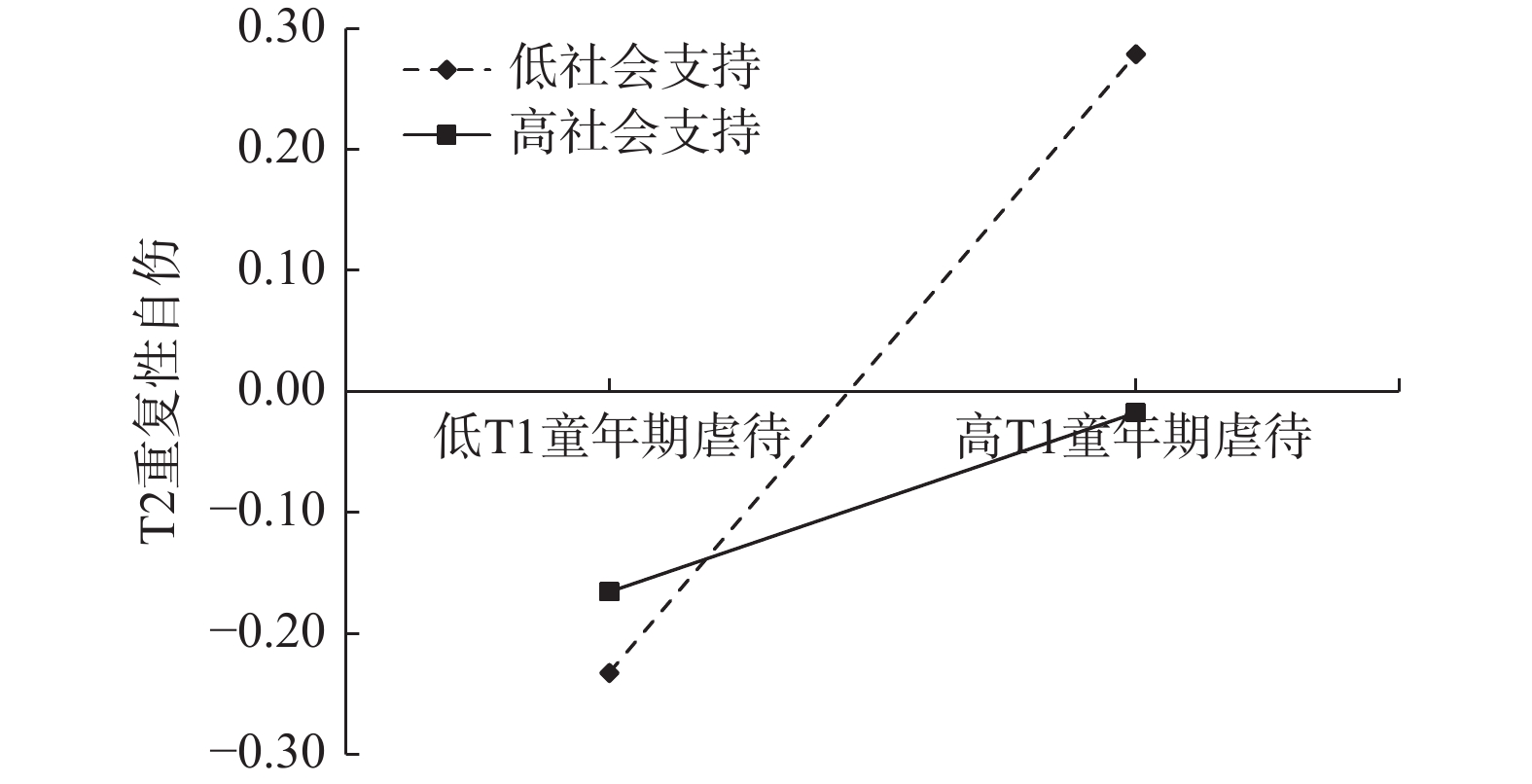
图1 社会支持在童年期虐待与重复性自伤关系中的调节作用
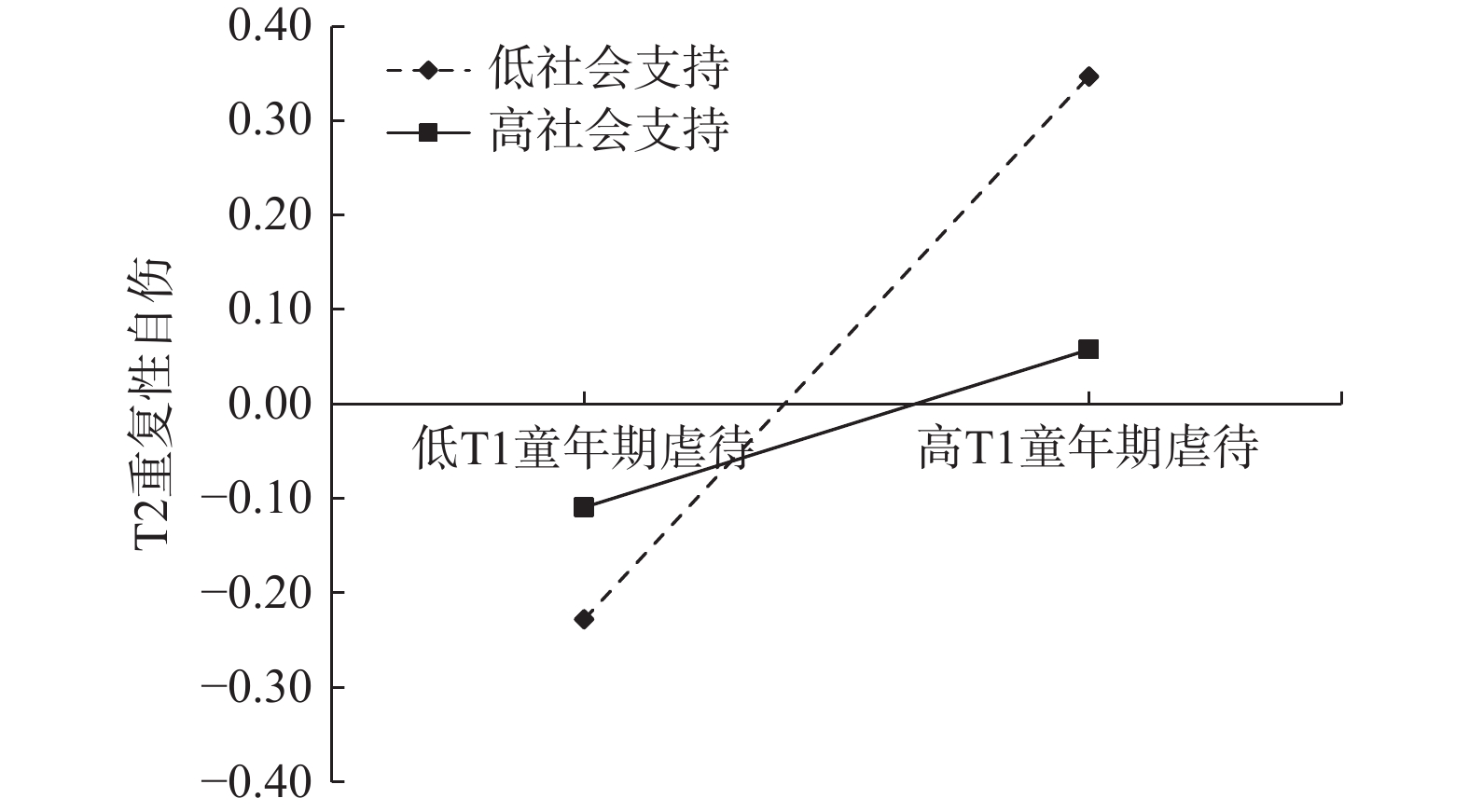
图2 女生群体中社会支持在童年期虐待与重复性自伤关系中的调节作用
|
白荣, 高叶淼, 李金文, 刘霞. 远近端人际压力与FKBP5基因对青少年自伤行为的联合影响: 基于发展的视角. 心理学报, 2023, 55 (9): 1477- 1488.
DOI |
|
|
纪林芹, 陈亮, 徐夫真, 赵守盈, 张文新. 童年中晚期同伴侵害对儿童心理社会适应影响的纵向分析. 心理学报, 2011, 43 (10): 1151- 1162.
DOI |
|
|
宋佳萌, 范会勇. 社会支持与主观幸福感关系的元分析. 心理科学进展, 2013, 21 (8): 1357- 1370.
|
|
|
田相娟, 曹衍淼, 张文新. 母亲消极教养、同伴侵害与FKBP5基因对青少年抑郁的影响. 心理学报, 2020, 52 (12): 1407- 1420.
|
|
|
王玮, 袁茵, 刘霞, 李永鑫. 养育倦怠与青少年问题行为: 家庭功能与共同养育的作用. 天津师范大学学报(社会科学版), 2024, (2): 140- 150.
|
|
|
张书朋, 张庆垚, 李彩娜. 领悟社会支持性别差异的元分析. 心理发展与教育, 2015, 31 (4): 393- 401.
|
|
|
赵幸福, 张亚林, 李龙飞, 周云飞, 李鹤展, 杨世昌. 中文版儿童期虐待问卷的信度和效度. 中国临床康复, 2005, 9 (20): 105- 107.
|
|
|
Addis, M. E., & Mahalik, J. R. Men, masculinity, and the contexts of help seeking. American Psychologist, 2003, 58 (1): 5- 14.
DOI |
|
|
Angelakis, I., & Gooding, P. Associations of anxiety and depression with suicide experiences in individuals with and without childhood trauma: The role of social support. Psychiatry Research, 2022, 309, 114424.
DOI |
|
|
Ayres, M. M., & Leaper, C. Adolescent girls’ experiences of discrimination: An examination of coping strategies, social support, and self-esteem. Journal of Adolescent Research, 2013, 28 (4): 479- 508.
DOI |
|
|
Bennardi, M., McMahon, E., Corcoran, P., Griffin, E., & Arensman, E. Risk of repeated self-harm and associated factors in children, adolescents and young adults. BMC Psychiatry, 2016, 16 (1): 421.
DOI |
|
|
Bernstein, D. P., Stein, J. A., Newcomb, M. D., Walker, E., Pogge, D., Ahluvalia, T., … Zule, W. Development and validation of a brief screening version of the Childhood Trauma Questionnaire. Child Abuse & Neglect, 2003, 27 (2): 169- 190.
DOI |
|
|
Bjärehed, J., & Lundh, L. G. Deliberate self-harm in 14-year-old adolescents: How frequent is it, and how is it associated with psychopathology, relationship variables, and styles of emotional regulation. Cognitive Behaviour Therapy, 2008, 37 (1): 26- 37.
DOI |
|
|
Blasco-Fontecilla, H., Fernández-Fernández, R., Colino, L., Fajardo, L., Perteguer-Barrio, R., & de Leon, J. The addictive model of self-harming (non-suicidal and suicidal) behavior. Frontiers in Psychiatry, 2016, 7, 8.
DOI |
|
|
Brunner, R., Kaess, M., Parzer, P., Fischer, G., Carli, V., Hoven, C. W., … Wasserman, D. Life-time prevalence and psychosocial correlates of adolescent direct self-injurious behavior: A comparative study of findings in 11 European countries. Journal of Child Psychology and Psychiatry, 2014, 55 (4): 337- 348.
DOI |
|
|
Chen, X. X., Shao, J. J., Pu, X., & Wang, Z. Childhood maltreatment and adolescents’ peer victimization: The effect of security, school connectedness and gender. Children and Youth Services Review, 2023, 148, 106843.
DOI |
|
|
Claes, L., Luyckx, K., Baetens, I., van de Ven, M., & Witteman, C. Bullying and victimization, depressive mood, and non-suicidal self-injury in adolescents: The moderating role of parental support. Journal of Child and Family Studies, 2015, 24 (11): 3363- 3371.
DOI |
|
|
Ding, Y., Li, D. P., Li, X., Xiao, J. L., Zhang, H. Y., & Wang, Y. H. Profiles of adolescent traditional and cyber bullying and victimization: The role of demographic, individual, family, school, and peer factors. Computers in Human Behavior, 2020, 111, 106439.
DOI |
|
|
Evans, S. E., Steel, A. L., & DiLillo, D. Child maltreatment severity and adult trauma symptoms: Does perceived social support play a buffering role. Child Abuse & Neglect, 2013, 37 (11): 934- 943.
DOI |
|
|
Gao, Y. M., Liu, J. M., Liu, X., Wang, Y. M., & Qiu, S. J. Dimensions of family stress and repetitive nonsuicidal self-injury in adolescence: Examining the interactive effects of impulsivity and emotion dysregulation. Child Abuse & Neglect, 2024, 152, 106804.
DOI |
|
|
Gillies, D., Christou, M. A., Dixon, A. C., Featherston, O. J., Rapti, I., Garcia-Anguita, A., … Christou, P. A. Prevalence and characteristics of self-harm in adolescents: Meta-analyses of community-based studies 1990–2015. Journal of the American Academy of Child and Adolescent Psychiatry, 2018, 57 (10): 733- 741.
DOI |
|
|
Gottlieb, B. H., & Bergen, A. E. Social support concepts and measures. Journal of Psychosomatic Research, 2010, 69 (5): 511- 520.
DOI |
|
|
Gratz, K. L. Measurement of deliberate self-harm: Preliminary data on the deliberate self-harm inventory. Journal of Psychopathology and Behavioral Assessment, 2001, 23 (4): 253- 263.
DOI |
|
|
Gunnar, M., & Quevedo, K. The neurobiology of stress and development. Annual Review of Psychology, 2007, 58 (1): 145- 173.
DOI |
|
|
Hawton, K., Bergen, H., Kapur, N., Cooper, J., Steeg, S., Ness, J., & Waters, K. Repetition of self-harm and suicide following self-harm in children and adolescents: Findings from the Multicentre Study of Self-harm in England. Journal of Child Psychology and Psychiatry, 2012, 53 (12): 1212- 1219.
DOI |
|
|
Hasking, P., Kiekens, G., Petukhova, M. V., Albor, Y., Al-Hadi, A., Alonso, J., … World Mental Health – International College Student collaborators. The relationships between sporadic and repetitive non-suicidal self-injury and mental disorders among first-year college students: Results from the World Mental Health International College Student Initiative. Psychological Medicine, 2025, 55, e280.
DOI |
|
|
Hayes, A. F. (2022). Introduction to mediation, moderation, and conditional process analysis: A regression-based approach (3rd ed.). New York: Guilford Press.
|
|
|
Hong, J. S., Espelage, D. L., Grogan-Kaylor, A., & Allen-Meares, P. Identifying potential mediators and moderators of the association between child maltreatment and bullying perpetration and victimization in school. Educational Psychology Review, 2012, 24 (2): 167- 186.
DOI |
|
|
Kaufman, T. M. L., Kretschmer, T., Huitsing, G., & Veenstra, R. Caught in a vicious cycle? Explaining bidirectional spillover between parent-child relationships and peer victimization. Development and Psychopathology, 2020, 32 (1): 11- 20.
DOI |
|
|
Kiekens, G., Claes, L., Hasking, P., Mortier, P., Bootsma, E., Boyes, M., … Bruffaerts, R. A longitudinal investigation of non-suicidal self-injury persistence patterns, risk factors, and clinical outcomes during the college period. Psychological Medicine, 2023, 53 (13): 6011- 6026.
DOI |
|
|
Klonsky, E. D. The functions of deliberate self-injury: A review of the evidence. Clinical Psychology Review, 2007, 27 (2): 226- 239.
DOI |
|
|
Liang, Y. T., Wang, Y. M., Bai, R., & Liu, X. Gender-specific trajectories of non-suicidal self-injury among adolescents: Predictive roles of distal and proximal risk factors. Journal of Youth And Adolescence, 2025, 54 (1): 62- 75.
DOI |
|
|
Liu, J. M., Gao, Y. M., Liang, C. X., & Liu, X. The potential addictive mechanism involved in repetitive nonsuicidal self-injury: The roles of emotion dysregulation and impulsivity in adolescents. Journal of Behavioral Addictions, 2022, 11 (4): 953- 962.
DOI |
|
|
Liu, J. M., Wang, Y. M., Liu, X., Li, J. W., & Xing, S. F. Experiencing stress impact on adolescent repetitive nonsuicidal self-injury: The Mediating role of emotion dysregulation and maladaptive cognitive schemas. Journal of Affective Disorders, 2023, 339, 392- 399.
DOI |
|
|
Liu, X. C., Liu, Z. Z., & Jia, C. X. Repeat self-harm among Chinese adolescents: 1-year incidence and psychosocial predictors. Social Psychiatry and Psychiatric Epidemiology, 2021, 56 (11): 1979- 1992.
DOI |
|
|
Logan-Greene, P., & Jones, A. S. Chronic neglect and aggression/delinquency: A longitudinal examination. Child Abuse & Neglect, 2015, 45, 9- 20.
DOI |
|
|
Lutz, N. M., Chamberlain, S. R., Goodyer, I. M., Bhardwaj, A., Sahakian, B. J., Jones, P. B., & Wilkinson, P. O. Behavioral measures of impulsivity and compulsivity in adolescents with nonsuicidal self-injury. CNS Spectrums, 2022, 27 (5): 604- 612.
DOI |
|
|
Manna, G., Falgares, G., Costanzo, G., La Sala, M. C., Lamis, D. A., & Musso, P. Cumulative childhood maltreatment and non-suicidal self-injury: The mediating and moderating role of perceived social support in a sample of university students. Journal of Family Violence, 2022, 37 (4): 657- 669.
DOI |
|
|
Masten, A. S., & Cicchetti, D. Developmental cascades. Development and Psychopathology, 2010, 22 (3): 491- 495.
DOI |
|
|
McCrory, E., Ogle, J. R., Gerin, M. I., & Viding, E. Neurocognitive adaptation and mental health vulnerability following maltreatment: The role of social functioning. Child Maltreatment, 2019, 24 (4): 435- 451.
DOI |
|
|
Miloseva, L., Vukosavljevic-Gvozden, T., Richter, K., Milosev, V., & Niklewski, G. Perceived social support as a moderator between negative life events and depression in adolescence: Implications for prediction and targeted prevention. EPMA Journal, 2017, 8 (3): 237- 245.
DOI |
|
|
Mynard, H., & Joseph, S. Development of the Multidimensional Peer-Victimization Scale. Aggressive Behavior, 2000, 26 (2): 169- 178.
DOI |
|
|
Nixon, M. K., Cloutier, P. F., & Aggarwal, S. Affect regulation and addictive aspects of repetitive self-injury in hospitalized adolescents. Journal of the American Academy of Child & Adolescent Psychiatry, 2002, 41 (11): 1333- 1341.
DOI |
|
|
Nock, M. K. Why do people hurt themselves? New insights into the nature and functions of self-injury. Current Directions in Psychological Science, 2009, 18 (2): 78- 83.
DOI |
|
|
Poudel, A., Lamichhane, A., Magar, K. R., & Khanal, G. P. Non suicidal self injury and suicidal behavior among adolescents: Co-occurrence and associated risk factors. BMC Psychiatry, 2022, 22 (1): 96.
DOI |
|
|
Salazar, A. M., Keller, T. E., & Courtney, M. E. Understanding social support’s role in the relationship between maltreatment and depression in youth with foster care experience. Child Maltreatment, 2011, 16 (2): 102- 113.
DOI |
|
|
Troisi, A. Gender differences in vulnerability to social stress: A Darwinian perspective. Physiology & Behavior, 2001, 73 (3): 443- 449.
DOI |
|
|
van Geel, M., Goemans, A., & Vedder, P. A meta-analysis on the relation between peer victimization and adolescent non-suicidal self-injury. Psychiatry Research, 2015, 230 (2): 364- 368.
DOI |
|
|
Wang, S. Y., Ding, W., Song, S. C., Tan, Y. X., Ahmed, M. Z., Xie, R. B., & Li, L. The relationship between adolescent victimization, nonsuicidal self-injury, and core self-evaluation: A cross-lagged study. Current Psychology, 2024, 43 (1): 28- 38.
DOI |
|
|
Zhou, Q., Liang, Y. T., Gao, Y. M., & Liu, X. Social support and non-suicidal self-injury in adolescents: The differential influences of family, friends, and teachers. Journal of Youth and Adolescence, 2025, 54 (2): 414- 425.
DOI |
|
|
Zimet, G., Powell, S., Farley, G., Werkman, S., & Berkoff, K. Psychometric characteristics of the Multidimensional Scale of Perceived Social Support. Journal of Personality Assessment, 1990, 55 (3): 610- 617.
DOI |
| [1] | 赵海燕, 马燕, 周爱保. 青少年心理复原力的发展趋势及性别的作用:基于动态发展视角[J]. 心理与行为研究, 2026, 24(3): 335-342. |
| [2] | 樊雪戎, 段依凡, 邢晓沛. 温暖的亲子感知差异与青少年内化问题的关系:基于二项式回归的响应面分析[J]. 心理与行为研究, 2026, 24(2): 195-203. |
| [3] | 张野, 刘致宏, 赵丽云. 青少年网络社会排斥、敌意归因偏向与网络偏差行为的关系:一项纵向研究[J]. 心理与行为研究, 2026, 24(1): 60-68. |
| [4] | 杨昕珠, 王腾飞, 郑晓龙. 青少年社会情感能力与学业倦怠的双向预测作用:一项交叉滞后研究[J]. 心理与行为研究, 2025, 23(6): 789-797. |
| [5] | 王海擎. 社区矫正对象歧视知觉与社会退缩的关系:一个链式中介模型[J]. 心理与行为研究, 2025, 23(5): 706-713. |
| [6] | 吴一枫, 李欣, 陈慧丽, 丁童, 侯娟. 情同己身,传之于众:新闻的自我相关性提高分享意愿[J]. 心理与行为研究, 2025, 23(2): 249-256. |
| [7] | 张野, 刘致宏, 申婷, 赵雨露. 父母心理控制、校园排斥与初中生内化问题的动态关系:交叉滞后研究[J]. 心理与行为研究, 2024, 22(5): 658-665. |
| [8] | 关文军, 吴添昊, 程毓可, 多强. 孤独症儿童父母负面评价恐惧和社交焦虑的关系:一个有调节的中介效应模型[J]. 心理与行为研究, 2024, 22(3): 418-424. |
| [9] | 李祖儿, 侯金芹, 陈祉妍. 严厉管教的代际传递:父母的互倚及子女性别的调节作用[J]. 心理与行为研究, 2024, 22(1): 93-99. |
| [10] | 刘仁洁, 夏凌翔, 赵永萍. 大学生网络欺凌受害潜在类别的发展特点及性别因素的作用[J]. 心理与行为研究, 2023, 21(6): 784-791. |
| [11] | 李文福, 刘燕, 段熙明, 牛四方, 许瑞雪, 慕福芹. 反刍思维量表在不同性别和抑郁症状医学院校新生中的测量等值性[J]. 心理与行为研究, 2023, 21(6): 854-860. |
| [12] | 吴旻, 宋文琦, 鞠佳雯. 父母粗暴养育与儿童睡眠质量的关系:核心自我评价和消极情绪的中介作用[J]. 心理与行为研究, 2023, 21(3): 344-351. |
| [13] | 蒋俊杰, 陈珺怡, 喻婧. 老年人微信使用与获得感的关系:领悟社会支持和生命意义感的链式中介作用[J]. 心理与行为研究, 2023, 21(3): 367-373. |
| [14] | 高斌, 谭莉华, 张丹丹, 黎明新, 蔡艳香. 网络社会支持与高中生网络学习投入:有调节的中介模型[J]. 心理与行为研究, 2023, 21(3): 403-409. |
| [15] | 马艺丹, 薛威峰, 刘琴, 徐银. 群体认同与听障青少年主观幸福感的关系:听障朋友支持的中介作用[J]. 心理与行为研究, 2023, 21(2): 266-272. |
| 阅读次数 | ||||||
|
全文 |
|
|||||
|
摘要 |
|
|||||
