
心理与行为研究 ›› 2025, Vol. 23 ›› Issue (5): 706-713.DOI: 10.12139/j.1672-0628.2025.05.016
王海擎*( )
)
收稿日期:2024-06-28
出版日期:2025-09-20
发布日期:2025-09-20
通讯作者:
王海擎
基金资助:
Haiqing WANG*()
Received:2024-06-28
Online:2025-09-20
Published:2025-09-20
Contact:
Haiqing WANG
摘要:
为考察社区矫正对象歧视知觉与社会退缩的关系及内在作用机制,研究采用问卷法测量715名社区矫正对象的歧视知觉、领悟社会支持、生命意义感和社会退缩情况。结果发现:(1)歧视知觉显著正向预测社区矫正对象的社会退缩;(2)领悟社会支持在社区矫正对象的歧视知觉与社会退缩之间起中介作用;(3)生命意义感在社区矫正对象的歧视知觉与社会退缩之间起中介作用;(4)领悟社会支持和生命意义感在社区矫正对象的歧视知觉与社会退缩之间起链式中介作用。研究结果为促进社区矫正对象回归社会、降低重新犯罪风险提供一些启发。
王海擎. 社区矫正对象歧视知觉与社会退缩的关系:一个链式中介模型[J]. 心理与行为研究, 2025, 23(5): 706-713.
Haiqing WANG. The Relationship Between Perceived Discrimination and Social Withdrawal of Community-Correction Subjects: A Chain Mediation Model[J]. Studies of Psychology and Behavior, 2025, 23(5): 706-713.
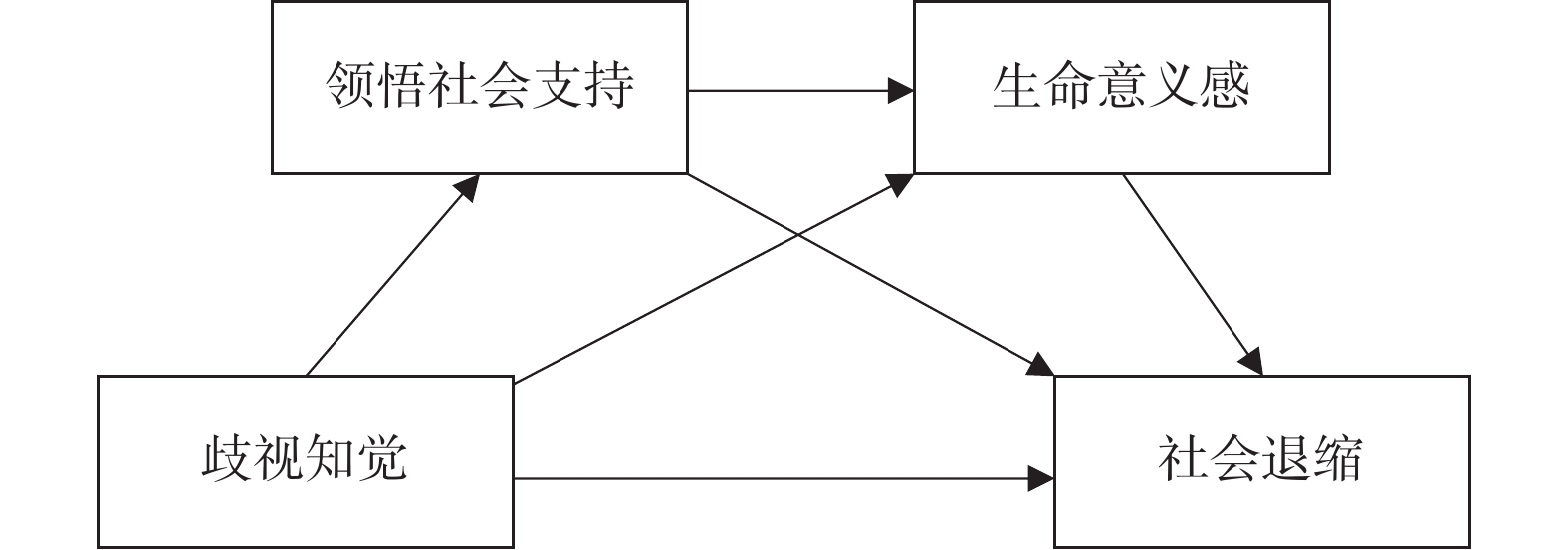
图1 假设模型
| 变量 | 类别 | 人数 | 百分比(%) |
| 性别 | 男 | 566 | 79.16 |
| 女 | 149 | 20.84 | |
| 年龄(岁) | 18~30 | 201 | 28.11 |
| 31~50 | 436 | 60.98 | |
| 51~70 | 78 | 10.91 | |
| 户籍情况 | 本地户籍 | 223 | 31.19 |
| 外来人口 | 492 | 68.81 | |
| 婚姻状况 | 未婚 | 211 | 29.51 |
| 已婚 | 403 | 56.36 | |
| 离异 | 98 | 13.71 | |
| 丧偶 | 3 | 0.42 | |
| 受教育程度 | 初中及以下 | 326 | 45.60 |
| 高中/中专 | 209 | 29.23 | |
| 大专 | 115 | 16.08 | |
| 本科及以上 | 65 | 9.09 |
表1 被试人员基本信息(n=715)
| 变量 | 类别 | 人数 | 百分比(%) |
| 性别 | 男 | 566 | 79.16 |
| 女 | 149 | 20.84 | |
| 年龄(岁) | 18~30 | 201 | 28.11 |
| 31~50 | 436 | 60.98 | |
| 51~70 | 78 | 10.91 | |
| 户籍情况 | 本地户籍 | 223 | 31.19 |
| 外来人口 | 492 | 68.81 | |
| 婚姻状况 | 未婚 | 211 | 29.51 |
| 已婚 | 403 | 56.36 | |
| 离异 | 98 | 13.71 | |
| 丧偶 | 3 | 0.42 | |
| 受教育程度 | 初中及以下 | 326 | 45.60 |
| 高中/中专 | 209 | 29.23 | |
| 大专 | 115 | 16.08 | |
| 本科及以上 | 65 | 9.09 |
| M | SD | 1 | 2 | 3 | 4 | 5 | |
| 1.受教育程度 | |||||||
| 2.户籍情况 | −0.19*** | ||||||
| 3.歧视知觉 | 35.46 | 12.97 | −0.07 | −0.03 | |||
| 4.领悟社会支持 | 61.06 | 12.47 | 0.14*** | −0.10*** | −0.52*** | ||
| 5.生命意义感 | 37.46 | 6.43 | 0.18*** | −0.08* | −0.39*** | 0.58*** | |
| 6.社会退缩 | 50.42 | 9.13 | −0.13*** | −0.03 | 0.59*** | −0.58*** | −0.48*** |
表2 描述性统计与相关性分析(n=715)
| M | SD | 1 | 2 | 3 | 4 | 5 | |
| 1.受教育程度 | |||||||
| 2.户籍情况 | −0.19*** | ||||||
| 3.歧视知觉 | 35.46 | 12.97 | −0.07 | −0.03 | |||
| 4.领悟社会支持 | 61.06 | 12.47 | 0.14*** | −0.10*** | −0.52*** | ||
| 5.生命意义感 | 37.46 | 6.43 | 0.18*** | −0.08* | −0.39*** | 0.58*** | |
| 6.社会退缩 | 50.42 | 9.13 | −0.13*** | −0.03 | 0.59*** | −0.58*** | −0.48*** |
| 结果变量 | 预测变量 | R | R2 | F | β | t |
| 社会退缩 | 0.60 | 0.35 | 127.62*** | |||
| 受教育程度 | −1.48 | −3.64*** | ||||
| 户籍情况 | −1.06 | −1.23 | ||||
| 歧视知觉 | 1.16 | 18.97*** | ||||
| 领悟社会支持 | 0.52 | 0.27 | 86.59*** | |||
| 受教育程度 | 1.32 | 3.16** | ||||
| 户籍情况 | −2.61 | −2.96** | ||||
| 歧视知觉 | −0.95 | −15.27*** | ||||
| 生命意义感 | 0.55 | 0.30 | 77.34*** | |||
| 受教育程度 | 0.95 | 3.32** | ||||
| 户籍情况 | −0.31 | −0.49 | ||||
| 歧视知觉 | −0.16 | −3.10** | ||||
| 领悟社会支持 | 0.34 | 12.57*** | ||||
| 社会退缩 | 0.69 | 0.47 | 127.77*** | |||
| 受教育程度 | −0.72 | −1.94 | ||||
| 户籍情况 | −2.14 | −2.74** | ||||
| 歧视知觉 | 0.75 | 11.77*** | ||||
| 领悟社会支持 | −0.29 | −7.93*** | ||||
| 生命意义感 | −0.27 | −5.84*** |
表3 社区矫正对象歧视知觉与社会退缩的回归分析(n=715)
| 结果变量 | 预测变量 | R | R2 | F | β | t |
| 社会退缩 | 0.60 | 0.35 | 127.62*** | |||
| 受教育程度 | −1.48 | −3.64*** | ||||
| 户籍情况 | −1.06 | −1.23 | ||||
| 歧视知觉 | 1.16 | 18.97*** | ||||
| 领悟社会支持 | 0.52 | 0.27 | 86.59*** | |||
| 受教育程度 | 1.32 | 3.16** | ||||
| 户籍情况 | −2.61 | −2.96** | ||||
| 歧视知觉 | −0.95 | −15.27*** | ||||
| 生命意义感 | 0.55 | 0.30 | 77.34*** | |||
| 受教育程度 | 0.95 | 3.32** | ||||
| 户籍情况 | −0.31 | −0.49 | ||||
| 歧视知觉 | −0.16 | −3.10** | ||||
| 领悟社会支持 | 0.34 | 12.57*** | ||||
| 社会退缩 | 0.69 | 0.47 | 127.77*** | |||
| 受教育程度 | −0.72 | −1.94 | ||||
| 户籍情况 | −2.14 | −2.74** | ||||
| 歧视知觉 | 0.75 | 11.77*** | ||||
| 领悟社会支持 | −0.29 | −7.93*** | ||||
| 生命意义感 | −0.27 | −5.84*** |
| 路径 | 效应值 | Boot SE | Boot LLCI | Boot ULCI | 相对中介效应(%) |
| 总间接效应 | 0.41 | 0.06 | 0.30 | 0.53 | 35.34 |
| 间接效应1 | 0.28 | 0.06 | 0.18 | 0.39 | 24.14 |
| 间接效应2 | 0.04 | 0.02 | 0.01 | 0.09 | 3.45 |
| 间接效应3 | 0.09 | 0.02 | 0.05 | 0.12 | 7.76 |
表4 链式中介效应分析
| 路径 | 效应值 | Boot SE | Boot LLCI | Boot ULCI | 相对中介效应(%) |
| 总间接效应 | 0.41 | 0.06 | 0.30 | 0.53 | 35.34 |
| 间接效应1 | 0.28 | 0.06 | 0.18 | 0.39 | 24.14 |
| 间接效应2 | 0.04 | 0.02 | 0.01 | 0.09 | 3.45 |
| 间接效应3 | 0.09 | 0.02 | 0.05 | 0.12 | 7.76 |
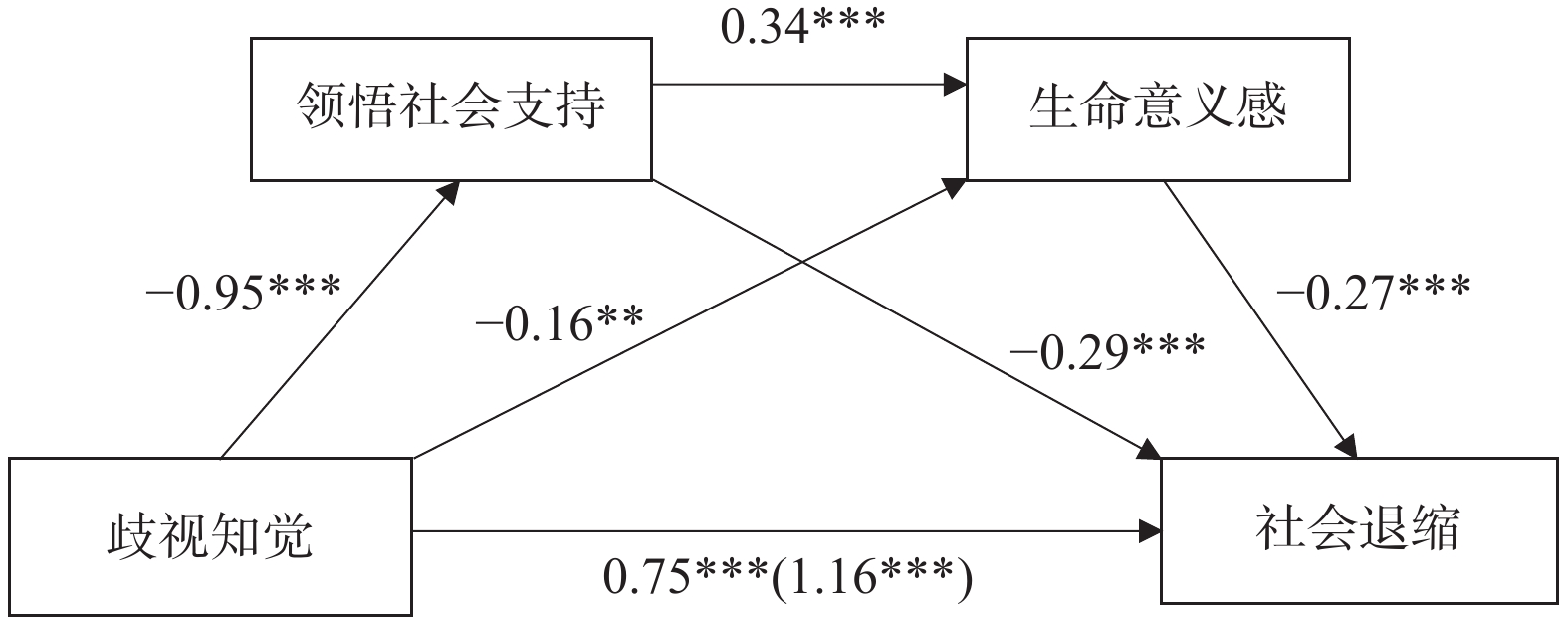
图2 链式中介效应路径
|
班永飞, 卢林鑫, 陈燕琴, 孙霁, 王庭照. 盲生的歧视知觉与心理健康的关系: 领悟社会支持和自尊的链式中介作用. 中国特殊教育, 2022 (9): 29- 38.
|
|
|
付立华, 石文乐. 社会支持视阈下社区矫正中的家庭参与. 东岳论丛, 2022, 43 (7): 176- 181.
|
|
|
胡玉宁, 张鹤, 牛媛媛, 董少凤. 残疾人大学生的歧视知觉与社会疏离: 社会支持和社会适应的多重中介作用. 南京航空航天大学学报(社会科学版), 2021, 23 (4): 111- 118.
|
|
|
李光勇. 青年社区服刑人员就业歧视现状、原因与对策——基于D市三个区的调查. 中国青年研究, 2013 (5): 15- 19,90.
|
|
|
李旭. 大学生社会支持与生命意义的关系: 乐观的中介和调节作用. 中国特殊教育, 2015 (1): 81- 86.
|
|
|
李乙. (2022). 社区矫正对象歧视知觉问卷的编制和应用研究(硕士学位论文). 西南大学, 重庆.
|
|
|
李占宏, 赵梦娇, 肖紫瑶, 刘亚楠. 利他行为与生命意义感: 领悟到的社会支持与自尊的中介作用. 中国特殊教育, 2018 (5): 92- 96.
|
|
|
刘亚楠, 张迅, 朱澄铨, 苏芮莹, 尹媛媛. 生命意义研究: 积极心理学的视角. 中国特殊教育, 2020 (11): 70- 75.
|
|
|
陆小云, 刘亚楠, 苏克刚. 共建共治模式下社区服刑人员的多重困惑与纾解. 南京工程学院学报(社会科学版), 2021, 21 (1): 24- 27.
|
|
|
王江洋, 于子洋, 聂家昕. 自我污名与孤儿学生消极情绪的关系: 解释风格及领悟社会支持的多重中介作用. 心理与行为研究, 2020, 18 (6): 777- 783.
|
|
|
王晓静, 雷利静. 颅脑损伤术后患者生命意义感与应对方式的相关性. 中国民康医学, 2023, 35 (5): 14- 16, 20.
|
|
|
王鑫强. 生命意义感量表中文修订版在中学生群体中的信效度. 中国临床心理学杂志, 2013, 21 (5): 764- 767, 763.
|
|
|
温忠麟, 叶宝娟. 中介效应分析: 方法和模型发展. 心理科学进展, 2014, 22 (5): 731- 745.
|
|
|
项明强, 侯晓晖. 听力障碍中学生社会支持和生命意义的关系: 核心自我评价的中介和调节作用. 中国特殊教育, 2013 (6): 34- 40.
|
|
|
杨彩云. 歧视知觉对社区矫正对象社会疏离的影响机制研究——基于身份认同整合和社会支持的中介效应. 浙江工商大学学报, 2022 (3): 127- 139.
|
|
|
张玲玲, 徐晶, 朱安宏, 谢莉, 李艳玲. 领悟社会支持对大学生应对方式的影响: 生命意义感和心理韧性的链式中介作用. 中国健康心理学杂志, 2021, 29 (5): 758- 761.
|
|
|
张曼玉, 封慰. 自我控制对大学新生学校适应的影响: 应对方式的中介作用. 心理学通讯, 2024, 7 (1): 79- 87.
|
|
|
张荣伟, 李丹. 如何过上有意义的生活?——基于生命意义理论模型的整合. 心理科学进展, 2018, 26 (4): 744- 760.
|
|
|
张薇薇, 张玉柱. 领悟社会支持与大学生抑郁: 生命意义感和自我控制的作用. 内蒙古师范大学学报(自然科学汉文版), 2021, 50 (1): 82- 87.
|
|
|
周浩, 龙立荣. 共同方法偏差的统计检验与控制方法. 心理科学进展, 2004, 12 (6): 942- 950.
|
|
|
庾泳, 王道豫, 李辉, 肖富群, 王梦莹. 自尊对ART成功的HIV/AIDS患者的歧视知觉与抑郁焦虑关系的调节作用. 中国艾滋病性病, 2022, 28 (5): 555- 559.
|
|
|
Bares, K. J., & Mowen, T. J. Examining the parole officer as a mechanism of social support during reentry from prison. Crime & Delinquency, 2020, 66 (6–7): 1023- 1051.
|
|
|
Baumeister, R. F., Campbell, J. D., Krueger, J. I., & Vohs, K. D. Does high self-esteem cause better performance, interpersonal success, happiness, or healthier lifestyles. Psychological Science in the Public Interest, 2003, 4 (1): 1- 44.
DOI |
|
|
Blumenthal, J. A., Burg, M. M., Barefoot, J., Williams, R. B., Haney, T., & Zimet, G. Social support, type A behavior, and coronary artery disease. Psychosomatic Medicine, 1987, 49 (4): 331- 340.
DOI |
|
|
Chronister, J., Chou, C. C., & Liao, H. Y. The role of stigma coping and social support in mediating the effect of societal stigma on internalized stigma, mental health recovery, and quality of life among people with serious mental illness. Journal of Community Psychology, 2013, 41 (5): 582- 600.
DOI |
|
|
Corrigan, P. W., Larson, J. E., & Rüsch, N. Self-stigma and the “why try” effect: Impact on life goals and evidence-based practices. World Psychiatry, 2009, 8 (2): 75- 81.
DOI |
|
|
Desjardins, L., Barrera, M., Schulte, F., Chung, J., Cataudella, D., Janzen, L., … Downie, A. Predicting social withdrawal, anxiety and depression symptoms in pediatric brain tumor survivors. Journal of Psychosocial Oncology, 2019, 37 (1): 22- 36.
DOI |
|
|
Fife, B. L. The role of constructed meaning in adaptation to the onset of life-threatening illness. Social Science & Medicine, 2005, 61 (10): 2132- 2143.
|
|
|
Hatzenbuehler, M. L. Structural stigma: Research evidence and implications for psychological science. American Psychologist, 2016, 71 (8): 742- 751.
DOI |
|
|
Heine, S. J., Proulx, T., & Vohs, K. D. The meaning maintenance model: On the coherence of social motivations. Personality and Social Psychology Review, 2006, 10 (2): 88- 110.
DOI |
|
|
Ilic, M., Reinecke, J., Bohner, G., Röttgers, H. O., Beblo, T., Driessen, M., ... Corrigan, P. W. Managing a stigmatized identity—Evidence from a longitudinal analysis about people with mental illness. Journal of Applied Social Psychology, 2014, 44 (7): 464- 480.
DOI |
|
|
Jiang, T. L., & Chen, Z. S. Meaning in life accounts for the association between long-term ostracism and depressive symptoms: The moderating role of self-compassion. The Journal of Social Psychology, 2020, 160 (5): 535- 547.
DOI |
|
|
King, L. A., & Hicks, J. A. The science of meaning in life. Annual Review of Psychology, 2021, 72, 561- 584.
DOI |
|
|
Kondrat, D. C., Sullivan, W. P., Wilkins, B., Barrett, B. J., & Beerbower, E. The mediating effect of social support on the relationship between the impact of experienced stigma and mental health. Stigma and Health, 2018, 3 (4): 305- 314.
DOI |
|
|
Krause, N. Longitudinal study of social support and meaning in life. Psychology and Aging, 2007, 22 (3): 456- 469.
DOI |
|
|
Link, B. G., Struening, E. L., Neese-Todd, S., Asmussen, S., & Phelan, J. C. Stigma as a barrier to recovery: The consequences of stigma for the self-esteem of people with mental illnesses. Psychiatric Services, 2001, 52 (12): 1621- 1626.
DOI |
|
|
Lopez, F. G., Ramos, K., Nisenbaum, M., Thind, N., & Ortiz-Rodriguez, T. Predicting the presence and search for life meaning: Test of an attachment theory-driven model. Journal of Happiness Studies, 2015, 16 (1): 103- 116.
DOI |
|
|
McWilliams, E. R., & Hunter, B. A. The impact of criminal record stigma on quality of life: A test of theoretical pathways. American Journal of Community Psychology, 2021, 67 (1–2): 89- 102.
DOI |
|
|
Miller, C. T., & Kaiser, C. R. A theoretical perspective on coping with stigma. Journal of social issues, 2001, 57 (1): 73- 92.
DOI |
|
|
Moore, K. E., & Tangney, J. P. Managing the concealable stigma of criminal justice system involvement: A longitudinal examination of anticipated stigma, social withdrawal, and post-release adjustment. Journal of Social Issues, 2017, 73 (2): 322- 340.
DOI |
|
|
Norris, F. H., & Kaniasty, K. Received and perceived social support in times of stress: A test of the social support deterioration deterrence model. Journal of Personality and Social Psychology, 1996, 71 (3): 498- 511.
DOI |
|
|
Ong, H. L., Vaingankar, J. A., Abdin, E., Sambasivam, R., Fauziana, R., Tan, M. E., ... Subramaniam, M. Resilience and burden in caregivers of older adults: Moderating and mediating effects of perceived social support. BMC Psychiatry, 2018, 18 (1): 1- 9.
DOI |
|
|
Or, S. E. B., Hasson-Ohayon, I., Feingold, D., Vahab, K., Amiaz, R., Weiser, M., & Lysaker, P. H. Meaning in life, insight and self-stigma among people with severe mental illness. Comprehensive Psychiatry, 2013, 54 (2): 195- 200.
DOI |
|
|
Park, J., & Baumeister, R. F. Meaning in life and adjustment to daily stressors. The Journal of Positive Psychology, 2017, 12 (4): 333- 341.
DOI |
|
|
Pascual-Sanchez, A., Jenaro, C., & Montes, J. M. Understanding social withdrawal in euthymic bipolar patients: The role of stigma. Psychiatry Research, 2020, 284, 112753.
DOI |
|
|
Ren, D., Wesselmann, E., & Williams, K. D. Evidence for another response to ostracism: Solitude seeking. Social Psychological and Personality Science, 2015, 7 (3): 204- 212.
|
|
|
Rueger, S. Y., Malecki, C. K., Pyun, Y., Aycock, C., & Coyle, S. A meta-analytic review of the association between perceived social support and depression in childhood and adolescence. Psychological Bulletin, 2016, 142 (10): 1017- 1067.
DOI |
|
|
Ruijne, R. E., Zarchev, M., van Weeghel, J., Henrichs, J., Garofalo, C., Bogaerts, S., ... Kamperman, A. M. Experiencing discrimination mediates the relationship between victimization and social withdrawal in patients suffering from a severe mental illness: A cross-sectional study. Journal of Psychiatric Research, 2022, 148, 14- 20.
DOI |
|
|
Schuck, A., Calati, R., Barzilay, S., Bloch-Elkouby, S., & Galynker, I. Suicide crisis syndrome: A review of supporting evidence for a new suicide-specific diagnosis. Behavioral Sciences & the Law, 2019, 37 (3): 223- 239.
|
|
|
Shin, J. Y., & Steger, M. F. Supportive college environment for meaning searching and meaning in life among American college students. Journal of College Student Development, 2016, 57 (1): 18- 31.
DOI |
|
|
Steger, M. F., Frazier, P., Oishi, S., & Kaler, M. The meaning in life questionnaire: Assessing the presence of and search for meaning in life. Journal of Counseling Psychology, 2006, 53 (1): 80- 93.
DOI |
|
|
Steger, M. F., & Kashdan, T. B. The unbearable lightness of meaning: Well-being and unstable meaning in life. The Journal of Positive Psychology, 2013, 8 (2): 103- 115.
DOI |
|
|
Teo, A. R., Chen, J. I., Kubo, H., Katsuki, R., Sato-Kasai, M., Shimokawa, N., ... Kato, T. A. Development and validation of the 25-item Hikikomori Questionnaire (HQ-25). Psychiatry and Clinical Neurosciences, 2018, 72 (10): 780- 788.
DOI |
|
|
Williams, K. D. Ostracism: A temporal need-threat model. Advances in Experimental Social Psychology, 2009, 41, 275- 314.
|
|
|
Woods, A., Solomonov, N., Liles, B., Guillod, A., Kales, H. C., & Sirey, J. A. Perceived social support and interpersonal functioning as predictors of treatment response among depressed older adults. The American Journal of Geriatric Psychiatry, 2021, 29 (8): 843- 852.
DOI |
|
|
Zhao, J. X., Wang, Q., & Xue, X. J. The longitudinal associations among perceived discrimination, social initiative, and depressive symptoms in Chinese rural left-behind adolescents. Journal of Adolescence, 2020, 81 (1): 114- 123.
DOI |
|
|
Zoppei, S., Lasalvia, A., Bonetto, C., van Bortel, T., Nyqvist, F., Webber, M., ... the ASPEN Study Group. Social capital and reported discrimination among people with depression in 15 European countries. Social Psychiatry and Psychiatric Epidemiology, 2014, 49 (10): 1589- 1598.
DOI |
| [1] | 于永菊, 何敏. 高校大学生生命意义感的演变模式及其与抑郁症状的关联[J]. 心理与行为研究, 2025, 23(3): 354-360. |
| [2] | 徐金凤, 吴添昊, 程毓可, 于冲, 关文军. 歧视知觉如何影响特殊儿童的家庭功能?孤独感和亲子亲合的作用机制[J]. 心理与行为研究, 2024, 22(6): 799-805. |
| [3] | 关文军, 吴添昊, 程毓可, 多强. 孤独症儿童父母负面评价恐惧和社交焦虑的关系:一个有调节的中介效应模型[J]. 心理与行为研究, 2024, 22(3): 418-424. |
| [4] | 胡永时, 赵怡霖, 张镇. 老年人独处能力与生命意义感:基本心理需求的中介和家庭亲密度的调节作用[J]. 心理与行为研究, 2024, 22(3): 425-432. |
| [5] | 吴明证, 陈迪, 严梦瑶, 倪苏杭, 王士祺, 尹金荣, 孙晓玲. 家庭仪式与青少年自我控制的关系:亲子依恋与生命意义感的链式中介作用[J]. 心理与行为研究, 2023, 21(6): 832-838. |
| [6] | 王思怡, 丁菀, 宋省成, 孙赵星, 谢瑞波, 李伟健. 中职生同伴、师生关系对学业倦怠的影响:歧视知觉与自我同情的链式中介作用[J]. 心理与行为研究, 2023, 21(5): 691-697. |
| [7] | 张晓颖, 李亚琴, 黄希庭, 杨庆. 自我概念视角下的师范生职业使命感提升机制:一项追踪研究[J]. 心理与行为研究, 2023, 21(4): 524-532. |
| [8] | 蒋俊杰, 陈珺怡, 喻婧. 老年人微信使用与获得感的关系:领悟社会支持和生命意义感的链式中介作用[J]. 心理与行为研究, 2023, 21(3): 367-373. |
| [9] | 麻超, 刘亚飞, 于海波, 武晓光. 高中生生命意义感的类别特征及与孤独感的关系:基于潜在剖面分析[J]. 心理与行为研究, 2023, 21(2): 216-223. |
| [10] | 蒋俊杰, 王旭, 喻婧, 向欢欢, 郭成. 教师关怀行为对中学生学业压力的影响:睡眠质量的中介作用和生命意义感的调节作用[J]. 心理与行为研究, 2023, 21(2): 260-265. |
| [11] | 谭丽苹, 李晴, 郭成. 师生关系对留守儿童学习投入的影响:有调节的中介模型[J]. 心理与行为研究, 2022, 20(6): 782-789. |
| [12] | 余益兵, 于家伟, 李艳如, 杜宜展. 农村留守儿童领悟家庭支持、朋友支持与抑郁的交叉滞后分析[J]. 心理与行为研究, 2022, 20(4): 472-478. |
| [13] | 靳铭, 曾练平, 曾小叶, 黄亚夫. 高中生正念与学习倦怠:基于自我调节学习模型的视角[J]. 心理与行为研究, 2022, 20(4): 494-500. |
| [14] | 鲍旭辉, 黄杰, 李娜, 李健军, 李亚红. 主动性人格对学习投入的影响:领悟社会支持和积极情绪的链式中介作用[J]. 心理与行为研究, 2022, 20(4): 508-514. |
| [15] | 丁倩, 罗星雨. 歧视知觉对留守青少年攻击行为的影响:多重中介效应分析[J]. 心理与行为研究, 2022, 20(3): 346-352. |
| 阅读次数 | ||||||
|
全文 |
|
|||||
|
摘要 |
|
|||||
