
心理与行为研究 ›› 2023, Vol. 21 ›› Issue (5): 592-599.DOI: 10.12139/j.1672-0628.2023.05.003
徐淑颖, 蔡曙光, 冯廷勇( )
)
收稿日期:2022-09-28
出版日期:2023-09-20
发布日期:2023-09-20
通讯作者:
冯廷勇
基金资助:
Shuying XU, Shuguang CAI, Tingyong FENG()
Received:2022-09-28
Online:2023-09-20
Published:2023-09-20
Contact:
Tingyong FENG
摘要:
依据情境预期−情绪模型,招募151名大学生被试,通过3(预期情绪效价:积极、消极、中性)×2(组别:训练组、控制组)×2(测量时间:前测、后测)混合实验设计,从可塑性角度探究预期想象能力对延迟折扣的影响,结果发现:(1)预期想象训练有效提升了个体的预期想象能力,且预期想象能力越强,延迟折扣率的变化程度越大;(2)这一过程受到预期情绪效价的调节,即积极预期情绪会降低延迟折扣率,消极预期情绪会提高延迟折扣率,而中性预期情绪则不会显著改变延迟折扣率。结果表明,预期想象能力影响延迟折扣率的变化程度,而预期情绪效价调节延迟折扣方向。
中图分类号:
徐淑颖, 蔡曙光, 冯廷勇. 预期想象对延迟折扣的影响:基于预期想象能力可塑性的研究[J]. 心理与行为研究, 2023, 21(5): 592-599.
Shuying XU, Shuguang CAI, Tingyong FENG. The Effect of Episodic Future Thinking on Delay Discounting: The Malleability of Episodic Prospective Ability[J]. Studies of Psychology and Behavior, 2023, 21(5): 592-599.

图1 基线跨期选择任务流程
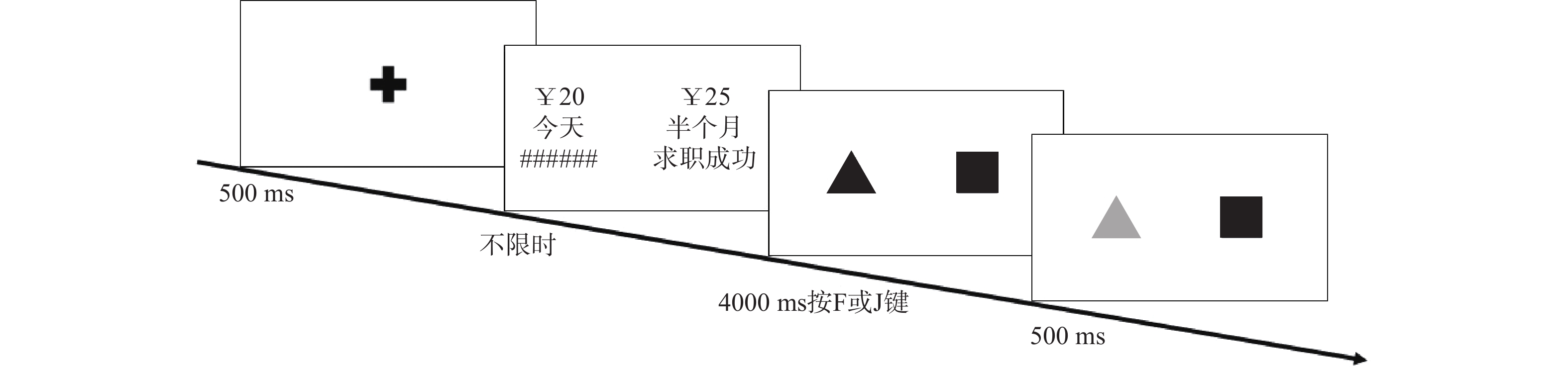
图2 预期想象跨期选择任务流程
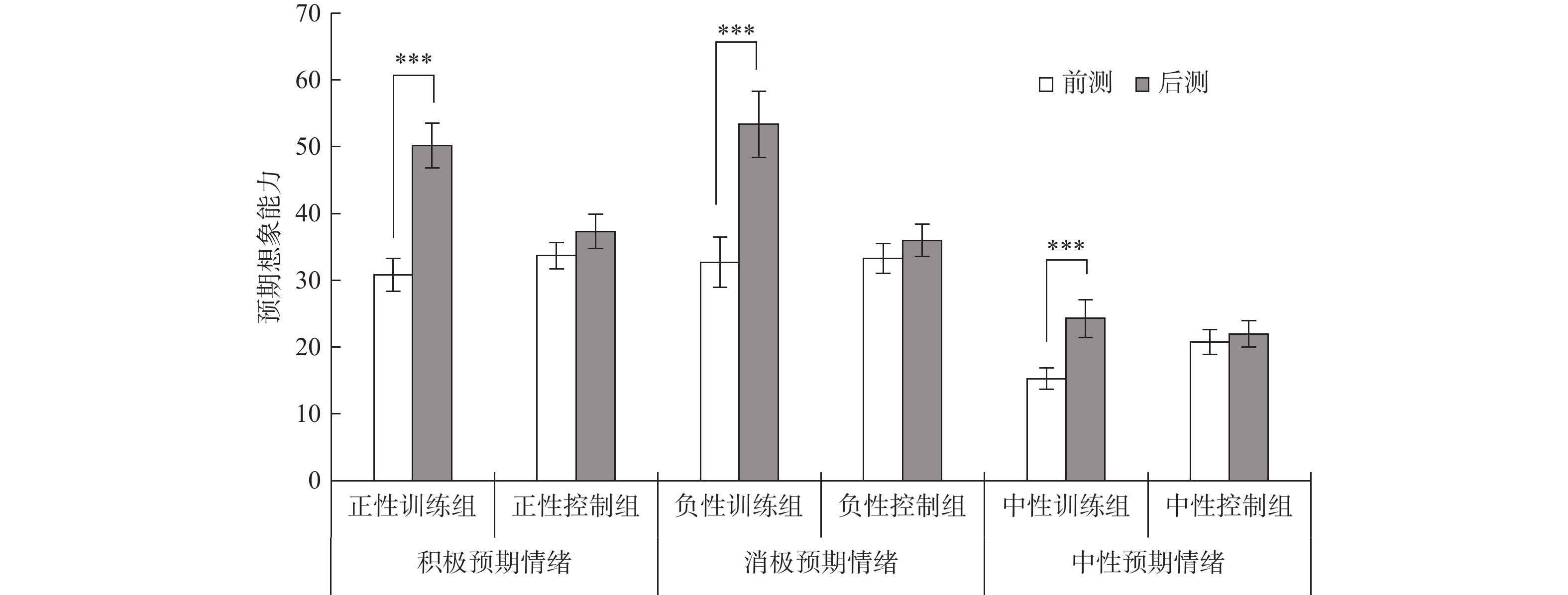
图3 三种预期情绪条件下被试的预期想象能力 注:误差线表示标准误;*p<0.05,**p<0.01,***p<0.001,以下同。
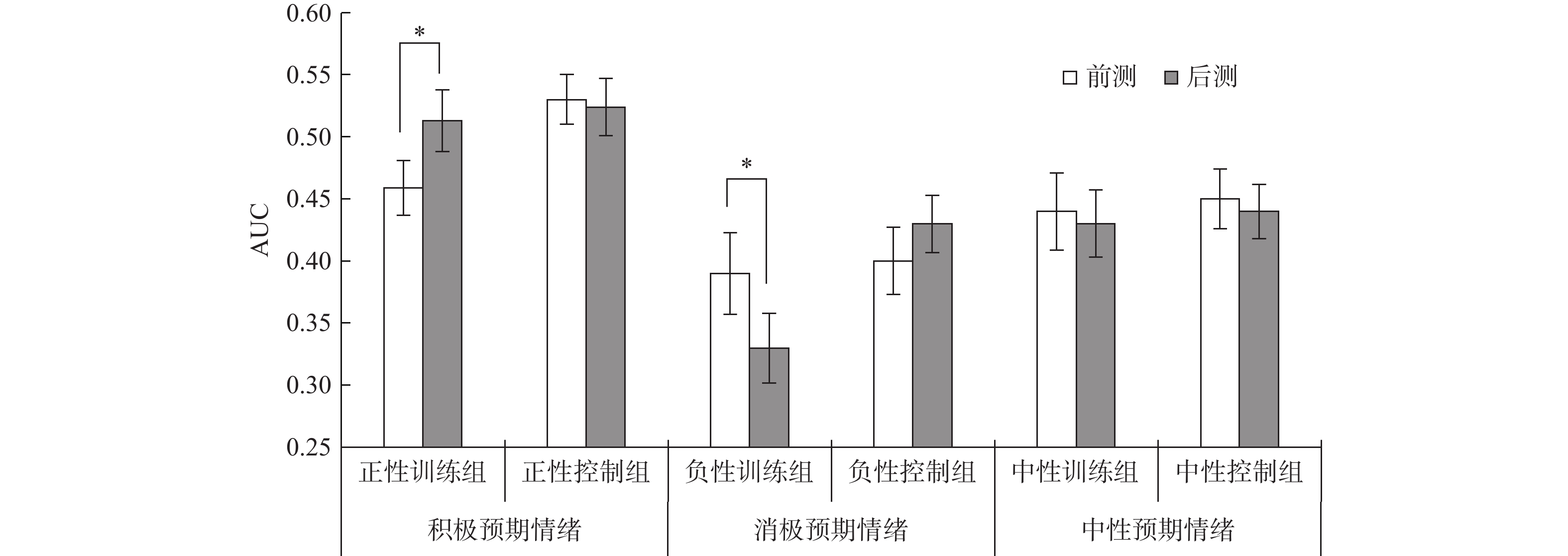
图4 三种预期情绪条件下训练组和控制组被试的AUC
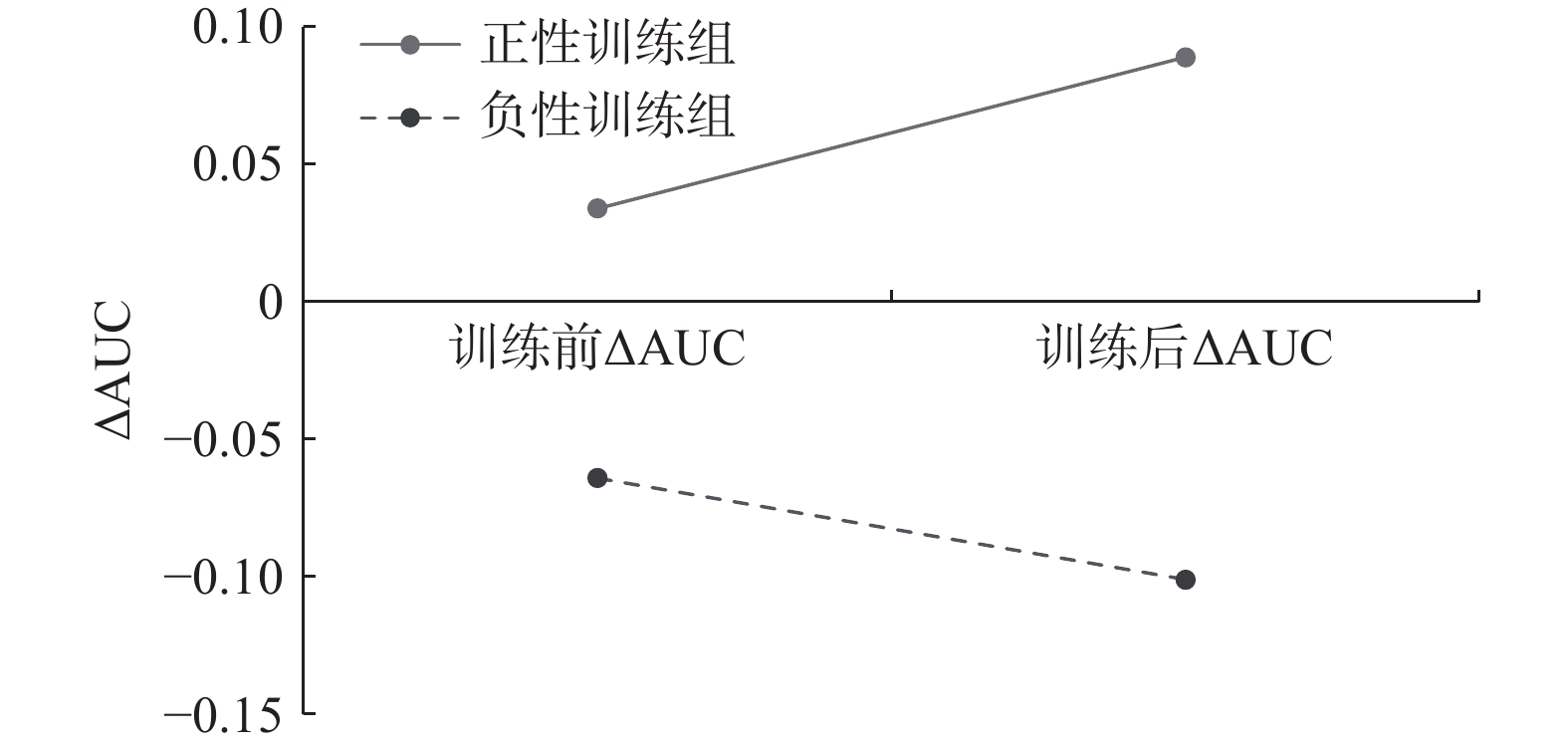
图5 训练组的前、后测ΔAUC变化趋势
| 蒋多, 何贵兵. (2017). 心理距离视角下的行为决策. 心理科学进展, 25(11), 1992–2001. | |
| 刘雷, 苏缇, 彭娟, 郭逸群, 冯廷勇. 延迟折扣的认知与神经机制: 特质性与状态性研究取向. 心理科学进展, 2014, 22 (7): 1047- 1061. | |
| 刘扬, 孙彦. (2016). 时间分解效应及其对跨期决策的影响. 心理学报, 48(4), 362–370. | |
| 秦玲玲. (2014). 预期情绪对跨期选择调控的认知神经机制(硕士学位论文). 西南大学, 重庆. | |
| 王鹏, 刘永芳. 情绪对跨时选择的影响. 心理科学, 2009, 32 (6): 1318- 1320. | |
|
Anokhin, A. P., Grant, J. D., Mulligan, R. C., & Heath, A. C.. The genetics of impulsivity: Evidence for the heritability of delay discounting. Biological Psychiatry, 2015, 77 (10): 887- 894.
DOI |
|
|
Atance, C. M., & O’Neill, D. K.. Episodic future thinking. Trends in Cognitive Sciences, 2001, 5 (12): 533- 539.
DOI |
|
|
Benoit, R. G., Gilbert, S. J., & Burgess, P. W.. A neural mechanism mediating the impact of episodic prospection on farsighted decisions. Journal of Neuroscience, 2011, 31 (18): 6771- 6779.
DOI |
|
|
Buckner, R. L., & Carroll, D. C.. Self-projection and the brain. Trends in Cognitive Sciences, 2007, 11 (2): 49- 57.
DOI |
|
|
Bulley, A., Henry, J., & Suddendorf, T.. Prospection and the present moment: The role of episodic foresight in intertemporal choices between immediate and delayed rewards. Review of General Psychology, 2016, 20 (1): 29- 47.
DOI |
|
|
Chiou, W. B., & Wu, W. H.. Episodic future thinking involving the nonsmoking self can induce lower discounting and cigarette consumption. Journal of Studies on Alcohol and Drugs, 2017, 78 (1): 106- 112.
DOI |
|
|
Clore, G. L., & Huntsinger, J. R.. How emotions inform judgment and regulate thought. Trends in Cognitive Sciences, 2007, 11 (9): 393- 399.
DOI |
|
|
Eubig, P. A., Noe, T. E., Floresco, S. B., Sable, J. J., & Schantz, S. L.. Sex differences in response to amphetamine in adult Long-Evans rats performing a delay-discounting task. Pharmacology Biochemistry and Behavior, 2014, 118, 1- 9.
DOI |
|
|
Frederick, S., Loewenstein, G., & O’Donoghue, T.. Time discounting and time preference: A critical review. Journal of Economic Literature, 2002, 40 (2): 351- 401.
DOI |
|
|
Green, L., & Myerson, J.. A discounting framework for choice with delayed and probabilistic rewards. Psychological Bulletin, 2004, 130 (5): 769- 792.
DOI |
|
|
Kable, J. W., & Glimcher, P. W.. The neural correlates of subjective value during intertemporal choice. Nature Neuroscience, 2007, 10 (12): 1625- 1633.
DOI |
|
|
Kim, H., Schnall, S., & White, M. P.. Similar psychological distance reduces temporal discounting. Personality and Social Psychology Bulletin, 2013, 39 (8): 1005- 1016.
DOI |
|
|
Lempert, K. M., & Phelps, E. A.. The malleability of intertemporal choice. Trends in Cognitive Sciences, 2016, 20 (1): 64- 74.
DOI |
|
|
Levine, B., Svoboda, E., Hay, J. F., Winocur, G., & Moscovitch, M.. Aging and autobiographical memory: Dissociating episodic from semantic retrieval. Psychology and Aging, 2002, 17 (4): 677- 689.
DOI |
|
|
Lin, H., & Epstein, L. H.. Living in the moment: Effects of time perspective and emotional valence of episodic thinking on delay discounting. Behavioral Neuroscience, 2014, 128 (1): 12- 19.
DOI |
|
| Liu, L., Feng, T. Y., Chen, J., & Li, H. (2013). The value of emotion: How does episodic prospection modulate delay discounting? PLoS One, 8(11), e81717. | |
| Loewenstein, G., & O’Donoghue, T. (2007). The heat of the moment: Modeling interactions between affect and deliberation. Retrieved June 1, 2021, from http://martinstrobel.net/Jena/literature/Loewenstein-ODonoghue_WP-2007_In-the-heat-of-the-moment.pdf | |
|
Miloyan, B., Bulley, A., & Suddendorf, T.. Episodic foresight and anxiety: Proximate and ultimate perspectives. British Journal of Clinical Psychology, 2016, 55 (1): 4- 22.
DOI |
|
| O’Donnell, S., Oluyomi Daniel, T., & Epstein, L. H. (2017). Does goal relevant episodic future thinking amplify the effect on delay discounting? Consciousness and Cognition, 51, 10–16. | |
|
Peters, J., & Büchel, C.. Overlapping and distinct neural systems code for subjective value during intertemporal and risky decision making. The Journal of Neuroscience, 2009, 29 (50): 15727- 15734.
DOI |
|
|
Peters, J., & Büchel, C.. Episodic future thinking reduces reward delay discounting through an enhancement of prefrontal-mediotemporal interactions. Neuron, 2010, 66 (1): 138- 148.
DOI |
|
|
Peters, J., & Büchel, C.. The neural mechanisms of inter-temporal decision-making: Understanding variability. Trends in Cognitive Sciences, 2011, 15 (5): 227- 239.
DOI |
|
|
Renner, F., Murphy, F. C., Ji, J. L., Manly, T., & Holmes, E. A.. Mental imagery as a “motivational amplifier” to promote activities. Behaviour Research and Therapy, 2019, 114, 51- 59.
DOI |
|
|
Sasse, L. K., Peters, J., Büchel, C., & Brassen, S.. Effects of prospective thinking on intertemporal choice: The role of familiarity. Human Brain Mapping, 2015, 36 (10): 4210- 4221.
DOI |
|
|
Snider, S. E., LaConte, S. M., & Bickel, W. K.. Episodic future thinking: Expansion of the temporal window in individuals with alcohol dependence. Alcoholism: Clinical and Experimental Research, 2016, 40 (7): 1558- 1566.
DOI |
|
|
Trope, Y., & Liberman, N.. Temporal construal. Psychological Review, 2003, 110 (3): 403- 421.
DOI |
|
|
Zhang, S. M., Peng, J., Qin, L. L., Suo, T., & Feng, T. Y.. Prospective emotion enables episodic prospection to shift time preference. British Journal of Psychology, 2018, 109 (3): 487- 499.
DOI |
| [1] | 马燕, 王振宏. 道德自我知觉对欺骗行为的影响:解释水平的调节作用[J]. 心理与行为研究, 2024, 22(1): 39-45. |
| [2] | 刘思远, 朱麟, 王瑞冰, 徐楚言, 王芸萍, 刘聪慧. 道德决策中是否存在方言效应?[J]. 心理与行为研究, 2024, 22(1): 31-38. |
| [3] | 姚远青, 郭易安, 李春梅, 吴亚楠, 石雷, 赵广平. 几何图形社会角色隐喻的映射机制:行为和ERPs证据[J]. 心理与行为研究, 2024, 22(1): 23-30. |
| [4] | 付春野, 吕勇. 预期与时间注意对视觉感知的影响[J]. 心理与行为研究, 2024, 22(1): 15-22. |
| [5] | 钱程, 赵越, 牛溪溪, 顾佳灿, 王爱君. 三维空间深度位置上情绪面孔对返回抑制的影响[J]. 心理与行为研究, 2024, 22(1): 8-14. |
| [6] | 郭梅华, 兰泽波, 巫金根, 李赛男, 吴俊杰, 闫国利. 汉语词切分和字号对阅读知觉广度的影响:眼动的证据[J]. 心理与行为研究, 2024, 22(1): 1-7. |
| [7] | 陈汝淇, 包亚倩, 黄林洁琼, 李兴珊. 中文阅读中词语加工与眼动控制整合模型简介[J]. 心理与行为研究, 2023, 21(6): 725-735. |
| [8] | 梁菲菲, 冯琳琳, 刘瑛, 王昶浩, 王洁. 词素位置概率信息在中文双字词识别中的作用:词汇语境多样性的调节[J]. 心理与行为研究, 2023, 21(6): 736-743. |
| [9] | 于秒, 王文娣, 陈晓霄. 汉语“N的V”结构加工的韵律制约[J]. 心理与行为研究, 2023, 21(6): 744-750. |
| [10] | 陈婉婷, 张逸飞, 何清华. 准确性提示降低错误信息的分享意愿[J]. 心理与行为研究, 2023, 21(6): 751-759. |
| [11] | 马大付, 秦春影, 喻晓锋, 何催. 项目区分度指标在属性多水平和混合计分项目下的组卷研究[J]. 心理与行为研究, 2023, 21(6): 760-769. |
| [12] | 刘蕾, 李亚楠, 牛若愚, 于文婷, 陈玉雪, 刘莹. 踏步任务下动作同步的神经基础[J]. 心理与行为研究, 2023, 21(5): 600-607. |
| [13] | 王卓, 刘旭, 蔡佳, 陈芷柔. 提取诱发遗忘的动态效应:提取与重学交叉混合练习的联合影响[J]. 心理与行为研究, 2023, 21(5): 585-591. |
| [14] | 鹿子佳, 张志超, 符颖, 张慢慢, 臧传丽, 白学军. 重复词无法帮助中文读者获得副中央凹词类信息[J]. 心理与行为研究, 2023, 21(5): 577-584. |
| [15] | 高阳, 倪士光, 夏志远, 田午林. 群体夸耀方式对旁观者网络攻击行为的影响:旁观者的被挑衅感和群体认同的作用[J]. 心理与行为研究, 2023, 21(4): 471-478. |
| 阅读次数 | ||||||
|
全文 |
|
|||||
|
摘要 |
|
|||||
