
心理与行为研究 ›› 2024, Vol. 22 ›› Issue (5): 673-681.DOI: 10.12139/j.1672-0628.2024.05.013
肖皓月, 张杉*( ), 郝海平, 吕厚超*()
收稿日期:2023-12-19
出版日期:2024-09-20
发布日期:2024-09-20
通讯作者:
张杉, 吕厚超
基金资助:
Haoyue XIAO, Shan ZHANG*(), Haiping HAO, Houchao LYU*()
Received:2023-12-19
Online:2024-09-20
Published:2024-09-20
Contact:
Shan ZHANG, Houchao LYU
摘要:
为深入探讨高中生网络成瘾、抑郁和未来时间洞察力的纵向联系及内在作用机制,采用整群抽样对697名高中生进行了六个月的追踪调查。结果表明:(1)网络成瘾与未来时间洞察力存在相互负向预测关系;(2)T1网络成瘾对T2抑郁有显著的正向预测作用,T1抑郁对T2未来时间洞察力有显著的负向预测作用;(3)抑郁在网络成瘾与未来时间洞察力中的中介效应在不同性别的高中生群体存在差异。结果揭示了高中生网络成瘾对未来时间洞察力的影响,并证明抑郁在其中起中介作用。
肖皓月, 张杉, 郝海平, 吕厚超. 高中生网络成瘾与未来时间洞察力的纵向关系:抑郁的中介作用[J]. 心理与行为研究, 2024, 22(5): 673-681.
Haoyue XIAO, Shan ZHANG, Haiping HAO, Houchao LYU. The Longitudinal Relationship Between Internet Addiction and Future Time Perspective Among High School Students: The Mediating Role of Depression[J]. Studies of Psychology and Behavior, 2024, 22(5): 673-681.
| 变量 | 1 | 2 | 3 | 4 | 5 | 6 | 7 | 8 |
| 1. 性别 | ||||||||
| 2. 年龄 | −0.097* | |||||||
| 3. T1网络成瘾 | −0.085* | −0.017 | ||||||
| 4. T2网络成瘾 | −0.001 | −0.046 | 0.462** | |||||
| 5. T1抑郁 | −0.004 | 0.029 | 0.354** | 0.290** | ||||
| 6. T2抑郁 | −0.080* | 0.018 | 0.277** | 0.417** | 0.515** | |||
| 7. T1未来时间洞察力 | 0.003 | −0.039 | −0.300** | −0.215** | −0.343** | −0.222** | ||
| 8. T2未来时间洞察力 | −0.110** | −0.002 | −0.193** | −0.317** | −0.300** | −0.383** | 0.315** | |
| 均值(标准差) | 16.39(0.94) | 2.86(2.58) | 3.34(2.93) | 10.67(4.68) | 11.03(5.21) | 17.42(3.16) | 16.63(3.52) |
表1 各变量的平均值、标准差及相关系数
| 变量 | 1 | 2 | 3 | 4 | 5 | 6 | 7 | 8 |
| 1. 性别 | ||||||||
| 2. 年龄 | −0.097* | |||||||
| 3. T1网络成瘾 | −0.085* | −0.017 | ||||||
| 4. T2网络成瘾 | −0.001 | −0.046 | 0.462** | |||||
| 5. T1抑郁 | −0.004 | 0.029 | 0.354** | 0.290** | ||||
| 6. T2抑郁 | −0.080* | 0.018 | 0.277** | 0.417** | 0.515** | |||
| 7. T1未来时间洞察力 | 0.003 | −0.039 | −0.300** | −0.215** | −0.343** | −0.222** | ||
| 8. T2未来时间洞察力 | −0.110** | −0.002 | −0.193** | −0.317** | −0.300** | −0.383** | 0.315** | |
| 均值(标准差) | 16.39(0.94) | 2.86(2.58) | 3.34(2.93) | 10.67(4.68) | 11.03(5.21) | 17.42(3.16) | 16.63(3.52) |
| 变量 | 模型 | χ2 | df | CFI | TLI | RMSEA | 90 % CI | SRMR | 模型比较 | ∆χ2 | ∆df | p | ∆CFI | ∆TLI |
| 网络成瘾 | M1 | 433.40 | 159 | 0.93 | 0.91 | 0.05 | [0.04, 0.06] | 0.04 | ||||||
| M2 | 442.53 | 168 | 0.93 | 0.92 | 0.05 | [0.04, 0.05] | 0.04 | M2-M1 | 9.13 | 9 | >0.05 | |||
| M3 | 483.84 | 178 | 0.92 | 0.91 | 0.05 | [0.04, 0.06] | 0.05 | M3-M2 | 41.32 | 10 | <0.05 | −0.008 | −0.004 | |
| M4 | 521.97 | 188 | 0.91 | 0.91 | 0.05 | [0.05, 0.06] | 0.05 | M4-M3 | 38.12 | 10 | <0.05 | −0.007 | −0.003 | |
| 抑郁 | M1 | 618.92 | 157 | 0.92 | 0.90 | 0.07 | [0.06, 0.07] | 0.05 | ||||||
| M2 | 623.56 | 166 | 0.92 | 0.91 | 0.06 | [0.06, 0.07] | 0.05 | M2-M1 | 4.64 | 9 | >0.05 | |||
| M3 | 648.66 | 176 | 0.92 | 0.91 | 0.06 | [0.06, 0.07] | 0.06 | M3-M2 | 25.10 | 10 | <0.05 | −0.002 | 0.002 | |
| M4 | 676.61 | 186 | 0.91 | 0.91 | 0.06 | [0.06, 0.07] | 0.06 | M4-M3 | 27.95 | 10 | <0.05 | −0.004 | 0.002 | |
| 未来时间洞察力 | M1 | 67.52 | 29 | 0.98 | 0.97 | 0.04 | [0.03, 0.06] | 0.03 | ||||||
| M2 | 71.05 | 33 | 0.98 | 0.98 | 0.04 | [0.03, 0.05] | 0.03 | M2-M1 | 3.53 | 4 | >0.05 | |||
| M3 | 110.94 | 38 | 0.97 | 0.96 | 0.05 | [0.04, 0.06] | 0.05 | M3-M2 | 39.89 | 5 | <0.05 | −0.016 | −0.016 | |
| M4 | 117.72 | 43 | 0.97 | 0.96 | 0.05 | [0.04, 0.06] | 0.06 | M4-M3 | 6.77 | 5 | >0.05 |
表2 纵向测量不变性模型拟合指数
| 变量 | 模型 | χ2 | df | CFI | TLI | RMSEA | 90 % CI | SRMR | 模型比较 | ∆χ2 | ∆df | p | ∆CFI | ∆TLI |
| 网络成瘾 | M1 | 433.40 | 159 | 0.93 | 0.91 | 0.05 | [0.04, 0.06] | 0.04 | ||||||
| M2 | 442.53 | 168 | 0.93 | 0.92 | 0.05 | [0.04, 0.05] | 0.04 | M2-M1 | 9.13 | 9 | >0.05 | |||
| M3 | 483.84 | 178 | 0.92 | 0.91 | 0.05 | [0.04, 0.06] | 0.05 | M3-M2 | 41.32 | 10 | <0.05 | −0.008 | −0.004 | |
| M4 | 521.97 | 188 | 0.91 | 0.91 | 0.05 | [0.05, 0.06] | 0.05 | M4-M3 | 38.12 | 10 | <0.05 | −0.007 | −0.003 | |
| 抑郁 | M1 | 618.92 | 157 | 0.92 | 0.90 | 0.07 | [0.06, 0.07] | 0.05 | ||||||
| M2 | 623.56 | 166 | 0.92 | 0.91 | 0.06 | [0.06, 0.07] | 0.05 | M2-M1 | 4.64 | 9 | >0.05 | |||
| M3 | 648.66 | 176 | 0.92 | 0.91 | 0.06 | [0.06, 0.07] | 0.06 | M3-M2 | 25.10 | 10 | <0.05 | −0.002 | 0.002 | |
| M4 | 676.61 | 186 | 0.91 | 0.91 | 0.06 | [0.06, 0.07] | 0.06 | M4-M3 | 27.95 | 10 | <0.05 | −0.004 | 0.002 | |
| 未来时间洞察力 | M1 | 67.52 | 29 | 0.98 | 0.97 | 0.04 | [0.03, 0.06] | 0.03 | ||||||
| M2 | 71.05 | 33 | 0.98 | 0.98 | 0.04 | [0.03, 0.05] | 0.03 | M2-M1 | 3.53 | 4 | >0.05 | |||
| M3 | 110.94 | 38 | 0.97 | 0.96 | 0.05 | [0.04, 0.06] | 0.05 | M3-M2 | 39.89 | 5 | <0.05 | −0.016 | −0.016 | |
| M4 | 117.72 | 43 | 0.97 | 0.96 | 0.05 | [0.04, 0.06] | 0.06 | M4-M3 | 6.77 | 5 | >0.05 |
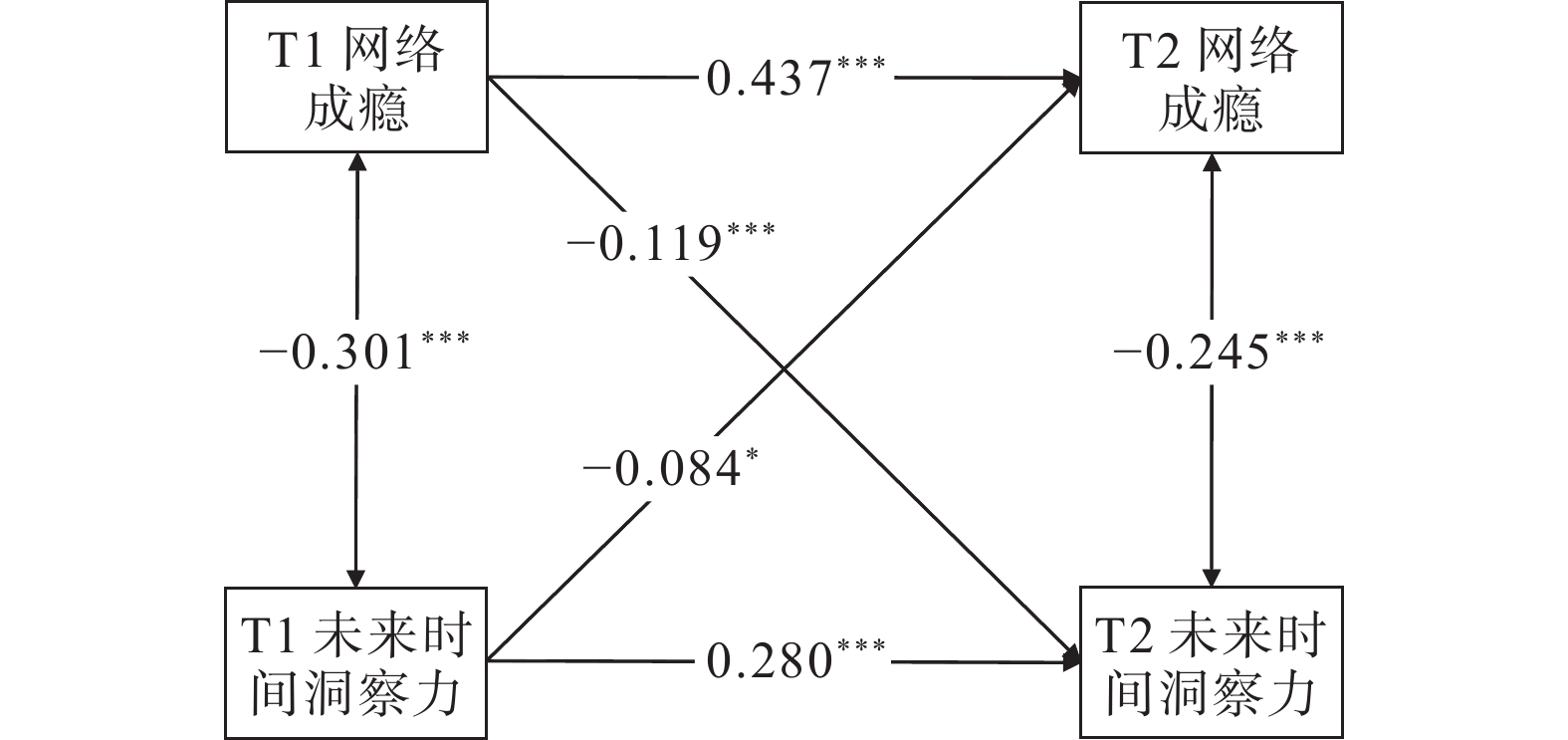
图1 网络成瘾和未来时间洞察力的交叉滞后模型
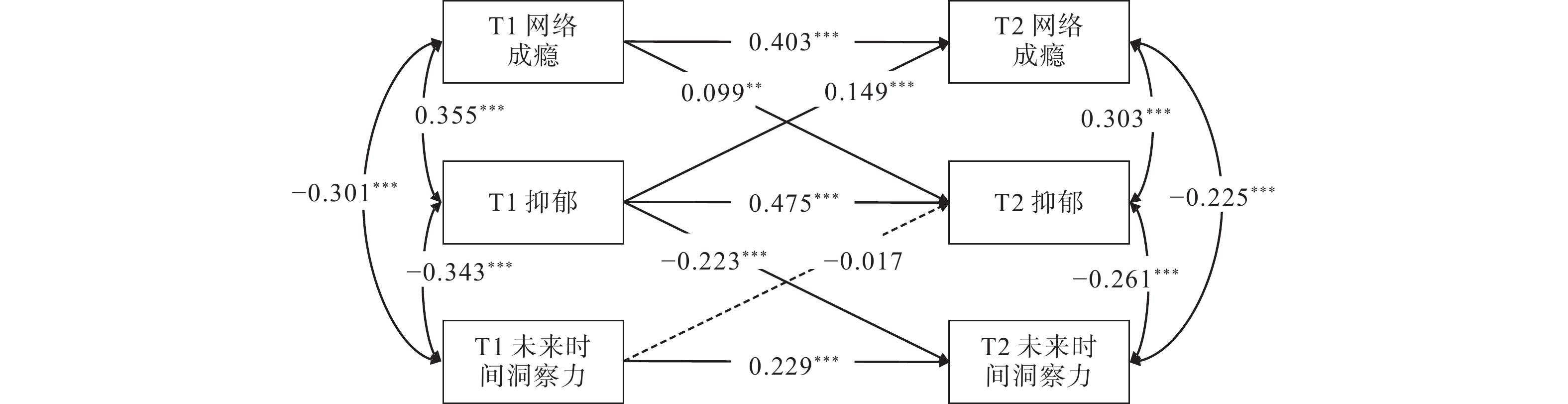
图2 抑郁的中介模型 注:该模型已控制性别变量,图中所呈现系数均为标准化系数。
| 模型 | χ2 | df | GFI | CFI | IFI | RMSEA |
| M1 | 25.399 | 6 | 0.988 | 0.978 | 0.978 | 0.068 |
| M2 | 32.159 | 12 | 0.985 | 0.977 | 0.977 | 0.049 |
| M3 | 60.109 | 24 | 0.973 | 0.958 | 0.959 | 0.047 |
表3 中介模型等值性拟合指数
| 模型 | χ2 | df | GFI | CFI | IFI | RMSEA |
| M1 | 25.399 | 6 | 0.988 | 0.978 | 0.978 | 0.068 |
| M2 | 32.159 | 12 | 0.985 | 0.977 | 0.977 | 0.049 |
| M3 | 60.109 | 24 | 0.973 | 0.958 | 0.959 | 0.047 |
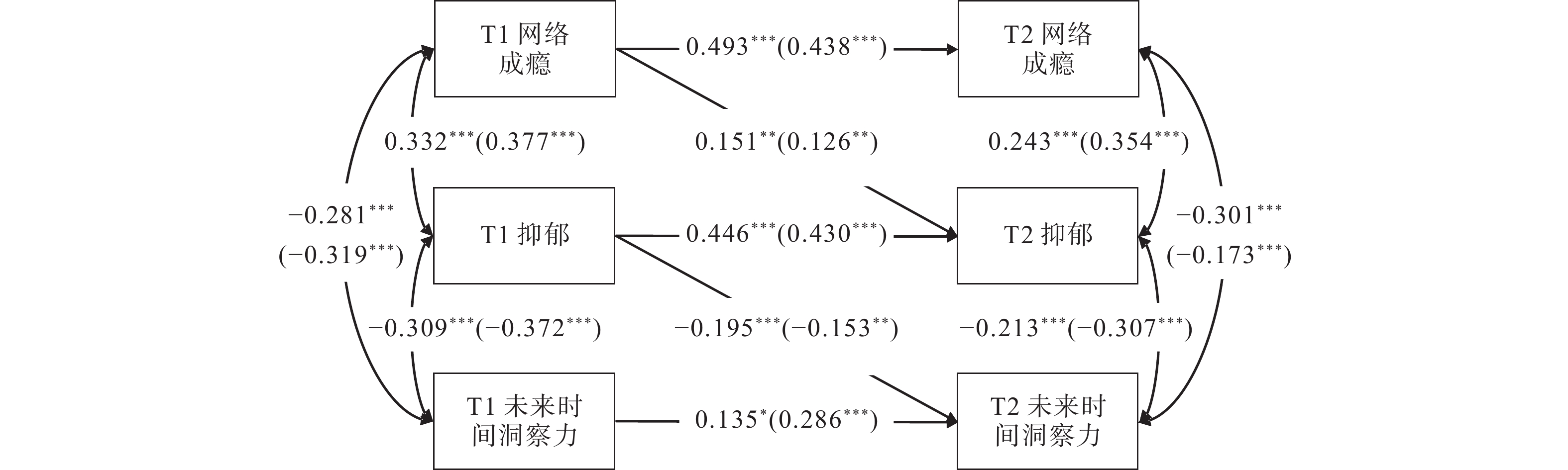
图3 抑郁中介模型的性别差异 注:括号外为男生群体在该模型中的路径系数,括号内为女生群体在该模型中的路径系数;图中所呈现系数均为标准化系数;图中未呈现不显著路径。
|
董奇, 林崇德. (2011). 中国儿童青少年心理发育标准化测验简介. 北京: 科学出版社.
|
|
|
杜刚, 吕厚超. 青少年未来时间洞察力和学业成绩的关系: 时间管理倾向的中介作用. 心理科学, 2017, 40 (1): 96- 102.
|
|
|
李明霞, 郑昊, 刘正奎. 农村青少年抑郁症状和亲社会行为的关系. 中国学校卫生, 2019, 40 (11): 1665- 1668.
|
|
|
李小保, 吴澜婷, 吕厚超. 自尊、未来时间洞察力与学业成就之间的关系: 一项追踪研究. 应用心理学, 2021, 27 (3): 244- 251,261.
DOI |
|
|
庞雪, 吕厚超, 华生旭. 延迟满足: 基于未来时间洞察力的自我调节. 心理科学, 2014, 37 (1): 78- 82.
|
|
|
Abramson, L. Y., Seligman, M. E., & Teasdale, J. D. Learned helplessness in humans: Critique and reformulation. Journal of Abnormal Psychology, 1978, 87 (1): 49- 74.
DOI |
|
|
Agbaria, Q. Internet addiction and aggression: The mediating roles of self-control and positive affect. International Journal of Mental Health and Addiction, 2021, 19 (4): 1227- 1242.
DOI |
|
|
Akin, A., & İskender, M. Internet addiction and depression, anxiety and stress. International Online Journal of Educational Sciences, 2011, 3 (1): 138- 148.
|
|
|
Andresen, E. M., Malmgren, J. A., Carter, W. B., & Patrick, D. L. Screening for depression in well older adults: Evaluation of a short form of the CES-D. American Journal of Preventive Medicine, 1994, 10 (2): 77- 84.
DOI |
|
|
Baird, H. M., Webb, T. L., Sirois, F. M., & Gibson-Miller, J. Understanding the effects of time perspective: A meta-analysis testing a self-regulatory framework. Psychological Bulletin, 2021, 147 (3): 233- 267.
DOI |
|
|
Baker, T. B., Piper, M. E., McCarthy, D. E., Majeskie, M. R., & Fiore, M. C. Addiction motivation reformulated: An affective processing model of negative reinforcement. Psychological Review, 2004, 111 (1): 33- 51.
DOI |
|
|
Borisenkov, M. F., Popov, S. V., Smirnov, V. V., Gubin, D. G., Petrov, I. M., Vasilkova, T. N., .. Symaniuk, E. E. (2022). Association between food addiction and time perspective during COVID-19 isolation. Eating and Weight Disorders-Studies on Anorexia, Bulimia and Obesity, 27(5), 1585–1591.
|
|
|
Carstensen, L. L. The influence of a sense of time on human development. Science, 2006, 312 (5782): 1913- 1915.
DOI |
|
|
Cate, R. A., & John, O. P. Testing models of the structure and development of future time perspective: Maintaining a focus on opportunities in middle age. Psychology and Aging, 2007, 22 (1): 186- 201.
DOI |
|
|
Cerniglia, L., Zoratto, F., Cimino, S., Laviola, G., Ammaniti, M., & Adriani, W. Internet addiction in adolescence: Neurobiological, psychosocial and clinical issues. Neuroscience & Biobehavioral Reviews, 2017, 76, 174- 184.
|
|
|
Cheng, Y. S., Ko, H. C., Sun, C. K., & Yeh, P. Y. The relationship between delay discounting and internet addiction: A systematic review and meta-analysis. Addictive Behaviors, 2021, 114, 106751.
DOI |
|
|
Chi, X. L., Hong, X., & Chen, X. C. Profiles and sociodemographic correlates of internet addiction in early adolescents in southern China. Addictive Behaviors, 2020, 106, 106385.
DOI |
|
|
Choung, Y., Chatterjee, S., & Pak, T. Y. Depression and financial planning horizon. Journal of Behavioral and Experimental Economics, 2022, 98, 101877.
DOI |
|
|
Christakis, D. A. Internet addiction: A 21st century epidemic. BMC Medicine, 2010, 8 (1): 61.
DOI |
|
|
de Leval, N. Scales of depression, ill-being and the quality of life—is there any difference? An assay in taxonomy. Quality of Life Research, 1995, 4 (3): 259- 269.
DOI |
|
|
Figner, B., Knoch, D., Johnson, E. J., Krosch, A. R., Lisanby, S. H., Fehr, E., & Weber, E. U. Lateral prefrontal cortex and self-control in intertemporal choice. Nature Neuroscience, 2010, 13 (5): 538- 539.
DOI |
|
|
Giordano, A. L., Schmit, M. K., & McCall, J. Exploring adolescent social media and internet gaming addiction: The role of emotion regulation. Journal of Addictions & Offender Counseling, 2023, 44 (1): 69- 80.
|
|
|
Goldstein, R. Z., & Volkow, N. D. Dysfunction of the prefrontal cortex in addiction: Neuroimaging findings and clinical implications. Nature Reviews Neuroscience, 2011, 12 (11): 652- 669.
DOI |
|
|
Hayat, A. A., Kojuri, J., & Amini, M. Academic procrastination of medical students: The role of internet addiction. Journal of Advances in Medical Education & Professionalism, 2020, 8 (2): 83- 89.
|
|
|
Karacic, S., & Oreskovic, S. Internet addiction through the phase of adolescence: A questionnaire study. JMIR Mental Health, 2017, 4 (2): e11.
DOI |
|
|
Kardefelt-Winther, D. A conceptual and methodological critique of internet addiction research: Towards a model of compensatory internet use. Computers in Human Behavior, 2014, 31, 351- 354.
DOI |
|
|
Kato, T. A., Shinfuku, N., & Tateno, M. Internet society, internet addiction, and pathological social withdrawal: The chicken and egg dilemma for internet addiction and hikikomori. Current Opinion in Psychiatry, 2020, 33 (3): 264- 270.
DOI |
|
|
Ko, C. H., Yen, J. Y., Yen, C. F., Chen, C. S., & Chen, C. C. The association between internet addiction and psychiatric disorder: A review of the literature. European Psychiatry, 2012, 27 (1): 1- 8.
DOI |
|
|
Kooij, D. T. A. M., Kanfer, R., Betts, M., & Rudolph, C. W. Future time perspective: A systematic review and meta-analysis. Journal of Applied Psychology, 2018, 103 (8): 867- 893.
DOI |
|
|
Lee, Z. W. Y., Cheung, C. M. K., & Chan, T. K. H. (2014). Explaining the development of the excessive use of massively multiplayer online games: A positive-negative reinforcement perspective. In 2014 47th Hawaii International Conference on System Sciences (pp. 668–677). Waikoloa, HI: IEEE.
|
|
|
Li, G. M., Liu, J., Wen, H. Y., & Shen, Q. Y. Changes in depression among adolescents: A multiple-group latent profile transition analysis. Psychology Research and Behavior Management, 2023, 16, 319- 332.
DOI |
|
|
Li, H. X., Guo, Y. F., & Yu, Q. L. Self-control makes the difference: The psychological mechanism of dual processing model on internet addicts’ unusual behavior in intertemporal choice. Computers in Human Behavior, 2019, 101, 95- 103.
DOI |
|
|
Li, X. B., Wang, C., Lyu, H. C., Worrell, F. C., & Mello, Z. R. Psychometric properties of the Chinese version of the Zimbardo Time Perspective Inventory. Current Psychology, 2023, 42, 13547- 13559.
DOI |
|
|
Liang, L. C., Zhou, D., Yuan, C. Y., Shao, A. H., & Bian, Y. F. Gender differences in the relationship between internet addiction and depression: A cross-lagged study in Chinese adolescents. Computers in Human Behavior, 2016, 63, 463- 470.
DOI |
|
|
Little, T. D., Preacher, K. J., Selig, J. P., & Card, N. A. New developments in latent variable panel analyses of longitudinal data. International Journal of Behavioral Development, 2007, 31 (4): 357- 365.
DOI |
|
|
Loh, K. K., & Kanai, R. How has the Internet reshaped human cognition. The Neuroscientist, 2016, 22 (5): 506- 520.
DOI |
|
|
Matthes, J., Karsay, K., Schmuck, D., & Stevic, A. “Too much to handle”: Impact of mobile social networking sites on information overload, depressive symptoms, and well-being. Computers in Human Behavior, 2020, 105, 106217.
DOI |
|
|
McClure, S. M., Laibson, D. I., Loewenstein, G., & Cohen, J. D. Separate neural systems value immediate and delayed monetary rewards. Science, 2004, 306 (5695): 503- 507.
DOI |
|
|
Méndez, M. L., Padrón, I., Fumero, A., & Marrero, R. J. Effects of internet and smartphone addiction on cognitive control in adolescents and young adults: A systematic review of fMRI studies. Neuroscience & Biobehavioral Reviews, 2024, 159, 105572.
|
|
|
Moore, M., Höfer, S., McGee, H., & Ring, L. Can the concepts of depression and quality of life be integrated using a time perspective. Health and Quality of Life Outcomes, 2005, 3, 1- 10.
DOI |
|
|
Müller, S. M., Wegmann, E., Stolze, D., & Brand, M. Maximizing social outcomes? Social zapping and fear of missing out mediate the effects of maximization and procrastination on problematic social networks use. Computers in Human Behavior, 2020, 107, 106296.
DOI |
|
|
Obeid, S., Saade, S., Haddad, C., Sacre, H., Khansa, W., Al Hajj, R., ... Hallit, S. Internet addiction among Lebanese adolescents: The role of self-esteem, anger, depression, anxiety, social anxiety and fear, impulsivity, and aggression—A cross-sectional study. The Journal of Nervous and Mental Disease, 2019, 207 (10): 838- 846.
DOI |
|
|
Ostovar, S., Allahyar, N., Aminpoor, H., Moafian, F., Nor, M. B. M., & Griffiths, M. D. Internet addiction and its psychosocial risks (depression, anxiety, stress and loneliness) among Iranian adolescents and young adults: A structural equation model in a cross-sectional study. International Journal of Mental Health and Addiction, 2016, 14 (3): 257- 267.
DOI |
|
|
Ouyang, M. K., Gui, D. N., Cai, X., Yin, Y. L., Mao, X. L., Huang, S. X., ... Wang, P. C. Stressful life events and subjective well-being in vocational school female adolescents: The mediating role of depression and the moderating role of perceived social support. Frontiers in Psychology, 2021, 11, 603511.
DOI |
|
|
Peviani, K. M., Kahn, R. E., Maciejewski, D., Bickel, W. K., Deater-Deckard, K., King-Casas, B., & Kim-Spoon, J. Intergenerational transmission of delay discounting: The mediating role of household chaos. Journal of Adolescence, 2019, 72 (1): 83- 90.
DOI |
|
|
Przepiorka, A., Blachnio, A., & Cudo, A. The role of depression, personality, and future time perspective in internet addiction in adolescents and emerging adults. Psychiatry Research, 2019, 272, 340- 348.
DOI |
|
|
Saadati, H. M., Mirzaei, H., Okhovat, B., & Khodamoradi, F. Association between internet addiction and loneliness across the world: A meta-analysis and systematic review. SSM-Population Health, 2021, 16, 100948.
DOI |
|
|
Saville, B. K., Gisbert, A., Kopp, J., & Telesco, C. Internet addiction and delay discounting in college students. The Psychological Record, 2010, 60 (2): 273- 286.
DOI |
|
|
Seligman, M. E. P. Learned helplessness. Annual Review of Medicine, 1972, 23, 407- 412.
DOI |
|
|
Servidio, R., Bartolo, M. G., Palermiti, A. L., & Costabile, A. Fear of COVID-19, depression, anxiety, and their association with internet addiction disorder in a sample of Italian students. Journal of Affective Disorders Reports, 2021, 4, 100097.
DOI |
|
|
Settanni, M., Marengo, D., Fabris, M. A., & Longobardi, C. The interplay between ADHD symptoms and time perspective in addictive social media use: A study on adolescent Facebook users. Children and Youth Services Review, 2018, 89, 165- 170.
DOI |
|
|
Sokol, Y., & Serper, M. Temporal self appraisal and continuous identity: Associations with depression and hopelessness. Journal of Affective Disorders, 2017, 208, 503- 511.
DOI |
|
|
Solomon, R. L., & Corbit, J. D. An opponent-process theory of motivation: I. Temporal dynamics of affect. Psychological Review, 1974, 81 (2): 119- 145.
DOI |
|
|
Stanković, M., Nešić, M., Čičević, S., & Shi, Z. H. Association of smartphone use with depression, anxiety, stress, sleep quality, and internet addiction. Empirical evidence from a smartphone application. Personality and Individual Differences, 2021, 168, 110342.
DOI |
|
|
Takahashi, M., Adachi, M., Hirota, T., Nishimura, T., Shinkawa, H., Mori, H., & Nakamura, K. Longitudinal association between addictive internet use and depression in early adolescents over a 2-year period: A study using a random intercept cross-lagged model. Computers in Human Behavior, 2022, 132, 107251.
DOI |
|
|
Taylor, S. E., Klein, L. C., Lewis, B. P., Gruenewald, T. L., Gurung, R. A., & Updegraff, J. A. Biobehavioral responses to stress in females: Tend-and-befriend, not fight-or-flight. Psychological Review, 2002, 107 (3): 411- 429.
|
|
|
Tomaszek, K., & Muchacka-Cymerman, A. Examining the relationship between student school burnout and problematic internet use. Educational Sciences: Theory & Practice, 2020, 20 (2): 16- 31.
|
|
|
Vanderlind, W. M., Millgram, Y., Baskin-Sommers, A. R., Clark, M. S., & Joormann, J. Understanding positive emotion deficits in depression: From emotion preferences to emotion regulation. Clinical Psychology Review, 2020, 76, 101826.
DOI |
|
|
Watson, R., Harvey, K., McCabe, C., & Reynolds, S. Understanding anhedonia: A qualitative study exploring loss of interest and pleasure in adolescent depression. European Child & Adolescent Psychiatry, 2020, 29 (2): 489- 499.
|
|
|
Wilson, A. E., & Ross, M. From chump to champ: People’s appraisals of their earlier and present selves. Journal of Personality and Social Psychology, 2001, 80 (4): 572- 584.
DOI |
|
|
Yen, J. Y., Ko, C. H., Yen, C. F., Wu, H. Y., & Yang, M. J. The comorbid psychiatric symptoms of internet addiction: Attention deficit and hyperactivity disorder (ADHD), depression, social phobia, and hostility. Journal of Adolescent Health, 2007, 41 (1): 93- 98.
DOI |
|
|
Young, K. S. Internet addiction: The emergence of a new clinical disorder. CyberPsychology & Behavior, 1998, 1 (3): 237- 244.
|
|
|
Zhao, Y., Qu, D. Y., Chen, S. Y., & Chi, X. L. Network analysis of internet addiction and depression among Chinese college students during the COVID-19 pandemic: A longitudinal study. Computers in Human Behavior, 2023, 138, 107424.
DOI |
|
|
Zimbardo, P. G., & Boyd, J. N. Putting time in perspective: A valid, reliable individual-differences metric. Journal of Personality and Social Psychology, 1999, 77 (6): 1271- 1288.
DOI |
| [1] | 陈竹, 方莉, 李兵兵. 高中生未来时间洞察力与睡眠质量的关系:感知压力与应对方式的多重中介作用[J]. 心理与行为研究, 2026, 24(2): 220-226. |
| [2] | 王伊萌, 程昊. 个人成长主动性与大学生心理健康:智慧的路径分析[J]. 心理与行为研究, 2026, 24(1): 40-50. |
| [3] | 赵纤, 黎志华. 童年累积创伤对成年早期抑郁症状的影响:压力知觉的中介机制[J]. 心理与行为研究, 2026, 24(1): 69-77. |
| [4] | 曾子豪, 何震, 袁言云, 赵纤, 印利红, 谭嵘, 常梦梦, 胡义秋. HPA轴系统多基因−亲子关系交互对青少年抑郁发展影响及性别差异[J]. 心理与行为研究, 2026, 24(1): 78-86. |
| [5] | 刘鑫, 刘衍玲, 曾晋逸. 心理需要挫折与青少年抑郁症状的纵向联系:心理素质的调节作用[J]. 心理与行为研究, 2025, 23(4): 496-503. |
| [6] | 鲍振宙, 刘花, 于明申. 青少年校园欺凌旁观行为与焦虑抑郁症状的关系:基于纵向网络分析法[J]. 心理与行为研究, 2025, 23(4): 504-512. |
| [7] | 王峥, 侯友, 韩洋, 杨邵峰, 陈丽霞. 执行意图编码促进抑郁症患者前瞻记忆的意图执行[J]. 心理与行为研究, 2025, 23(3): 322-329. |
| [8] | 于永菊, 何敏. 高校大学生生命意义感的演变模式及其与抑郁症状的关联[J]. 心理与行为研究, 2025, 23(3): 354-360. |
| [9] | 家晓余, 唐琪晴, 李平, 赵晶, 李伟健. 思其智还是虑其败?教师信念影响高中生日常性学业弹性的中介机制及性别差异[J]. 心理与行为研究, 2025, 23(2): 193-200. |
| [10] | 黎光明, 刘钰. 基于多组增长混合模型的青少年网络成瘾纵向分析[J]. 心理与行为研究, 2025, 23(2): 208-215. |
| [11] | 卢林鑫, 刘在花, 杨爽, 蒋政凯, 党韦强, 谭婧, 班永飞, 孙霁, 蔺秀云. 社会排斥与先天轻度肢残青少年抑郁特征的关联性:基于生成性模型与反映性模型的纵向分析[J]. 心理与行为研究, 2025, 23(2): 216-225. |
| [12] | 胡义秋, 何震, 曾子豪, 赵纤, 常梦梦. 初中生身体监控与抑郁症状的纵向关系研究:主观幸福感的中介作用[J]. 心理与行为研究, 2025, 23(1): 58-65. |
| [13] | 范苗苗, 林怡静, 辛自强, 陈文锋. 同伴依恋对青少年网络成瘾的影响:应对方式和心理韧性的链式中介作用[J]. 心理与行为研究, 2025, 23(1): 91-98. |
| [14] | 吴鹏, 王宇亮, 蒋星雨. 高中生未来职业规划的发展趋势:基于潜变量增长模型的分析[J]. 心理与行为研究, 2025, 23(1): 115-122. |
| [15] | 刘怿涛, 张鸾苏, 周钰琪, 钟欣玥, 攸佳宁. 留守儿童青少年家庭累积风险对网络成瘾的影响:一个有调节的中介模型[J]. 心理与行为研究, 2024, 22(6): 791-798. |
| 阅读次数 | ||||||
|
全文 |
|
|||||
|
摘要 |
|
|||||
