
Studies of Psychology and Behavior ›› 2023, Vol. 21 ›› Issue (1): 79-85.DOI: 10.12139/j.1672-0628.2023.01.012
• ? • Previous Articles Next Articles
Zhijun LIU1,*( ), Jiwei CHEN2
Received:2022-01-27
Online:2023-01-20
Published:2023-01-20
Contact:
Zhijun LIU
刘志军1,*(), 陈继为2
通讯作者:
刘志军
基金资助:CLC Number:
Zhijun LIU, Jiwei CHEN. The Impact of Parental Phubbing on Cyberbullying Perpetration and Victimization Among Adolescents: Chain Mediating Effects of Parent-Child Closeness and Internalizing Problems[J]. Studies of Psychology and Behavior, 2023, 21(1): 79-85.
刘志军, 陈继为. 父母“低头行为”对青少年网络欺负和受欺负的影响:亲子亲密感和内化问题的链式中介作用[J]. 心理与行为研究, 2023, 21(1): 79-85.
Add to citation manager EndNote|Ris|BibTeX
URL: https://psybeh.tjnu.edu.cn/EN/10.12139/j.1672-0628.2023.01.012
| 父母低头行为 | 亲子亲密感 | 内化问题 | 网络欺负 | 网络受欺负 | |
| 男 女 | 23.64±7.6124.36±7.57 | 31.79±8.1531.30±7.98 | 5.87±3.456.63±3.47 | 19.55±4.1719.27±4.01 | 20.66±5.1920.30±4.60 |
| t | −1.49 | 0.96 | −3.42*** | 1.05 | 1.17 |
| 初一(⑦) 初二(⑧) 初三(⑨) | 23.05±7.3625.24±7.9423.49±7.26 | 33.21±7.3530.20±8.0531.28±8.62 | 6.00±3.366.21±3.396.41±3.71 | 19.07±3.6419.77±5.0019.43±3.36 | 19.89±4.0220.92±5.4020.75±5.32 |
| F | 8.21*** | 12.85*** | 1.14 | 2.62 | 4.38*** |
| Scheffe比较 | ⑧>⑦; ⑧>⑨ | ⑦>⑨>⑧ | ⑧>⑦ |
| 父母低头行为 | 亲子亲密感 | 内化问题 | 网络欺负 | 网络受欺负 | |
| 男 女 | 23.64±7.6124.36±7.57 | 31.79±8.1531.30±7.98 | 5.87±3.456.63±3.47 | 19.55±4.1719.27±4.01 | 20.66±5.1920.30±4.60 |
| t | −1.49 | 0.96 | −3.42*** | 1.05 | 1.17 |
| 初一(⑦) 初二(⑧) 初三(⑨) | 23.05±7.3625.24±7.9423.49±7.26 | 33.21±7.3530.20±8.0531.28±8.62 | 6.00±3.366.21±3.396.41±3.71 | 19.07±3.6419.77±5.0019.43±3.36 | 19.89±4.0220.92±5.4020.75±5.32 |
| F | 8.21*** | 12.85*** | 1.14 | 2.62 | 4.38*** |
| Scheffe比较 | ⑧>⑦; ⑧>⑨ | ⑦>⑨>⑧ | ⑧>⑦ |
| 变量 | M | SD | 1 | 2 | 3 | 4 |
| 1.父母低头行为 | 23.95 | 7.59 | ||||
| 2.亲子亲密感 | 31.58 | 8.08 | −0.50*** | |||
| 3.内化问题 | 6.20 | 3.48 | 0.20*** | −0.18*** | ||
| 4.网络欺负 | 19.43 | 4.10 | 0.12*** | −0.19*** | 0.20*** | |
| 5.网络受欺负 | 20.51 | 4.95 | 0.26*** | −0.28*** | 0.29*** | 0.65*** |
| 变量 | M | SD | 1 | 2 | 3 | 4 |
| 1.父母低头行为 | 23.95 | 7.59 | ||||
| 2.亲子亲密感 | 31.58 | 8.08 | −0.50*** | |||
| 3.内化问题 | 6.20 | 3.48 | 0.20*** | −0.18*** | ||
| 4.网络欺负 | 19.43 | 4.10 | 0.12*** | −0.19*** | 0.20*** | |
| 5.网络受欺负 | 20.51 | 4.95 | 0.26*** | −0.28*** | 0.29*** | 0.65*** |
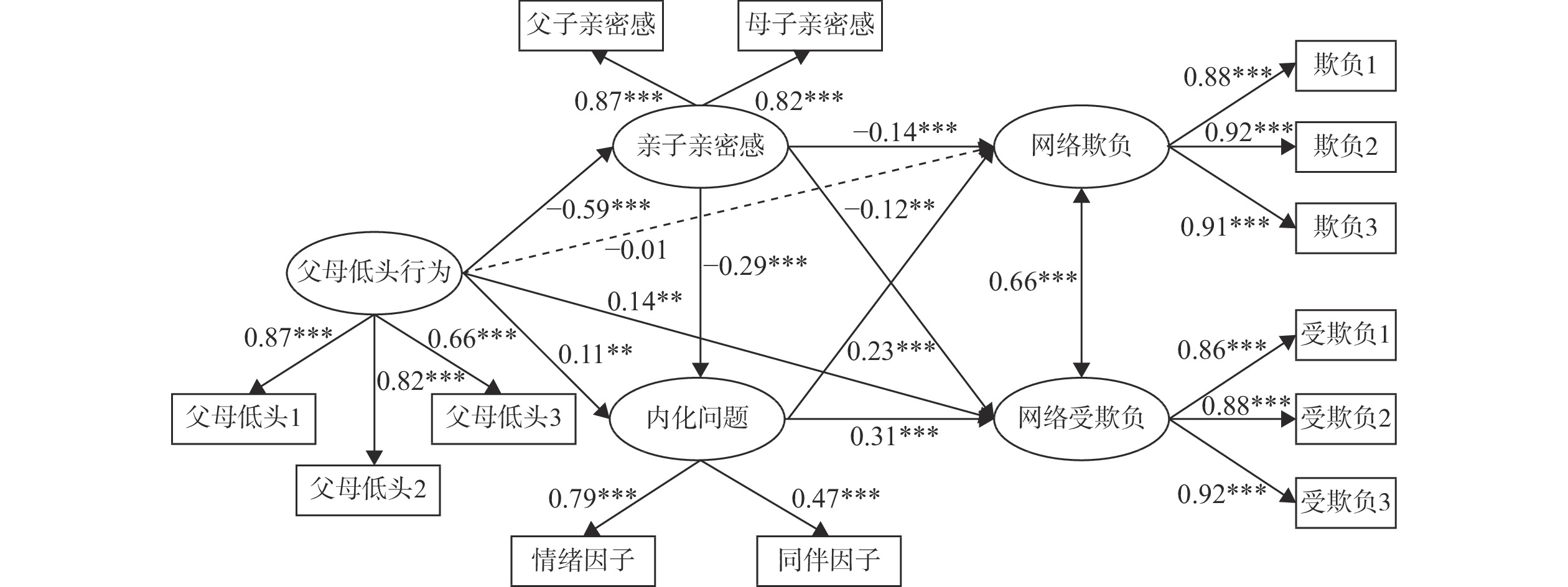
| 路径 | 间接效应值 | Boot CI下限 | Boot CI上限 | 相对中介效应(%) |
| 父母低头行为→亲子亲密感→网络欺负 | 0.08 | 0.03 | 0.13 | 68.97 |
| 父母低头行为→内化问题→网络欺负 | 0.02 | 0.01 | 0.05 | 17.24 |
| 父母低头行为→亲子亲密感→内化问题→网络欺负 | 0.04 | 0.02 | 0.06 | 34.48 |
| 父母低头行为→亲子亲密感→网络受欺负 | 0.07 | 0.02 | 0.13 | 26.92 |
| 父母低头行为→内化问题→网络受欺负 | 0.03 | 0.01 | 0.06 | 11.54 |
| 父母低头行为→亲子亲密感→内化问题→网络受欺负 | 0.05 | 0.03 | 0.08 | 19.23 |
| 路径 | 间接效应值 | Boot CI下限 | Boot CI上限 | 相对中介效应(%) |
| 父母低头行为→亲子亲密感→网络欺负 | 0.08 | 0.03 | 0.13 | 68.97 |
| 父母低头行为→内化问题→网络欺负 | 0.02 | 0.01 | 0.05 | 17.24 |
| 父母低头行为→亲子亲密感→内化问题→网络欺负 | 0.04 | 0.02 | 0.06 | 34.48 |
| 父母低头行为→亲子亲密感→网络受欺负 | 0.07 | 0.02 | 0.13 | 26.92 |
| 父母低头行为→内化问题→网络受欺负 | 0.03 | 0.01 | 0.06 | 11.54 |
| 父母低头行为→亲子亲密感→内化问题→网络受欺负 | 0.05 | 0.03 | 0.08 | 19.23 |
| 丁倩, 张永欣, 周宗奎 父母低头族与中学生手机成瘾的关系: 父母监控的调节作用. 中国特殊教育, 2019, (1): 66- 71. | |
| 杜亚松, 寇建华, 王秀玲, 夏黎明, 邹如皓 长处和困难问卷研究. 心理科学, 2006, 29 (6): 1419- 1421. | |
| 范翠英, 汪倩倩, 褚晓伟, 滕妍君 青少年网络欺负的影响因素、后果及教育对策. 教育研究与实验, 2018, (3): 93- 96. | |
| 姜倩云, 王兴超, 刘兵, 王鹏程, 雷雳 父母低头行为对儿童青少年心理发展的影响. 心理发展与教育, 2021, 37 (1): 137- 145. | |
| 刘俊升, 赵燕 童年中期受欺负与问题行为之关系: 一项两年纵向研究. 心理科学, 2013, 36 (3): 632- 637. | |
| 吕绍平, 邵嵘, 郭本禹, 王云强 家庭环境对青少年攻击性的影响: 暴力电子游戏和攻击规范信念的链式中介效应. 中国特殊教育, 2019, (3): 83- 89. | |
| 田菲菲, 田录梅 亲子关系、朋友关系影响问题行为的3种模型. 心理科学进展, 2014, 22 (6): 968- 976. | |
| 姚力宁, 高金帆, 贺立竞, 高鑫, 崔慧欣, 邢淑芬 睡眠时间参数对学前儿童问题行为的影响: 消极情绪性的调节作用. 心理发展与教育, 2019, 35 (6): 710- 718. | |
| 张珊珊, 鞠睿, 李亚林, 王晓庄 亲子依恋与青少年内外化问题的关系: 心理韧性与同伴影响抵抗的链式中介作用. 心理与行为研究, 2021, 19 (3): 354- 360. | |
| 周含芳, 刘志军, 樊毓美, 李百涵 初中生亲子关系与网络欺负: 孤独感的中介作用. 心理与行为研究, 2019, 17 (6): 787- 794. | |
|
Boniel-Nissim, M., & Sasson, H. Bullying victimization and poor relationships with parents as risk factors of problematic internet use in adolescence. Computers in Human Behavior, 2018, 88, 176- 183.
DOI |
|
|
Buchanan, C. M., Maccoby, E. E., & Dornbusch, S. M. Caught between parents: Adolescents’ experience in divorced homes. Child Development, 1991, 62 (5): 1008- 1029.
DOI |
|
|
Charalampous, K., Demetriou, C., Tricha, L., Ioannou, M., Georgiou, S., Nikiforou, M., & Stavrinides, P. The effect of parental style on bullying and cyber bullying behaviors and the mediating role of peer attachment relationships: A longitudinal study. Journal of Adolescence, 2018, 64 (1): 109- 123.
DOI |
|
|
Coelho, V. A., & Romão, A. M. The relation between social anxiety, social withdrawal and (cyber) bullying roles: A multilevel analysis. Computers in Human Behavior, 2018, 86, 218- 226.
DOI |
|
|
Hesapcioglu, S. T., & Ercan, F. Traditional and cyberbullying co-occurrence and its relationship to psychiatric symptoms. Pediatrics International, 2017, 59 (1): 16- 22.
DOI |
|
|
Hobfoll, S. E. Conservation of resource caravans and engaged settings. Journal of Occupational and Organizational Psychology, 2011, 84 (1): 116- 122.
DOI |
|
|
Kim, S., Colwell, S. R., Kata, A., Boyle, M. H., & Georgiades, K. Cyberbullying victimization and adolescent mental health: Evidence of differential effects by sex and mental health problem type. Journal of Youth and Adolescence, 2018, 47 (3): 661- 672.
DOI |
|
|
Kowalski, R. M., Giumetti, G. W., Schroeder, A. N., & Lattanner, M. R. Bullying in the digital age: A critical review and meta-analysis of cyberbullying research among youth. Psychological Bulletin, 2014, 140 (4): 1073- 1137.
DOI |
|
|
Livingstone, S. Taking risky opportunities in youthful content creation: Teenagers’ use of social networking sites for intimacy, privacy and self-expression. New Media & Society, 2008, 10 (3): 393- 411.
DOI |
|
|
McDaniel, B. T., & Radesky, J. S. Technoference: Parent distraction with technology and associations with child behavior problems. Child Development, 2018, 89 (1): 100- 109.
DOI |
|
|
Radesky, J. S., Kistin, C. J., Zuckerman, B., Nitzberg, K., Gross, J., Kaplan-Sanoff, M., … Silverstein, M. Patterns of mobile device use by caregivers and children during meals in fast food restaurants. Pediatrics, 2014, 133 (4): e843- e849.
DOI |
|
|
Smith, P. K., Mahdavi, J., Carvalho, M., Fisher, S., Russell, S., & Tippett, N. Cyberbullying: Its nature and impact in secondary school pupils. Journal of Child Psychology and Psychiatry, 2008, 49 (4): 376- 385.
DOI |
|
|
Solecki, S. The phubbing phenomenon: The impact on parent-child relationships. Journal of Pediatric Nursing, 2022, 62, 211- 214.
DOI |
|
|
Stockdale, L. A., Coyne, S. M., & Padilla-Walker, L. M. Parent and child technoference and socioemotional behavioral outcomes: A nationally representative study of 10- to 20-year-old adolescents. Computers in Human Behavior, 2018, 88, 219- 226.
DOI |
|
|
Wang, X. C., Gao, L., Yang, J. P., Zhao, F. Q., & Wang, P. C. Parental phubbing and adolescents’ depressive symptoms: Self-esteem and perceived social support as moderators. Journal of Youth and Adolescence, 2020, 49 (2): 427- 437.
DOI |
|
| Wang, X. C., Wang, W., Qiao, Y. R., Gao, L., Yang, J. P., & Wang, P. C. (2022). Parental phubbing and adolescents’ cyberbullying perpetration: A moderated mediation model of moral disengagement and online disinhibition. Journal of Interpersonal Violence, 37(7–8), 5344–5366. | |
|
Wei, H., Ding, H. M., Huang, F., & Zhu, L. Y. Parents’ phubbing and cyberbullying perpetration among adolescents: The mediation of anxiety and the moderation of Zhong-Yong thinking. International Journal of Mental Health and Addiction, 2022, 20 (5): 2609- 2622.
DOI |
|
|
Wu, C. Y., & Lee, T. S. H. Impact of parent-child relationship and sex on trajectories of children internalizing symptoms. Journal of Affective Disorders, 2020, 260, 167- 173.
DOI |
|
|
Xie, X. C., Chen, W., Zhu, X. W., & He, D. Parents’ phubbing increases adolescents’ mobile phone addiction: Roles of parent-child attachment, deviant peers, and gender. Children and Youth Services Review, 2019, 105, 104426.
DOI |
|
|
Zhou, Z. K., Tang, H. Y., Tian, Y., Wei, H., Zhang, F. J., & Morrison, C. M. Cyberbullying and its risk factors among Chinese high school students. School Psychology International, 2013, 34 (6): 630- 647.
DOI |
| Viewed | ||||||
|
Full text |
|
|||||
|
Abstract |
|
|||||
