
心理与行为研究 ›› 2026, Vol. 24 ›› Issue (3): 351-358.DOI: 10.12139/j.1672-0628.2026.03.009
吴泳茵1,2,3, 叶烨3, 曹碧华*,1,3( )
)
收稿日期:2024-07-17
出版日期:2026-05-20
发布日期:2026-05-20
通讯作者:
曹碧华
基金资助:
Yongyin WU1,2,3, Ye YE3, Bihua CAO*,1,3()
Received:2024-07-17
Online:2026-05-20
Published:2026-05-20
Contact:
Bihua CAO
摘要:
由于集中呈现仅聚焦单一条件的估计策略,本研究首次考察儿童在交替呈现数字线估计任务中的策略及认知机制。选取二年级儿童估计不同范围相同长度(0~50、0~100,10 cm)的数字(实验1),以及不同长度相同范围(10 cm、18 cm,0~100)的数字(实验2)。结果发现儿童掌握多种策略,且同时使用内部参照策略和基于条件间比例关系的外部参照策略。另外,呈现方式与实验情境对绝对误差百分比存在交互作用。由于认知资源有限,交替呈现不同范围情境的策略运用表现显著优于集中呈现,不同长度情境的策略运用表现则差于集中呈现。这些结果表明二年级儿童的策略呈现“共存与竞争”模式,为重叠波理论在复杂估计情境的适用性提供了新证据。
中图分类号:
吴泳茵, 叶烨, 曹碧华. 交替呈现下二年级儿童数字线估计的策略[J]. 心理与行为研究, 2026, 24(3): 351-358.
Yongyin WU, Ye YE, Bihua CAO. Strategies in Number Line Estimation Under Alternating Presentation for Second-Grade Children[J]. Studies of Psychology and Behavior, 2026, 24(3): 351-358.
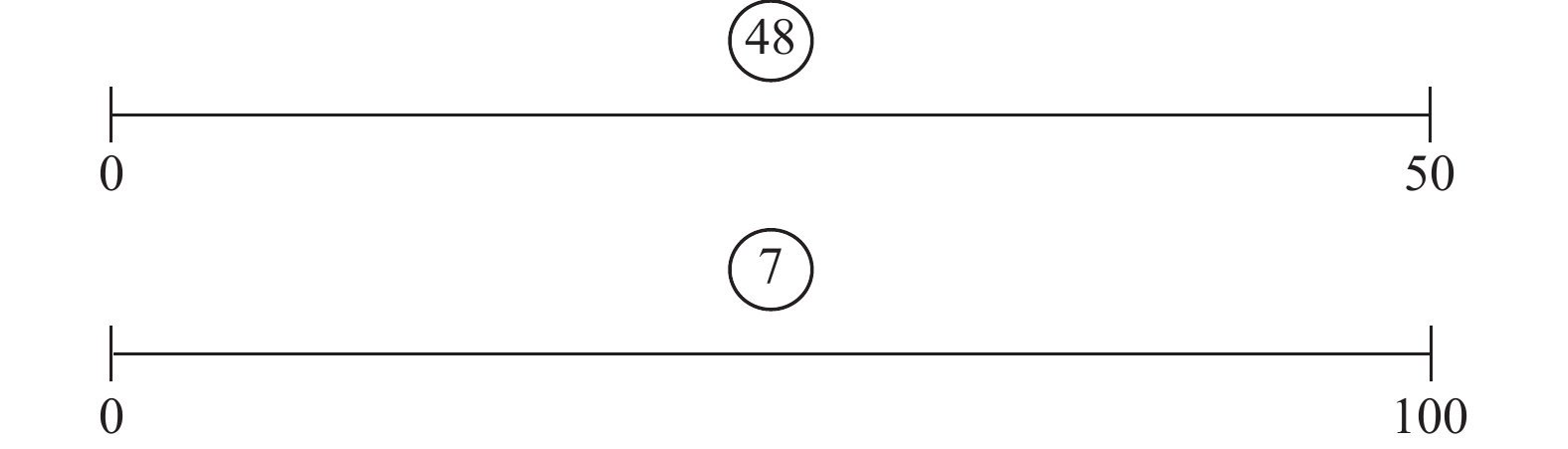
图1 实验1材料示例
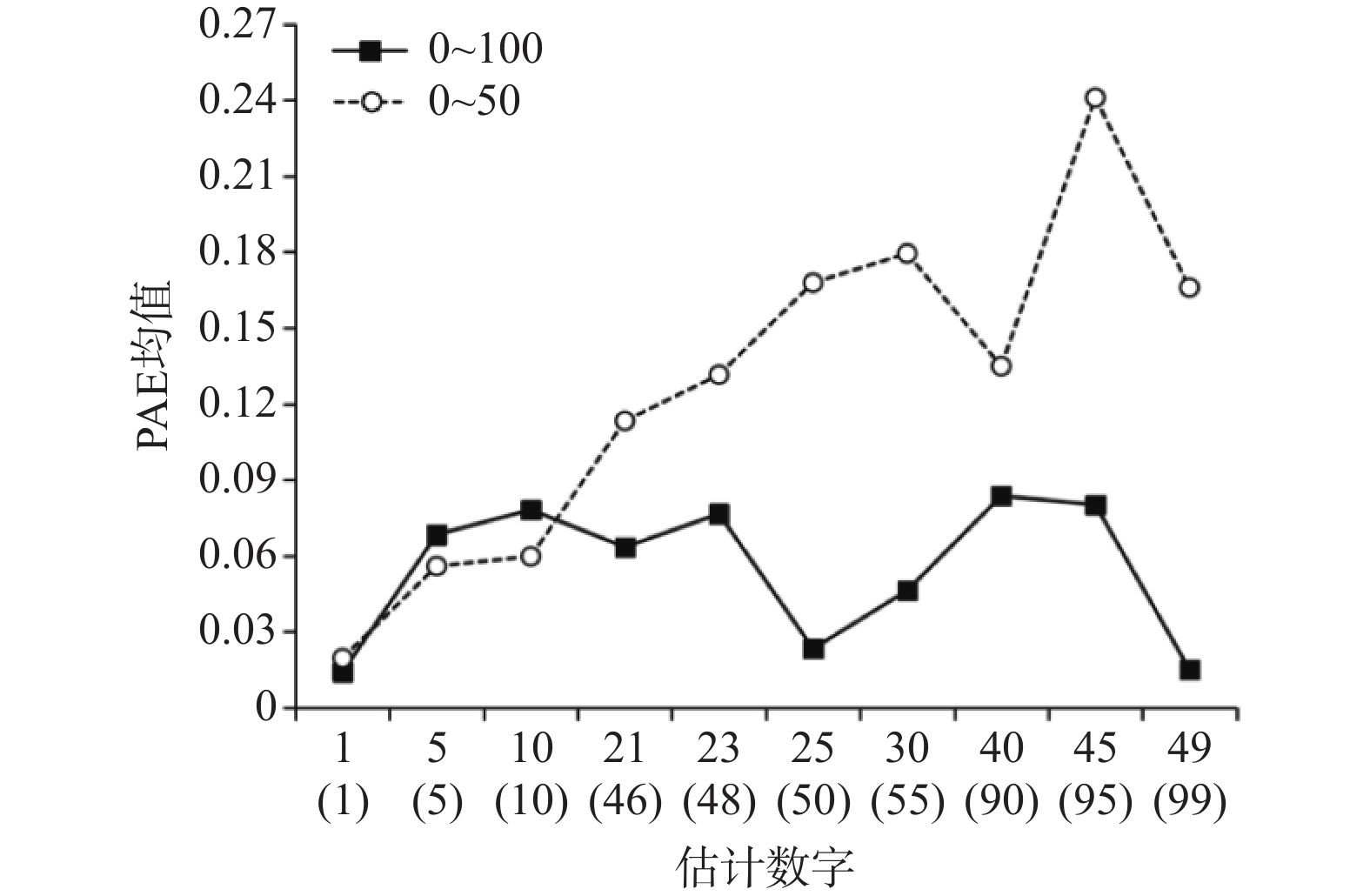
图2 不同范围估计的PAE均值
| 估计数字 | 0~50 | 0~100 | t(df=45) | p |
| 1−1 | 0.35±0.27 | 0.23±0.15 | 3.345 | 0.002 |
| 2−2 | 0.65±0.41 | 0.55±0.31 | 1.804 | 0.078 |
| 3−3 | 0.79±0.39 | 0.79±0.43 | −0.001 | 0.999 |
| 4−4 | 1.27±1.30 | 1.05±0.58 | 1.116 | 0.270 |
| 5−5 | 1.30±1.36 | 1.15±0.54 | 0.678 | 0.501 |
| 6−6 | 1.19±0.57 | 1.24±0.67 | −0.926 | 0.359 |
| 7−7 | 1.76±1.16 | 1.37±0.91 | 1.925 | 0.061 |
| 8−8 | 1.64±0.63 | 1.58±0.82 | 0.642 | 0.524 |
| 9−9 | 1.50±0.68 | 1.52±0.89 | −0.175 | 0.862 |
| 10−10 | 1.94±0.78 | 1.75±0.69 | 2.197 | 0.033 |
表1 两种范围低端数字估计的实际长度比较(cm)
| 估计数字 | 0~50 | 0~100 | t(df=45) | p |
| 1−1 | 0.35±0.27 | 0.23±0.15 | 3.345 | 0.002 |
| 2−2 | 0.65±0.41 | 0.55±0.31 | 1.804 | 0.078 |
| 3−3 | 0.79±0.39 | 0.79±0.43 | −0.001 | 0.999 |
| 4−4 | 1.27±1.30 | 1.05±0.58 | 1.116 | 0.270 |
| 5−5 | 1.30±1.36 | 1.15±0.54 | 0.678 | 0.501 |
| 6−6 | 1.19±0.57 | 1.24±0.67 | −0.926 | 0.359 |
| 7−7 | 1.76±1.16 | 1.37±0.91 | 1.925 | 0.061 |
| 8−8 | 1.64±0.63 | 1.58±0.82 | 0.642 | 0.524 |
| 9−9 | 1.50±0.68 | 1.52±0.89 | −0.175 | 0.862 |
| 10−10 | 1.94±0.78 | 1.75±0.69 | 2.197 | 0.033 |
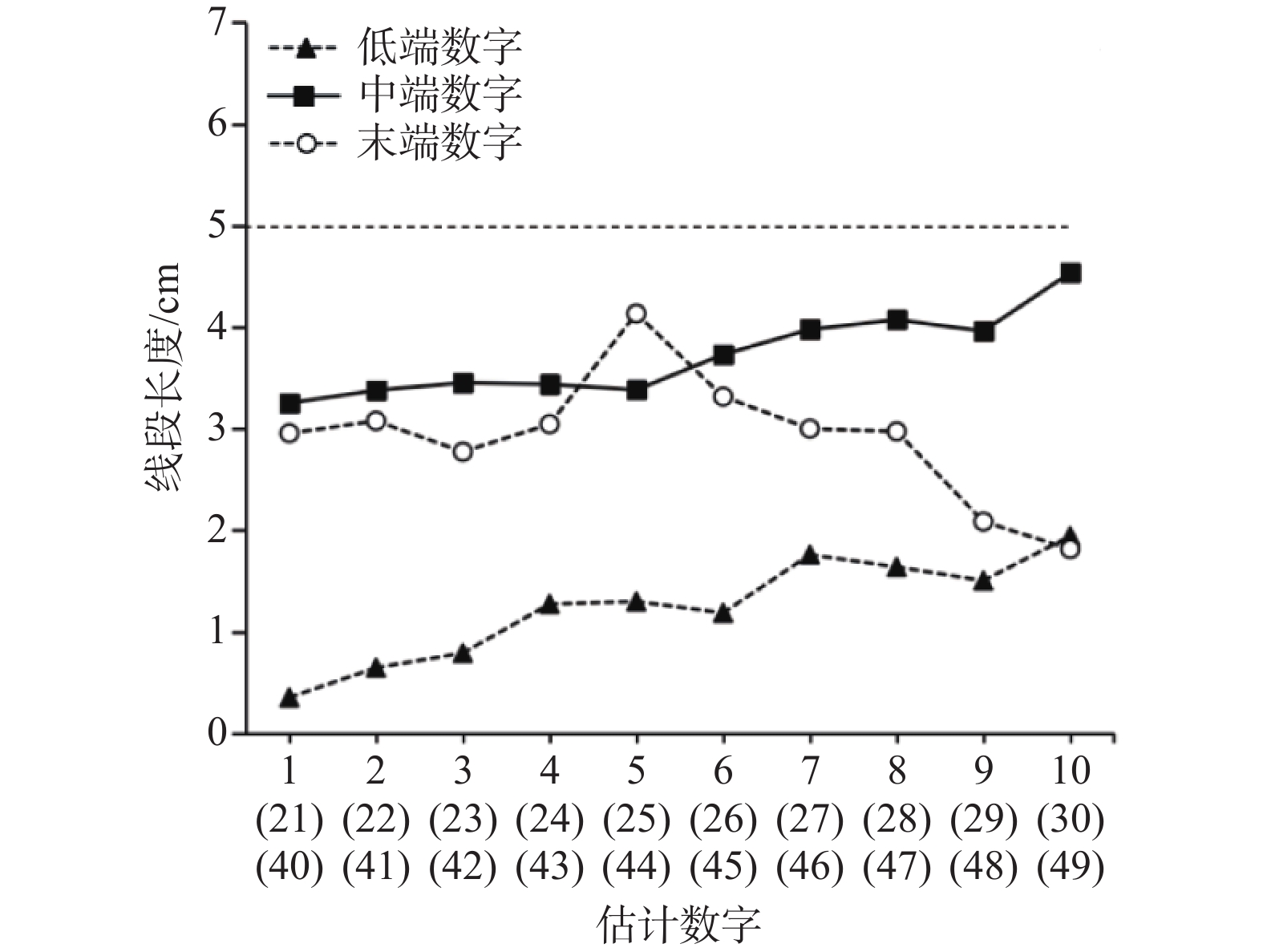
图3 低中端数字实际长度及末端数字标记位置到终点的距离(0~50)
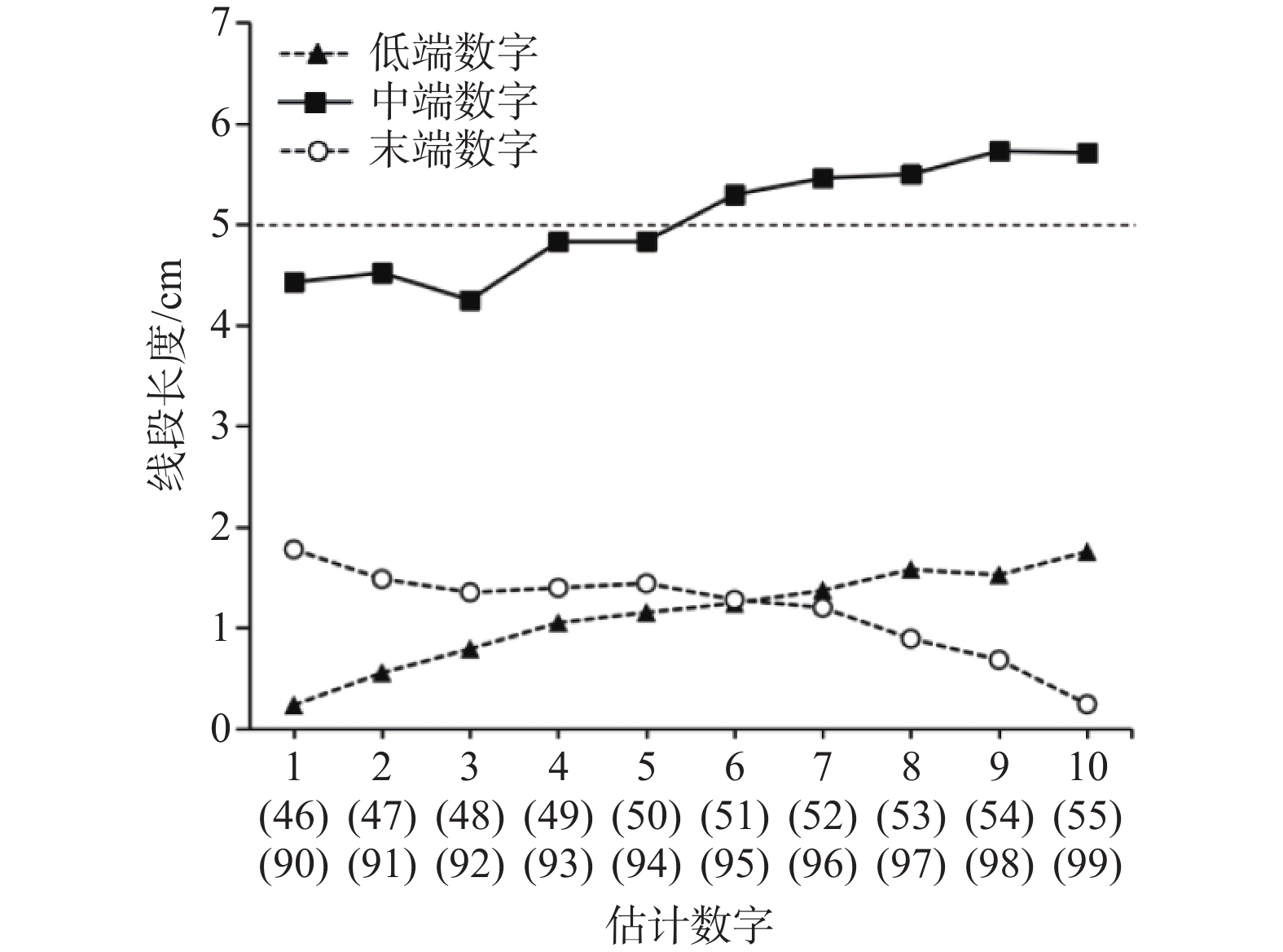
图4 低中端数字实际长度及末端数字标记位置到终点的距离(0~100)
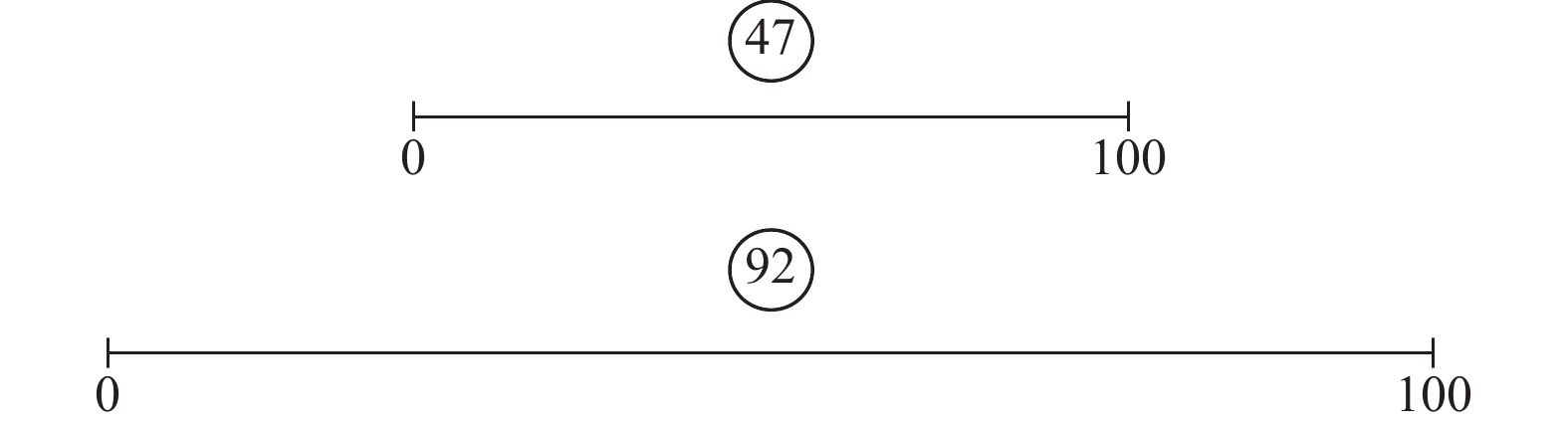
图5 实验2材料示例
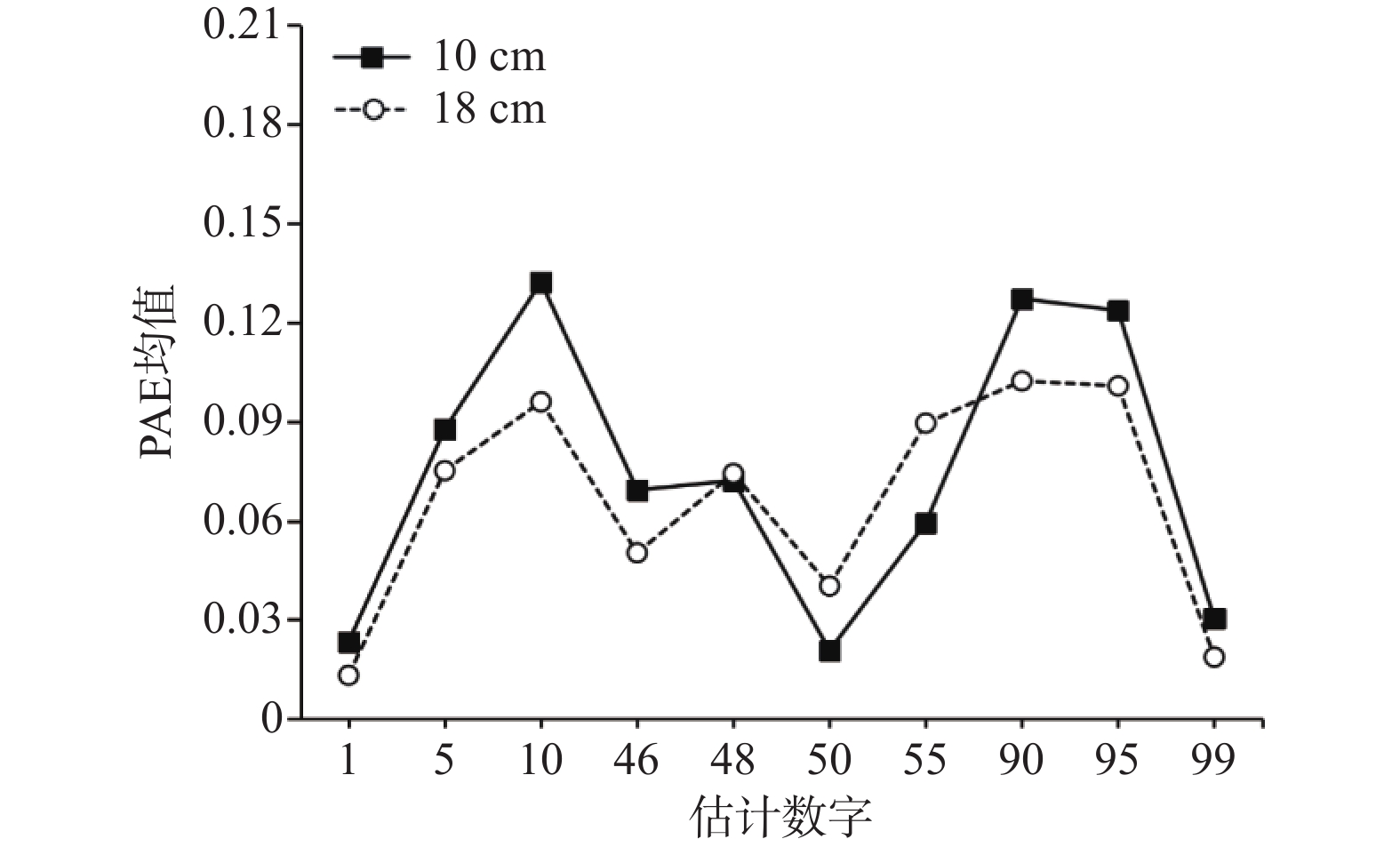
图6 不同长度下估计的PAE均值
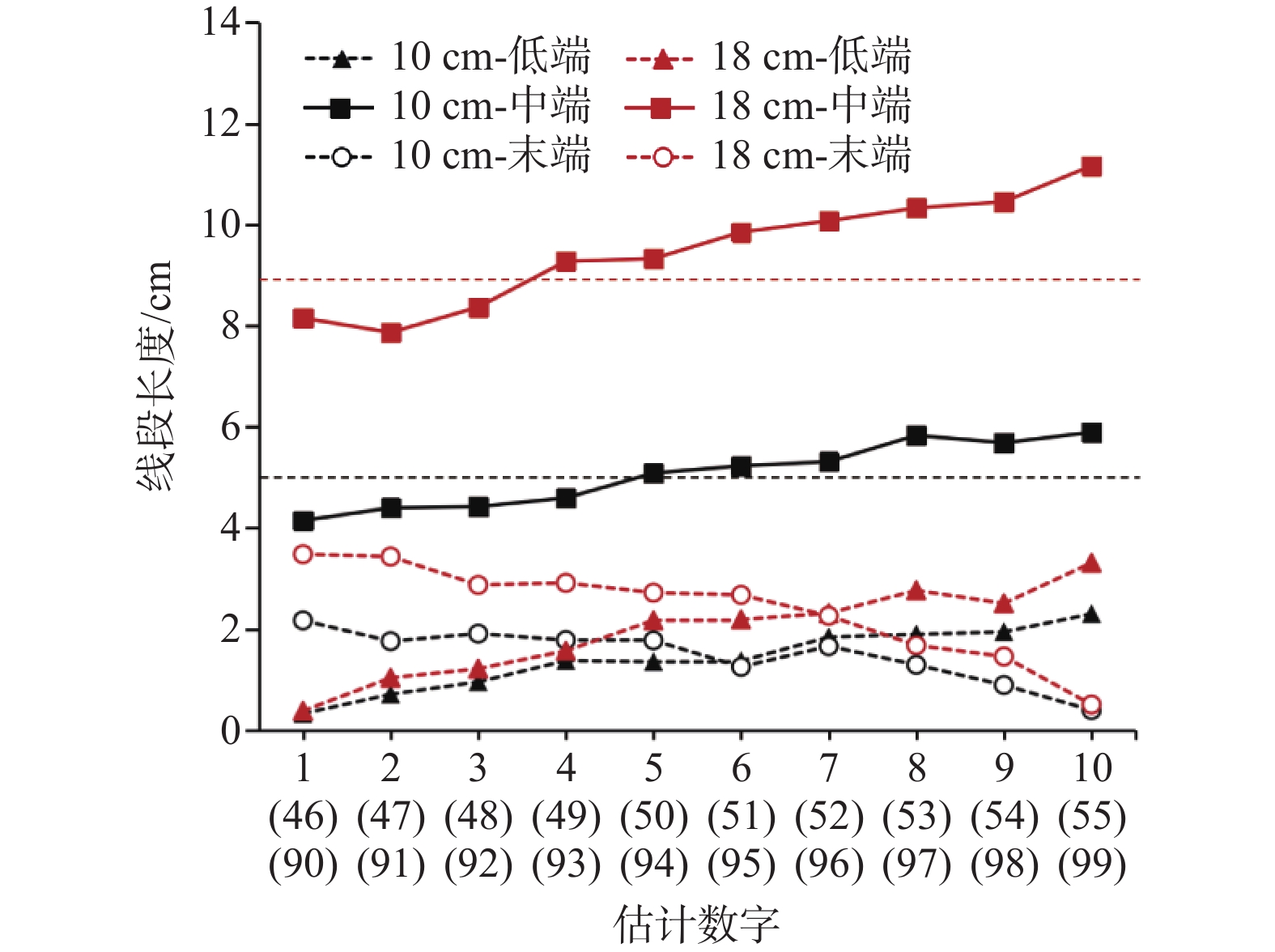
图7 不同长度下低中端数字的实际长度及末端数字标记位置到终点的距离
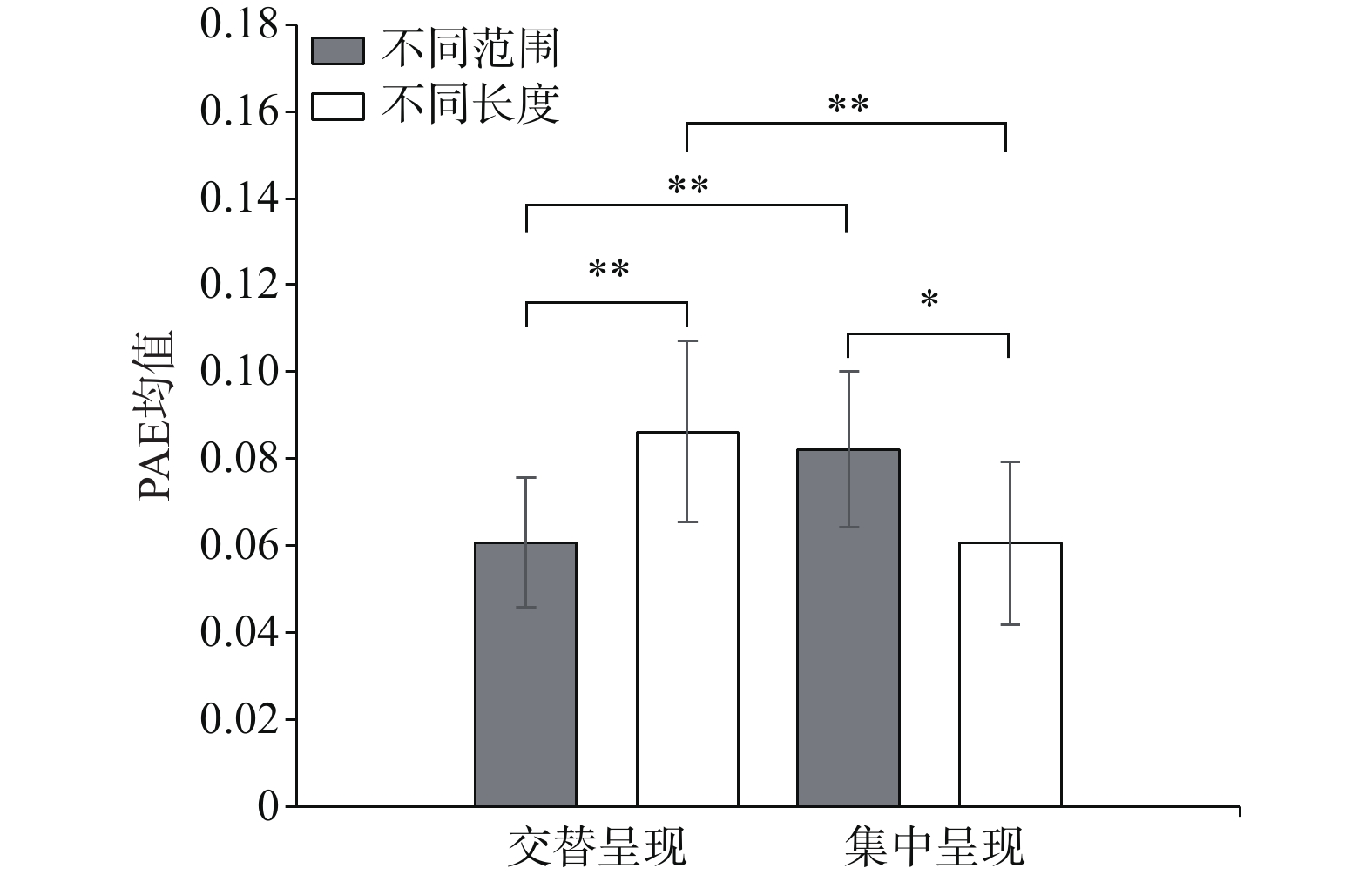
图8 呈现方式与实验情境对0~100(10 cm)PAE的交互作用 注:*p<0.05,**p<0.01。
|
曹碧华, 曾春雲, 廖虹, 李富洪. 心理长度对二年级儿童数字线估计表征的影响. 心理发展与教育, 2021, 37 (2): 190- 198.
DOI |
|
|
曹碧华, 曾婷, 廖虹, 李富洪. 儿童数字线估计: 不同范围和长度情境的影响. 心理技术与应用, 2023, 11 (5): 257- 270.
|
|
|
刘国芳, 辛自强. 数字线估计研究: “模型”背后的策略. 心理研究, 2012, 5 (2): 27- 33.
|
|
|
莫雷, 周广东, 温红博. 儿童数字估计中的心理长度. 心理学报, 2010, 42 (5): 569- 580.
|
|
|
潘伟伟. (2023). 呈现方式的集中性和同时性对不同水平类别学习的影响(硕士学位论文). 浙江师范大学, 金华.
|
|
|
司继伟, 杨佳, 贾国敬, 周超. 中央执行负荷对成人估算策略运用的影响. 心理学报, 2012, 44 (11): 1490- 1500.
|
|
|
孙玉, 卢淳, 司继伟, 王婷婷. 任务呈现方式、任务呈现顺序影响青少年算术策略运用的年龄差异. 心理研究, 2017, 10 (1): 39- 49.
|
|
|
杨伟星, 张堂正, 李红霞, 张佳佳, 司继伟. 数学困难儿童估算策略运用的中央执行负荷效应. 心理学报, 2018, 50 (5): 504- 516.
|
|
|
张帆, 赖颖慧, 陈英和. 儿童数字线表征的发展——心理长度的影响. 心理发展与教育, 2015, 31 (2): 149- 156.
|
|
|
Abel, R., Niedling, L. M., & Hänze, M. Spontaneous inferential processing while reading interleaved expository texts enables learners to discover the underlying regularities. Applied Cognitive Psychology, 2021, 35 (1): 258- 273.
DOI |
|
|
Ashcraft, M. H., & Moore, A. M. Cognitive processes of numerical estimation in children. Journal of Experimental Child Psychology, 2012, 111 (2): 246- 267.
DOI |
|
|
Barth, H. C., & Paladino, A. M. The development of numerical estimation: Evidence against a representational shift. Developmental Science, 2011, 14 (1): 125- 135.
DOI |
|
|
Booth, J. L., & Siegler, R. S. Developmental and individual differences in pure numerical estimation. Developmental Psychology, 2006, 42 (1): 189- 201.
DOI |
|
|
Booth, J. L., & Siegler, R. S. Numerical magnitude representations influence arithmetic learning. Child Development, 2008, 79 (4): 1016- 1031.
DOI |
|
|
Boyer, T. W., Levine, S. C., & Huttenlocher, J. Development of proportional reasoning: Where young children go wrong. Developmental Psychology, 2008, 44 (5): 1478- 1490.
DOI |
|
|
Brunmair, M., & Richter, T. Similarity matters: A meta-analysis of interleaved learning and its moderators. Psychological Bulletin, 2019, 145 (11): 1029- 1052.
DOI |
|
|
Cragg, L., Richardson, S., Hubber, P. J., Keeble, S., & Gilmore, C. When is working memory important for arithmetic? The impact of strategy and age. PLoS One, 2017, 12 (12): e0188693.
DOI |
|
|
Dehaene, S., Izard, V., Spelke, E., & Pica, P. Log or linear? Distinct intuitions of the Number Scale in Western and Amazonian indigene cultures. Science, 2008, 320 (5880): 1217- 1220.
DOI |
|
|
Fazio, L. K., DeWolf, M., & Siegler, R. S. (2016). Strategy use and strategy choice in fraction magnitude comparison. Journal of Experimental Psychology: Learning, Memory, and Cognition, 42(1), 1–16.
|
|
|
Imbo, I., Duverne, S., & Lemaire, P. Working memory, strategy execution, and strategy selection in mental arithmetic. Quarterly Journal of Experimental Psychology, 2007, 60 (9): 1246- 1264.
DOI |
|
|
Kornell, N., & Bjork, R. A. Learning concepts and categories: Is spacing the “enemy of induction”. Psychological Science, 2008, 19 (6): 585- 592.
DOI |
|
|
Lemaire, P., & Lecacheur, M. Age-related changes in children’s executive functions and strategy selection: A study in computational estimation. Cognitive Development, 2011, 26 (3): 282- 294.
DOI |
|
|
Metcalfe, J., & Xu, J. People mind wander more during massed than spaced inductive learning. Journal of Experimental Psychology: Learning Memory and Cognition, 2016, 42 (6): 978- 984.
DOI |
|
|
Peng, P., Namkung, J., Barnes, M., & Sun, C. Y. A meta-analysis of mathematics and working memory: Moderating effects of working memory domain, type of mathematics skill, and sample characteristics. Journal of Educational Psychology, 2016, 108 (4): 455- 473.
DOI |
|
|
Schneider, M., Merz, S., Stricker, J., De Smedt, B., Torbeyns, J., Verschaffel, L., & Luwel, K. Associations of number line estimation with mathematical competence: A meta-analysis. Child Development, 2018, 89 (5): 1467- 1484.
DOI |
|
|
Sella, F., Berteletti, I., Lucangeli, D., & Zorzi, M. Varieties of quantity estimation in children. Developmental Psychology, 2015, 51 (6): 758- 770.
DOI |
|
|
Siegler, R. S. (1996). Emerging minds: The process of change in children’s thinking. Oxford, United Kingdom: Oxford University Press.
|
|
|
Siegler, R. S., & Opfer, J. E. The development of numerical estimation: Evidence for multiple representations of numerical quantity. Psychological Science, 2003, 14 (3): 237- 250.
DOI |
|
|
Slusser, E., & Barth, H. Intuitive proportion judgment in number-line estimation: Converging evidence from multiple tasks. Journal of Experimental Child Psychology, 2017, 162, 181- 198.
DOI |
|
|
Thompson, C. A., & Siegler, R. S. Linear numerical-magnitude representations aid children’s memory for numbers. Psychological Science, 2010, 21 (9): 1274- 1281.
DOI |
|
|
van Der Ven, S. H. G., Boom, J., Kroesbergen, E. H., & Leseman, P. P. M. Microgenetic patterns of children’s multiplication learning: Confirming the overlapping waves model by latent growth modeling. Journal of Experimental Child Psychology, 2012, 113 (1): 1- 19.
DOI |
| [1] | 李玉华, 张宇祺, 韩靖雅, 李泉, 张李斌, 童廷婷, 张碧滢, 冯廷勇. 预期想象训练对小学生学业拖延的改善[J]. 心理与行为研究, 2026, 24(3): 327-334. |
| [2] | 赵海燕, 马燕, 周爱保. 青少年心理复原力的发展趋势及性别的作用:基于动态发展视角[J]. 心理与行为研究, 2026, 24(3): 335-342. |
| [3] | 王蓉蓉, 白荣, 刘霞. 远近端人际侵害对青少年重复性自伤的影响:社会支持的保护作用[J]. 心理与行为研究, 2026, 24(3): 343-350. |
| [4] | 吴琴, 韩宪国, 崔丽莹, 贺雯. 不同效价敬畏促进青少年合作行为:顺应需要和安静自我的作用[J]. 心理与行为研究, 2026, 24(3): 359-366. |
| [5] | 常保瑞, 郭佳宁, 敖月晨. 敬畏提升创造力:认知灵活性和创造自我效能感的链式中介效应[J]. 心理与行为研究, 2026, 24(3): 367-374. |
| [6] | 李祖儿, 侯金芹, 陈祉妍. 严厉管教的代际传递:父母的互倚及子女性别的调节作用[J]. 心理与行为研究, 2024, 22(1): 93-99. |
| [7] | 廖天嗣, 黄妍, 陈晓晨. 祖孙代际接触与青少年对老年人态度的关系:群际焦虑和共情的链式中介作用[J]. 心理与行为研究, 2024, 22(1): 86-92. |
| [8] | 张姝玥, 赵峰, 黄骏青, 彭春花, 王军利. 积极道德情绪对3~5岁幼儿分享行为的影响[J]. 心理与行为研究, 2024, 22(1): 79-85. |
| [9] | 郑柯君, 李妍, 陈欣银, 边玉芳. 青少年早期抑郁症状对父母温暖与社交淡漠关系的中介作用:一项三年追踪研究[J]. 心理与行为研究, 2024, 22(1): 71-78. |
| [10] | 武俐, 郭元祥. 父母自主支持与高中生学习投入:意向性自我调节和学校联结的作用[J]. 心理与行为研究, 2024, 22(1): 64-70. |
| [11] | 赵新宇, 乔晓光, 邢晓沛. 父母自主支持、10~12岁儿童的同伴关系与执行功能的动态互动关系:一个发展级联模型[J]. 心理与行为研究, 2024, 22(1): 55-63. |
| [12] | 曹贤才, 潘姝玮, 王大华, 白学军. 一般依恋、父母依恋与青少年抑郁和问题行为的关系[J]. 心理与行为研究, 2024, 22(1): 46-54. |
| [13] | 巩彦斌, 杨海波. 体育锻炼与大学生智能手机成瘾的关系:创新行为和心理健康的链式中介作用[J]. 心理与行为研究, 2023, 21(6): 770-775. |
| [14] | 占萍萍, 古静静, 王金良. 父母教养方式类型与青少年网络成瘾的关系:认知情绪调节策略的中介作用[J]. 心理与行为研究, 2023, 21(6): 776-783. |
| [15] | 刘仁洁, 夏凌翔, 赵永萍. 大学生网络欺凌受害潜在类别的发展特点及性别因素的作用[J]. 心理与行为研究, 2023, 21(6): 784-791. |
| 阅读次数 | ||||||
|
全文 |
|
|||||
|
摘要 |
|
|||||
