
心理与行为研究 ›› 2025, Vol. 23 ›› Issue (4): 487-495.DOI: 10.12139/j.1672-0628.2025.04.008
叶巧玲1,2, 周婷3, 李文4, 黄峥*,1,2( )
)
收稿日期:2023-11-02
出版日期:2025-07-20
发布日期:2025-07-20
通讯作者:
黄峥
基金资助:
Qiaoling YE1,2, Ting ZHOU3, Wen LI4, Zheng HUANG*,1,2()
Received:2023-11-02
Online:2025-07-20
Published:2025-07-20
Contact:
Zheng HUANG
摘要:
为探讨累积家庭风险对日常性学业弹性的纵向预测作用,以及自我效能感的中介作用及同伴支持的调节作用,本研究以523名北京市中学生为被试,进行两次间隔五个月的问卷调查。结果发现:T1累积家庭风险通过T2自我效能感间接预测T2日常性学业弹性的发展,自我效能感对中学生日常性学业弹性的发展具有保护作用。T2同伴支持调节了T1累积家庭风险→T2自我效能感→T2日常性学业弹性的前半段路径,调节效应表明同伴支持的保护性作用在低累积家庭风险的中学生群体中更明显。因此,自我效能感和同伴支持对中学生日常性学业弹性的发展具有重要保护作用,需要注意的是, 在累积家庭风险越来越严重的情境下,同伴支持对个体的保护作用逐渐减弱。
叶巧玲, 周婷, 李文, 黄峥. 累积家庭风险与中学生日常性学业弹性的纵向关系:自我效能感的中介和同伴支持的调节作用[J]. 心理与行为研究, 2025, 23(4): 487-495.
Qiaoling YE, Ting ZHOU, Wen LI, Zheng HUANG. Longitudinal Relationships of Cumulative Family Risk on Academic Buoyancy of Middle School Students: The Mediating Role of Self-Efficacy and The Moderating Role of Peer Support[J]. Studies of Psychology and Behavior, 2025, 23(4): 487-495.

图1 假设模型
| M | SD | 1 | 2 | 3 | 4 | 5 | 6 | 7 | |
| 1.T1累积家庭风险 | 1.56 | 1.48 | |||||||
| 2.T2累积家庭风险 | 1.66 | 1.58 | 0.63*** | ||||||
| 3.T1自我效能感 | 2.89 | 0.70 | −0.38*** | −0.28*** | |||||
| 4.T2自我效能感 | 2.87 | 0.71 | −0.25*** | −0.38*** | 0.40*** | ||||
| 5.T1日常性学业弹性 | 3.91 | 0.86 | −0.39*** | −0.28*** | 0.65*** | 0.30*** | |||
| 6.T2日常性学业弹性 | 3.89 | 0.93 | −0.24*** | −0.36*** | 0.27*** | 0.54*** | 0.34*** | ||
| 7.T1同伴支持 | 4.31 | 0.85 | −0.35*** | −0.26*** | 0.45*** | 0.24*** | 0.49*** | 0.21*** | |
| 8.T2同伴支持 | 4.28 | 0.82 | −0.25*** | −0.36*** | 0.24*** | 0.40*** | 0.25*** | 0.41*** | 0.48*** |
表1 各变量的描述性统计和相关分析
| M | SD | 1 | 2 | 3 | 4 | 5 | 6 | 7 | |
| 1.T1累积家庭风险 | 1.56 | 1.48 | |||||||
| 2.T2累积家庭风险 | 1.66 | 1.58 | 0.63*** | ||||||
| 3.T1自我效能感 | 2.89 | 0.70 | −0.38*** | −0.28*** | |||||
| 4.T2自我效能感 | 2.87 | 0.71 | −0.25*** | −0.38*** | 0.40*** | ||||
| 5.T1日常性学业弹性 | 3.91 | 0.86 | −0.39*** | −0.28*** | 0.65*** | 0.30*** | |||
| 6.T2日常性学业弹性 | 3.89 | 0.93 | −0.24*** | −0.36*** | 0.27*** | 0.54*** | 0.34*** | ||
| 7.T1同伴支持 | 4.31 | 0.85 | −0.35*** | −0.26*** | 0.45*** | 0.24*** | 0.49*** | 0.21*** | |
| 8.T2同伴支持 | 4.28 | 0.82 | −0.25*** | −0.36*** | 0.24*** | 0.40*** | 0.25*** | 0.41*** | 0.48*** |
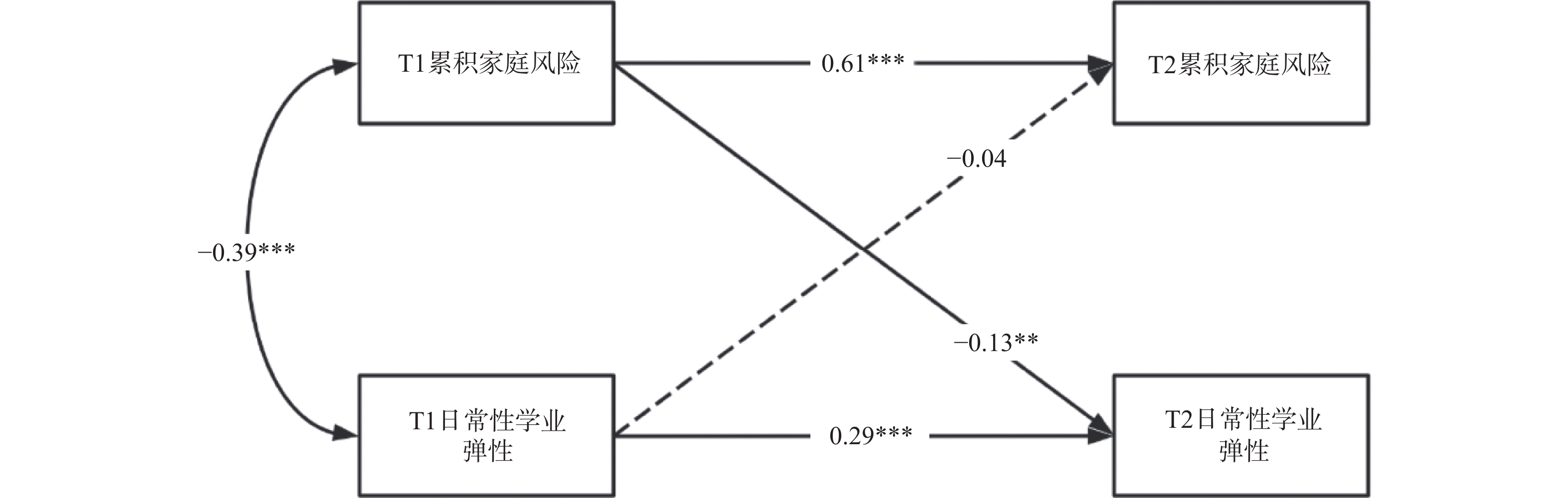
图2 累积家庭风险与日常性学业弹性的交叉滞后模型
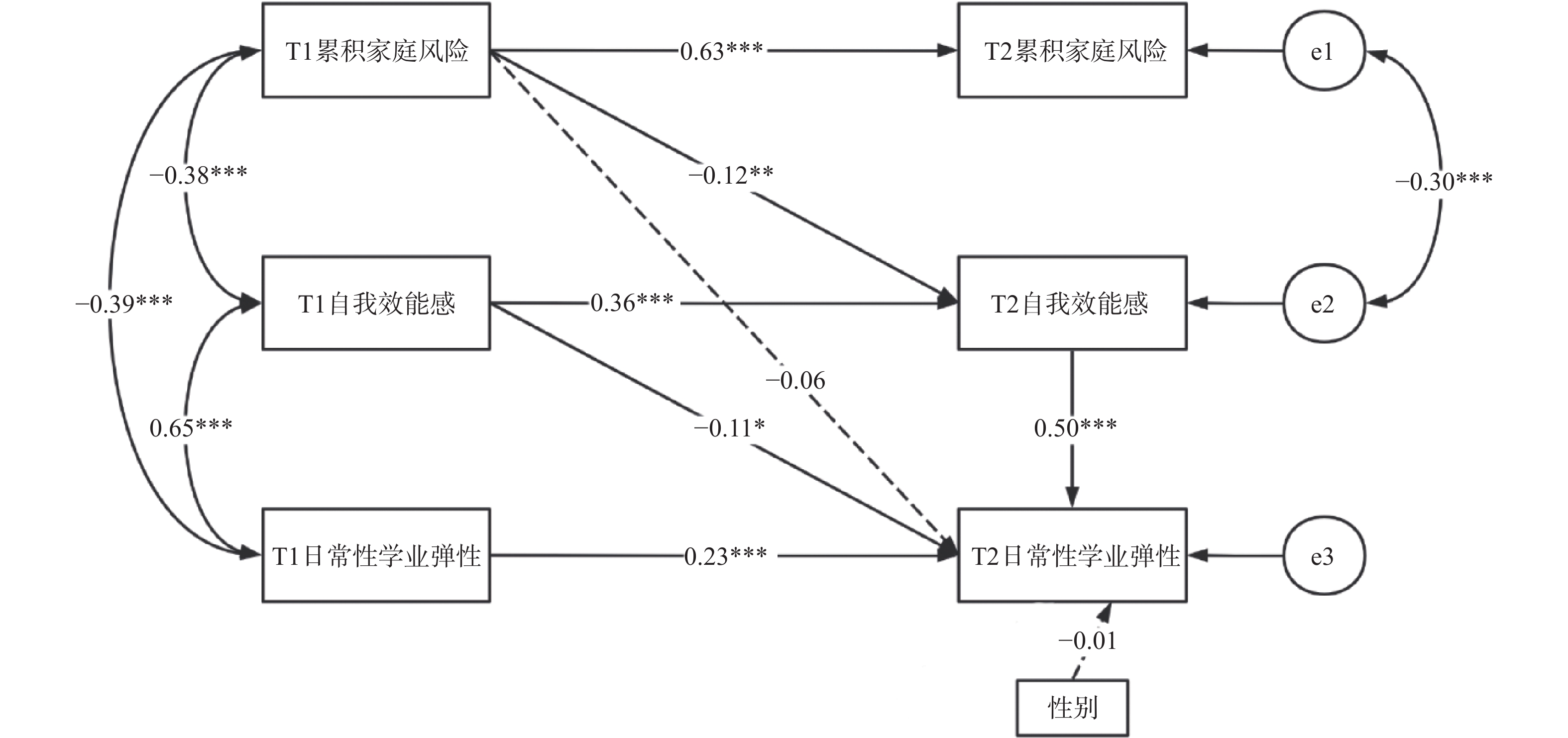
图3 纵向中介模型
| 结果变量 | 预测变量 | R | R2 | F | β | SE | t | LLCI | ULCI |
| T2自我效能感 | T1累积家庭风险 | 0.43 | 0.19 | 40.19*** | −0.17*** | 0.04 | −4.23 | −0.23 | −0.09 |
| T2同伴支持 | 0.37*** | 0.04 | 8.92 | 0.29 | 0.45 | ||||
| T1累积家庭风险×T2同伴支持 | −0.08* | 0.04 | −1.99 | −0.15 | −0.001 | ||||
| T2日常性学业弹性 | T1累积家庭风险 | 0.55 | 0.31 | 115.27*** | −0.11** | 0.04 | −2.87 | −0.18 | −0.03 |
| T2自我效能感 | 0.52*** | 0.04 | 13.72 | 0.44 | 0.59 |
表2 有调节的中介效应分析
| 结果变量 | 预测变量 | R | R2 | F | β | SE | t | LLCI | ULCI |
| T2自我效能感 | T1累积家庭风险 | 0.43 | 0.19 | 40.19*** | −0.17*** | 0.04 | −4.23 | −0.23 | −0.09 |
| T2同伴支持 | 0.37*** | 0.04 | 8.92 | 0.29 | 0.45 | ||||
| T1累积家庭风险×T2同伴支持 | −0.08* | 0.04 | −1.99 | −0.15 | −0.001 | ||||
| T2日常性学业弹性 | T1累积家庭风险 | 0.55 | 0.31 | 115.27*** | −0.11** | 0.04 | −2.87 | −0.18 | −0.03 |
| T2自我效能感 | 0.52*** | 0.04 | 13.72 | 0.44 | 0.59 |
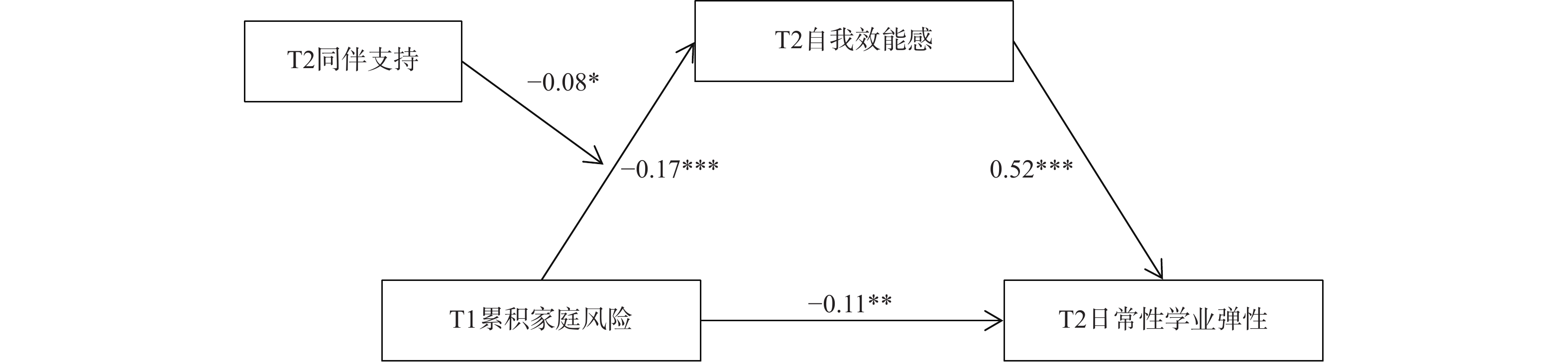
图4 有调节的中介模型
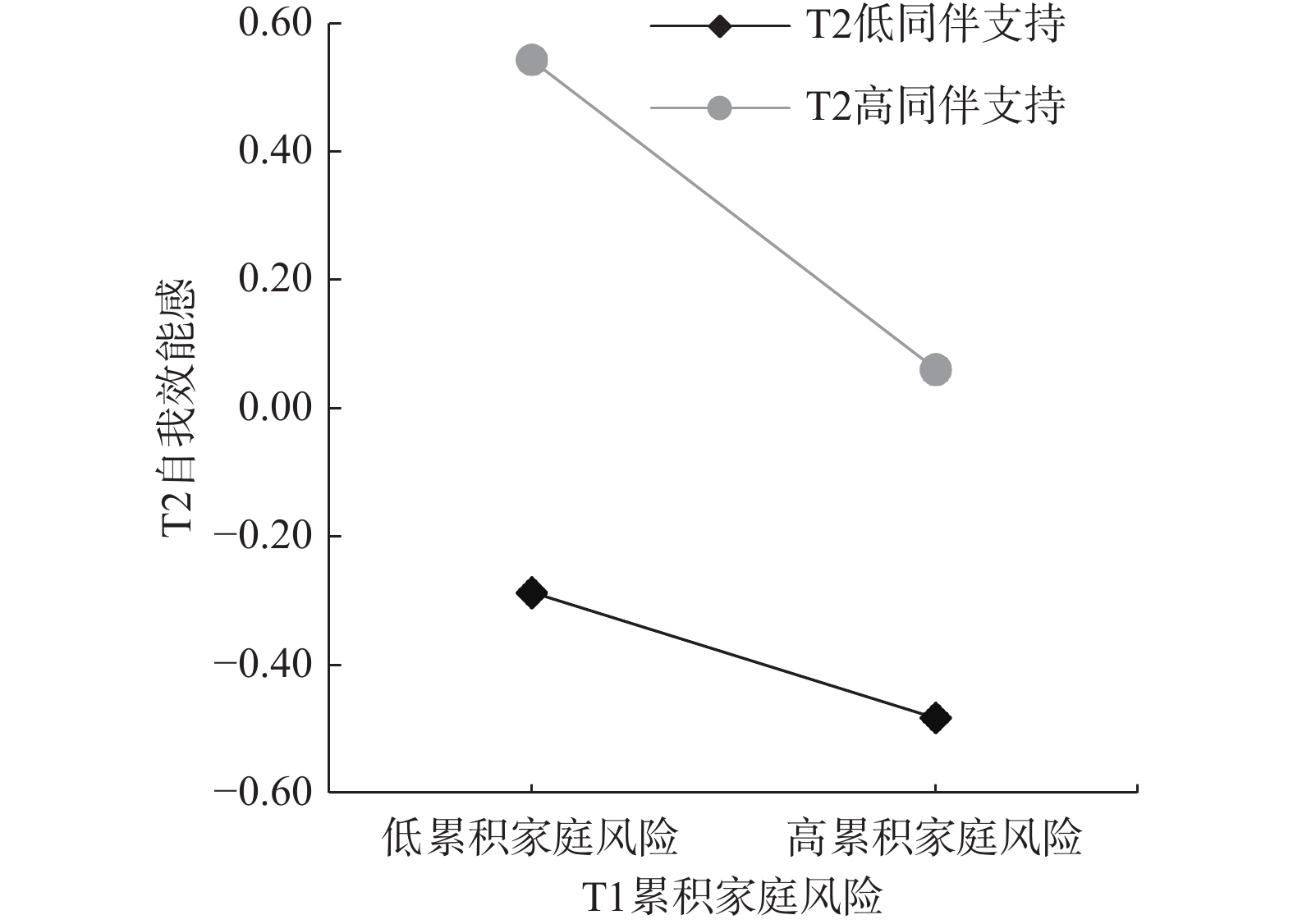
图5 简单斜率图
|
鲍振宙, 李董平, 张卫, 王艳辉, 孙文强, 赵力燕. 累积生态风险与青少年的学业和社交能力: 子女责任感的风险补偿与调节效应. 心理发展与教育, 2014, 30 (5): 482- 495.
|
|
|
董奇, 林崇德. (2011). 中国儿童青少年心理发育标准化测验简介. 北京: 科学出版社.
|
|
|
费立鹏, 沈其杰, 郑延平, 赵靖平, 蒋少艾, 王立伟, 汪向东. “家庭亲密度和适应性量表”和“家庭环境量表”的初步评价——正常家庭与精神分裂症家庭成员对照研究. 中国心理卫生杂志, 1991, 5 (5): 198- 202, 238.
|
|
|
李董平. (2012). 多重生态学风险因素与青少年社会适应风险建模与作用机制研究(博士学位论文). 华南师范大学, 广州.
|
|
|
潘云波. 中职护生领悟社会支持、一般自我效能感与心理韧性的关系. 中国健康心理学杂志, 2018, 26 (12): 1871- 1876.
|
|
|
孙蔚雯. (2009). 高中生日常性学业复原力、学业投入对学习成绩的影响(硕士学位论文). 东北师范大学, 长春.
|
|
|
王才康, 胡中锋, 刘勇. 一般自我效能感量表的信度和效度研究. 应用心理学, 2001, 7 (1): 37- 40.
DOI |
|
|
王建平, 李董平, 张卫. 家庭经济困难与青少年社会适应的关系: 应对效能的补偿、中介和调节效应. 北京师范大学学报(社会科学版), 2010, (4): 22- 32.
|
|
|
王金涛. (2017). 中学生累积生态风险与心理健康的关系: 累积生态风险的作用机制研究(硕士学位论文). 华中师范大学, 武汉.
|
|
|
王琼, 肖桃, 刘慧瀛, 胡伟. 父母拒绝与留守儿童网络成瘾的关系: 一个有调节的中介模型. 心理发展与教育, 2019, 35 (6): 749- 758.
|
|
|
温忠麟, 张雷, 侯杰泰, 刘红云. 中介效应检验程序及其应用. 心理学报, 2004, 36 (5): 614- 620.
|
|
|
席居哲, 左志宏, Wu, W. 心理韧性研究诸进路. 心理科学进展, 2012, 20 (9): 1426- 1447.
|
|
|
熊俊梅, 海曼, 黄飞, 辛亮, 徐颖. 家庭累积风险与青少年心理健康的关系——心理资本的补偿效应和调节效应. 心理发展与教育, 2020, 36 (1): 94- 102.
|
|
|
徐文明, 叶彩霞, 方烨仪. 早期累积家庭风险对青少年内化问题的影响: 弹性双重机制. 心理与行为研究, 2020, 18 (3): 361- 368.
|
|
|
赵凤青, 俞国良. 日常性学业弹性: 日常学业压力下的积极适应机制. 心理科学进展, 2018, 26 (6): 1054- 1062.
|
|
|
周浩, 龙立荣. 共同方法偏差的统计检验与控制方法. 心理科学进展, 2004, 12 (6): 942- 950.
DOI |
|
|
周宗奎, 孙晓军, 刘亚, 周东明. 农村留守儿童心理发展与教育问题. 北京师范大学学报(社会科学版), 2005, (1): 71- 79.
|
|
|
Alexander, K. L., Entwisle, D. R., & Kabbani, N. The dropout process in life course perspective: Early risk factors at home and school. Teachers College Record, 2001, 103 (5): 760- 822.
DOI |
|
|
Bandura, A. (1997). Self-efficacy: The exercise of control. New York: W. H. Freeman.
|
|
|
Bronfenbrenner, U. (2005). Making human beings human: Bioecological perspectives on human development. Thousand Oaks, CA: Sage.
|
|
|
Conley, K. M., & Lehman, B. J. Test anxiety and cardiovascular responses to daily academic stressors. Stress and Health, 2012, 28 (1): 41- 50.
DOI |
|
|
Criss, M. M., Pettit, G. S., Bates, J. E., Dodge, K. A., & Lapp, A. L. Family adversity, positive peer relationships, and children’s externalizing behavior: A longitudinal perspective on risk and resilience. Child Development, 2002, 73 (4): 1220- 1237.
DOI |
|
|
Cutrín, O., Gómez-Fraguela, J. A., & Luengo, M. Á. Peer-group mediation in the relationship between family and juvenile antisocial behavior. European Journal of Psychology Applied to Legal Context, 2015, 7 (2): 59- 65.
DOI |
|
|
Dahal, J., Prasad, P. W. C., Maag, A., Alsadoon, A., & Hoe, L. S. The effect of culture and belief systems on students’ academic buoyancy. Education and Information Technologies, 2018, 23 (4): 1465- 1482.
DOI |
|
|
Evans, G. W., Li, D. P., & Whipple, S. S. Cumulative risk and child development. Psychological Bulletin, 2013, 139 (6): 1342- 1396.
DOI |
|
|
Forehand, R., Biggar, H., & Kotchick, B. A. Cumulative risk across family stressors: Short- and long-term effects for adolescents. Journal of Abnormal Child Psychology, 1998, 26 (2): 119- 128.
DOI |
|
|
Furrer, C. J., Skinner, E. A., & Pitzer, J. R. The influence of teacher and peer relationships on students’ classroom engagement and everyday motivational resilience. National Society for the Study of Education, 2014, 113 (1): 101- 123.
|
|
|
Gerard, J. M., & Buehler, C. Cumulative environmental risk and youth problem behavior. Journal of Marriage and Family, 2004, 66 (3): 702- 720.
DOI |
|
|
Hamill, S. K. Resilience and self-efficacy: The importance of efficacy beliefs and coping mechanisms in resilient adolescents. Colgate University Journal of the Sciences, 2003, 35 (1): 115- 146.
|
|
|
Hobfoll, S. E. Conservation of resources: A new attempt at conceptualizing stress. American Psychologist, 1989, 44 (3): 513- 524.
DOI |
|
|
King, R. B. Sense of relatedness boosts engagement, achievement, and well-being: A latent growth model study. Contemporary Educational Psychology, 2015, 42, 26- 38.
|
|
|
Li, D. P., Zhang, W., Li, X., Li, N. N., & Ye, B. J. Gratitude and suicidal ideation and suicide attempts among Chinese adolescents: Direct, mediated, and moderated effects. Journal of Adolescence, 2012, 35 (1): 55- 66.
DOI |
|
|
Lin, Y. C., & Seo, D. C. Cumulative family risks across income levels predict deterioration of children’s general health during childhood and adolescence. PLoS One, 2017, 12 (5): e0177531.
DOI |
|
|
Luthar, S. S., Cicchetti, D., & Becker, B. The construct of resilience: A critical evaluation and guidelines for future work. Child Development, 2000, 71 (3): 543- 562.
DOI |
|
|
Martin, A. J. Motivation and engagement across the academic life span: A developmental construct validity study of elementary school, high school, and university/college students. Educational and Psychological Measurement, 2009, 69 (5): 794- 824.
DOI |
|
|
Martin, A. J., Colmar, S. H., Davey, L. A., & Marsh, H. W. Longitudinal modelling of academic buoyancy and motivation: Do the 5Cs hold up over time. British Journal of Educational Psychology, 2010, 80 (3): 473- 496.
DOI |
|
|
Martin, A. J., & Marsh, H. W. Academic buoyancy: Towards an understanding of students’ everyday academic resilience. Journal of School Psychology, 2008, 46 (1): 53- 83.
DOI |
|
|
Moore, G. F., Cox, R., Evans, R. E., Hallingberg, B., Hawkins, J., Littlecott, H. J., ... Murphy, S. School, peer and family relationships and adolescent substance use, subjective wellbeing and mental health symptoms in Wales: A cross sectional study. Child Indicators Research, 2018, 11 (6): 1951- 1965.
DOI |
|
|
Parker, P. D., Ciarrochi, J., Heaven, P., Marshall, S., Sahdra, B., & Kiuru, N. Hope, friends, and subjective well-being: A social network approach to peer group contextual effects. Child Development, 2015, 86 (2): 642- 650.
DOI |
|
|
Piquero, A. R., Farrington, D. P., Fontaine, N. M. G., Vincent, G., Coid, J., & Ullrich, S. (2012). Childhood risk, offending trajectories, and psychopathy at age 48 years in the Cambridge Study in Delinquent Development. Psychology, Public Policy, and Law, 18(4), 577–598.
|
|
|
Randolph, K. A., Fraser, M. W., & Orthner, D. K. A strategy for assessing the impact of time varying family risk factors on high school dropout. Journal of Family Issues, 2006, 27 (7): 933- 950.
DOI |
|
|
Sandler, I. Quality and ecology of adversity as common mechanisms of risk and resilience. American Journal of Community Psychology, 2001, 29 (1): 19- 61.
DOI |
|
|
Schwartz, D., Dodge, K. A., Pettit, G. S., & Bates, J. E. Friendship as a moderating factor in the pathway between early harsh home environment and later victimization in the peer group. Developmental Psychology, 2000, 36 (5): 646- 662.
DOI |
|
|
Soheili, M., Kazemi, S., Sohrabi Shekofti, N., & Barzegar, M. A causal model of parents’ personality traits and academic performance with the mediating role of academic buoyancy. Iranian Evolutionary and Educational Psychology Journal, 2020, 2 (3): 200- 207.
DOI |
|
|
Ulu-Yalçınkaya, A., & Demir, A. Loneliness with regard to maternal and paternal acceptance-rejection and sibling relationship quality. Journal of Psychologists and Counsellors in Schools, 2018, 28 (2): 197- 211.
DOI |
|
|
Wentzel, K. R. (2009). Peers and academic functioning at school. In K. H. Rubin, W. M. Bukowski, & B. Laursen (Eds.), Handbook of peer interactions, relationships, and groups (pp. 531–547). New York: Guilford Press.
|
|
|
Yun, S., Hiver, P., & Al-Hoorie, A. H. Academic buoyancy: Exploring learners’ everyday resilience in the language classroom. Studies in Second Language Acquisition, 2018, 40 (4): 805- 830.
DOI |
| [1] | 万娇娇, 李玲, 纪莉莉, 赵俊峰. “见贤思齐”还是“自惭形秽”?学业比较与中学生学习内生动机的纵向追踪研究[J]. 心理与行为研究, 2025, 23(3): 338-345. |
| [2] | 程黎, 陈啸宇, 刘玉娟. 教师支持、同伴支持、心理韧性与情绪智力的关系:超常与常态儿童的比较[J]. 心理与行为研究, 2025, 23(2): 185-192. |
| [3] | 家晓余, 唐琪晴, 李平, 赵晶, 李伟健. 思其智还是虑其败?教师信念影响高中生日常性学业弹性的中介机制及性别差异[J]. 心理与行为研究, 2025, 23(2): 193-200. |
| [4] | 赵黎明, 韩蒙蒙, 贾津津. 中学生社交焦虑与攻击性的关系:言语流畅性的中介作用和情绪智力的调节作用[J]. 心理与行为研究, 2025, 23(2): 265-272. |
| [5] | 杨华耕, 孙芳, 李欢欢. 基于潜在剖面分析的多重家庭因素与中学生网络游戏成瘾的关系:非适应性认知的中介作用[J]. 心理与行为研究, 2024, 22(3): 329-337. |
| [6] | 杨卓, 贾榕, 林瑶, 张宝山, 毕研玲. 完美主义与中学生学业倦怠的纵向关系及自我宽容的中介作用[J]. 心理与行为研究, 2024, 22(3): 363-371. |
| [7] | 邹孟芮, 刘舒野, 程诚, 王友碧. 心理虐待与青少年攻击行为的关系:有调节的中介模型[J]. 心理与行为研究, 2024, 22(2): 282-288. |
| [8] | 占友龙, 江雪芬, 刘长林, 刘旭, 谭千保. 大学生自我担当对道德困境下亲社会行为意愿的影响:自我效能感和预期自豪的链式中介作用[J]. 心理与行为研究, 2023, 21(6): 839-845. |
| [9] | 高斌, 谭莉华, 张丹丹, 黎明新, 蔡艳香. 网络社会支持与高中生网络学习投入:有调节的中介模型[J]. 心理与行为研究, 2023, 21(3): 403-409. |
| [10] | 李嘉欣, 雒瑞帆, 封洪敏, 司继伟. 初中生感知到的同伴支持与数学学习投入—基于变量为中心和个体为中心的分析[J]. 心理与行为研究, 2022, 20(5): 629-636. |
| [11] | 王江洋, 王蒙歌. 拒绝敏感性与留守中学生病理性网络使用:生命意义感和自我污名的中介作用[J]. 心理与行为研究, 2022, 20(2): 219-225. |
| [12] | 姜琨, 兰泽波, 孙晓铜, 丁晓辉, 陶佳雨. 听障大学生社会支持对学业自我效能感的影响:心理韧性的中介作用[J]. 心理与行为研究, 2022, 20(1): 96-100. |
| [13] | 刘拓, 陈雪明, 芦旭蓉, 杨莹. 父母积极教养方式对中学生应对方式的影响:社会支持、自我效能感的中介作用[J]. 心理与行为研究, 2021, 19(4): 507-514. |
| [14] | 高嘉林, 贾天琪, 姜媛, 方平. 父母教育卷入与中学生创造性自我效能感:掌握目标和批判性思维的作用[J]. 心理与行为研究, 2021, 19(4): 515-520. |
| [15] | 孙芳, 李欢欢, 包佳敏, 甄子昂, 宋巍, 蒋松源. 教师支持、同伴支持与中学生心理危机的关系:歧视知觉的中介作用[J]. 心理与行为研究, 2021, 19(2): 209-215. |
| 阅读次数 | ||||||
|
全文 |
|
|||||
|
摘要 |
|
|||||
