
心理与行为研究 ›› 2025, Vol. 23 ›› Issue (4): 472-478.DOI: 10.12139/j.1672-0628.2025.04.006
袁悦, 张航, 陈亚楠, 李巧灵*( )
)
收稿日期:2024-09-20
出版日期:2025-07-20
发布日期:2025-07-20
通讯作者:
李巧灵
基金资助:
Yue YUAN, Hang ZHANG, Yanan CHEN, Qiaoling LI*()
Received:2024-09-20
Online:2025-07-20
Published:2025-07-20
Contact:
Qiaoling LI
摘要:
为揭示3~6岁儿童执行功能子成分与情绪理解之间的关系以及纵向预测作用,本研究采用交叉滞后分析方法,对中部某省会城市某幼儿园108名儿童进行间隔6个月追踪调查。结果表明:(1)儿童执行功能显著正向预测其情绪理解;(2)工作记忆与情绪理解存在显著双向及正向预测作用;(3)认知灵活性显著正向预测情绪理解。因此,提升儿童工作记忆和认知灵活性可作为促进其情绪理解发展的有效路径,未来研究需结合多任务设计进一步验证抑制控制的作用机制。
袁悦, 张航, 陈亚楠, 李巧灵. 3~6岁儿童执行功能子成分与情绪理解的关系:一项交叉滞后分析[J]. 心理与行为研究, 2025, 23(4): 472-478.
Yue YUAN, Hang ZHANG, Yanan CHEN, Qiaoling LI. The Relationship Between Executive Function Subcomponents and Emotion Understanding in 3-6 Years Old Children: A Cross-Lagged Regression Analysis[J]. Studies of Psychology and Behavior, 2025, 23(4): 472-478.
| 1 | 2 | 3 | 4 | 5 | 6 | 7 | 8 | |
| 1.工作记忆T1 | ||||||||
| 2.工作记忆T2 | 0.50** | |||||||
| 3.认知灵活性T1 | 0.40** | 0.45** | ||||||
| 4.认知灵活性T2 | 0.16 | 0.20* | 0.35** | |||||
| 5.抑制控制T1 | 0.26** | 0.29** | 0.43** | 0.21* | ||||
| 6.抑制控制T2 | 0.17 | 0.10 | 0.12 | 0.23* | 0.20* | |||
| 7.情绪理解T1 | 0.42** | 0.46** | 0.43** | 0.13 | 0.42** | 0.08 | ||
| 8.情绪理解T2 | 0.33** | 0.33** | 0.31** | 0.22* | 0.20* | 0.20* | 0.33** | |
| M | 7.25 | 8.40 | 31.10 | 33.37 | 18.43 | 18.95 | 8.18 | 8.83 |
| SD | 2.82 | 2.14 | 5.96 | 3.24 | 2.88 | 1.84 | 1.71 | 1.16 |
表1 执行功能子成分与情绪理解的相关矩阵及描述性统计结果
| 1 | 2 | 3 | 4 | 5 | 6 | 7 | 8 | |
| 1.工作记忆T1 | ||||||||
| 2.工作记忆T2 | 0.50** | |||||||
| 3.认知灵活性T1 | 0.40** | 0.45** | ||||||
| 4.认知灵活性T2 | 0.16 | 0.20* | 0.35** | |||||
| 5.抑制控制T1 | 0.26** | 0.29** | 0.43** | 0.21* | ||||
| 6.抑制控制T2 | 0.17 | 0.10 | 0.12 | 0.23* | 0.20* | |||
| 7.情绪理解T1 | 0.42** | 0.46** | 0.43** | 0.13 | 0.42** | 0.08 | ||
| 8.情绪理解T2 | 0.33** | 0.33** | 0.31** | 0.22* | 0.20* | 0.20* | 0.33** | |
| M | 7.25 | 8.40 | 31.10 | 33.37 | 18.43 | 18.95 | 8.18 | 8.83 |
| SD | 2.82 | 2.14 | 5.96 | 3.24 | 2.88 | 1.84 | 1.71 | 1.16 |
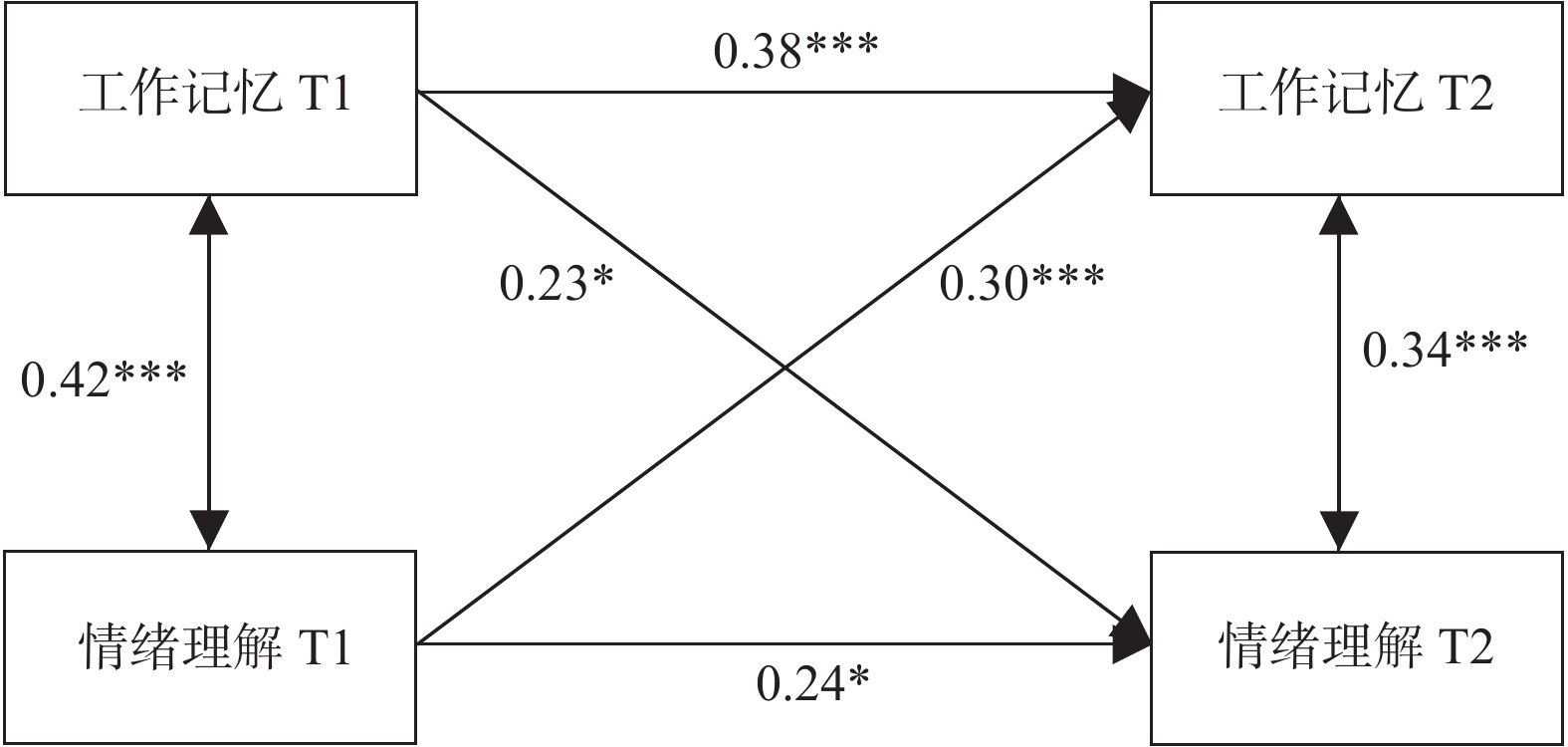
图1 3~6岁儿童工作记忆与情绪理解的交叉滞后分析模型图 注:实线表示路径显著;所有路径系数均为标准化系数,以下同。
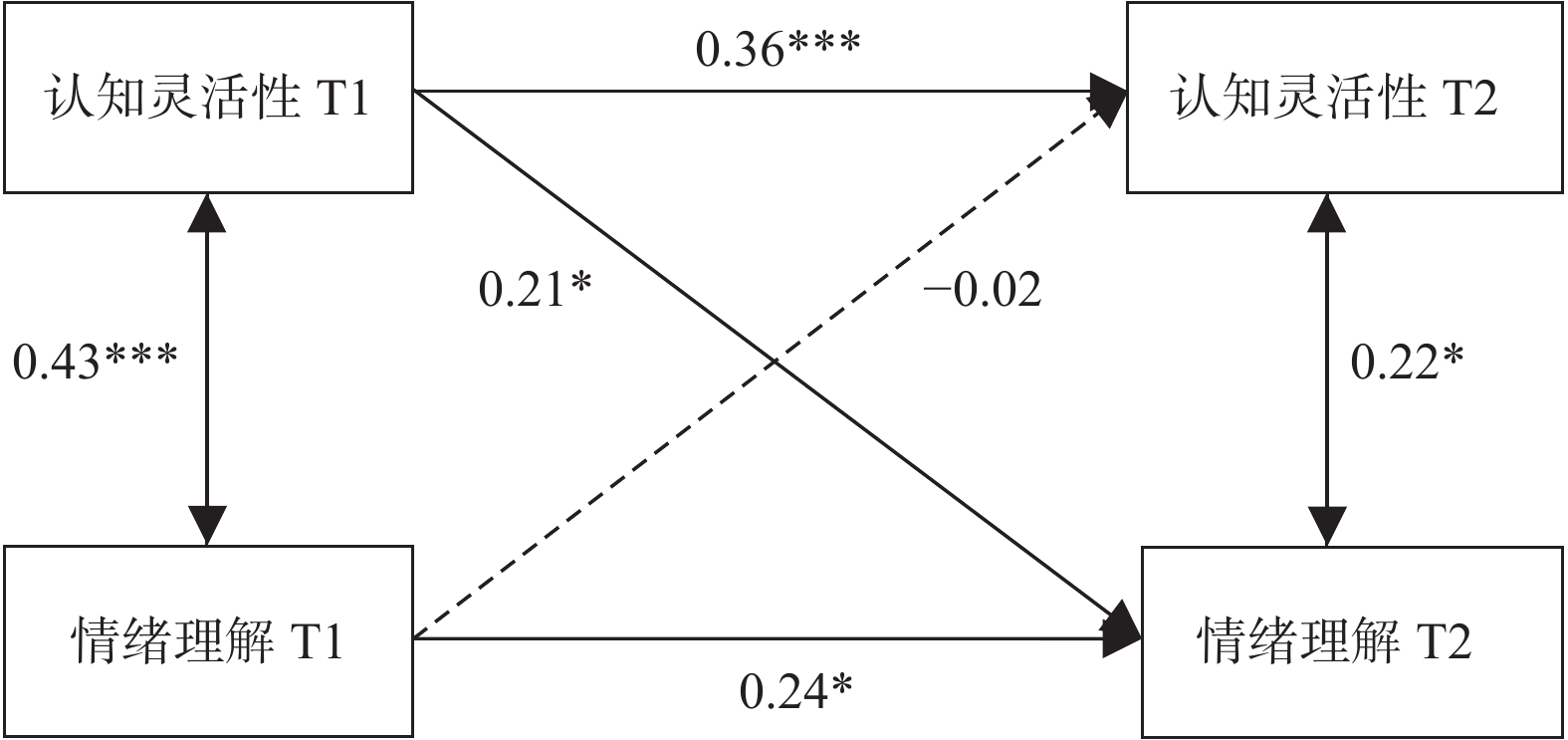
图2 3~6岁儿童认知灵活性与情绪理解的交叉滞后分析模型图
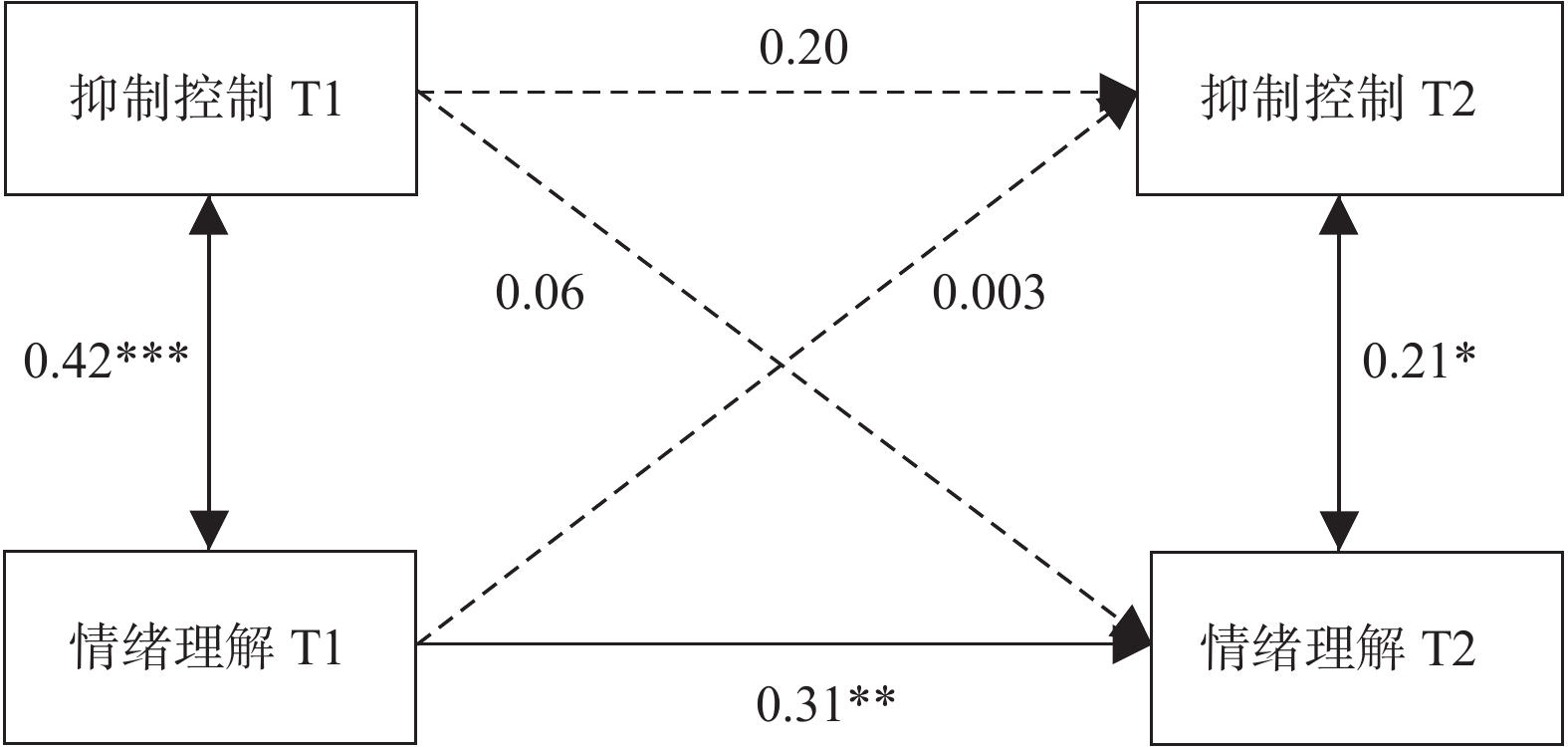
图3 3~6岁儿童抑制控制与情绪理解的交叉滞后分析模型图
|
高伟, 陈圣栋, 陈永强, 何飞澜, 杨洁敏, 袁加锦. 情绪调节策略的使用与转换: 认知灵活性的促进作用. 科学通报, 2021, 66 (19): 2405- 2415.
|
|
|
姜春萍, 周晓林. 情绪的自动加工与控制加工. 心理科学进展, 2004, 12 (5): 688- 692.
DOI |
|
|
李红, 高山, 王乃弋. 执行功能研究方法评述. 心理科学进展, 2004, 12 (5): 693- 705.
DOI |
|
|
李佳, 苏彦捷. 儿童心理理论能力中的情绪理解. 心理科学进展, 2004, 12 (1): 37- 44.
DOI |
|
|
李玲源, 邢小莉, 付永, 李巧灵. 3~6岁儿童动作发展与情绪理解的关系. 中国心理卫生杂志, 2023, 37 (5): 399- 404.
DOI |
|
|
李泉, 冯廷勇. 执行功能影响情绪胜任力的发展: 一项学前儿童的追踪研究. 心理与行为研究, 2022, 20 (6): 805- 812.
DOI |
|
|
李泉, 廖丽莉, 廉彬, 冯廷勇. 执行功能对4岁幼儿情绪胜任力的影响: 语言的中介作用. 心理与行为研究, 2019, 17 (3): 340- 347.
|
|
|
石曜彰, 孟现鑫. 抑制贬值效应: 抑制控制对个体情绪感受的影响. 心理技术与应用, 2021, 9 (9): 567- 576.
|
|
|
田园, 刘富丽, 苏彦捷. 3~6岁儿童对消极情绪的理解: 抑制控制与共情的作用. 心理技术与应用, 2019, 7 (6): 321- 331.
|
|
|
王静梅, 张义宾, 郑晨烨, 卢英俊, 秦金亮. 3~6岁儿童执行功能子成分发展的研究. 心理发展与教育, 2019, 35 (1): 1- 10.
|
|
|
徐琴美, 何洁. 儿童情绪理解发展的研究述评. 心理科学进展, 2006, 14 (2): 223- 228.
DOI |
|
|
颜志强, 苏彦捷. 认知共情和情绪共情的发展差异: 元分析初探. 心理发展与教育, 2021, 37 (1): 1- 9.
|
|
|
张航, 辛钊阳, 陈志梅, 岳亚平, 李巧灵. 3–6岁幼儿移动性动作发展与情绪理解: 工作记忆和抑制控制的链式中介作用. 中国临床心理学杂志, 2023, 31 (2): 413- 416.
|
|
|
张乾一, 文萍. 3岁幼儿抑制和工作记忆的可分离性研究. 心理发展与教育, 2013, 29 (3): 238- 246.
|
|
|
钟建安, 雷虹. 情绪调节对工作记忆的影响. 应用心理学, 2010, 16 (2): 160- 166.
DOI |
|
|
周玫, 周晓林. 儿童执行功能与情绪调节. 心理与行为研究, 2003, 1 (3): 194- 199.
|
|
|
Blankson, A. N., O’Brien, M., Leerkes, E. M., Marcovitch, S., & Calkins, S. D. Differentiating processes of control and understanding in the early development of emotion and cognition. Social Development, 2012, 21 (1): 1- 20.
DOI |
|
|
Case, R. (1992). The mind’s staircase: Exploring the conceptual underpinnings of children’s thought and knowledge. Mahwah, NJ: Lawrence Erlbaum Associates, Inc.
|
|
|
Demetriou, A., Efklides, A., & Platsidou, M. The architecture and dynamics of developing mind: Experiential structuralism as a frame for unifying cognitive developmental theories. Monographs of the Society for Research in Child Development, 1993, 58 (5–6): 1- 205.
DOI |
|
|
Denham, S. A., Bassett, H. H., Way, E., Mincic, M., Zinsser, K., & Graling, K. Preschoolers’ emotion knowledge: Self-regulatory foundations, and predictions of early school success. Cognition & Emotion, 2012, 26 (4): 667- 679.
|
|
|
Diamond, A., Carlson, S. M., & Beck, D. M. Preschool children’s performance in task switching on the dimensional change card sort task: Separating the dimensions aids the ability to switch. Developmental Neuropsychology, 2005, 28 (2): 689- 729.
DOI |
|
|
Fischer, K. W., & Bidell, T. R. (2006). Dynamic development of action and thought. In R. M. Lerner & W. Damon (Eds.), Handbook of child psychology: Theoretical models of human development (6th ed., pp. 313–399). Hoboken, NJ: John Wiley & Sons, Inc.
|
|
|
Gerstadt, C. L., Hong, Y. J., & Diamond, A. The relationship between cognition and action: Performance of children 3$ \frac{1}{2} $- 7 years old on a stroop-like day-night test. Cognition, 1994, 53 (2): 129- 153.
DOI |
|
|
Howard, S. J., Okely, A. D., & Ellis, Y. G. Evaluation of a differentiation model of preschoolers’ executive functions. Frontiers in Psychology, 2015, 6, 285.
|
|
|
Jacques, S., & Zelazo, P. D. The flexible item selection task (FIST): A measure of executive function in preschoolers. Developmental Neuropsychology, 2001, 20 (3): 573- 591.
DOI |
|
|
Martins, E. C., Osório, A., Veríssimo, M., & Martins, C. Emotion understanding in preschool children: The role of executive functions. International Journal of Behavioral Development, 2016, 40 (1): 1- 10.
DOI |
|
|
Miyake, A., Friedman, N. P., Emerson, M. J., Witzki, A. H., Howerter, A., & Wager, T. D. The unity and diversity of executive functions and their contributions to complex “frontal lobe” tasks: A latent variable analysis. Cognitive Psychology, 2000, 41 (1): 49- 100.
DOI |
|
|
Morra, S. Parrella, I., & Camba, R. (2011). The role of working memory in the development of emotion comprehension. British Journal of Developmental Psychology, 29(4), 744–764.
|
|
|
Pons, F., Lawson, J., Harris, P. L., & de Rosnay, M. Individual differences in children’s emotion understanding: Effects of age and language. Scandinavian Journal of Psychology, 2003, 44 (4): 347- 353.
DOI |
|
|
Pruessner, L., Barnow, S., Holt, D. V., Joormann, J., & Schulze, K. A cognitive control framework for understanding emotion regulation flexibility. Emotion, 2020, 20 (1): 21- 29.
DOI |
|
|
Thorndike, R. L., Hagen, E. P., & Sattler, J. M. (1986). The Stanford-Binet Intelligence Scales (4th ed.). Chicago: Riverside.
|
|
|
Wang, X. K., & Feng, T. Y. Bidirectional relationships between emotion understanding and executive functions in young children: A latent change score modeling study. International Journal of Behavioral Development, 2024, 48 (4): 326- 338.
DOI |
|
|
Wang, X. K., Liu, X. Y., & Feng, T. Y. The continuous impact of cognitive flexibility on the development of emotion understanding in children aged 4 and 5 years: A longitudinal study. Journal of Experimental Child Psychology, 2021, 203, 105018.
DOI |
|
|
Wiebe, S. A., Espy, K. A., & Charak, D. Using confirmatory factor analysis to understand executive control in preschool children: I. Latent structure. Developmental Psychology, 2008, 44 (2): 575- 587.
DOI |
|
|
Wiebe, S. A., Sheffield, T., Nelson, J. M., Clark, C. A. C., Chevalier, N., & Espy, K. A. The structure of executive function in 3-year-olds. Journal of Experimental Child Psychology, 2011, 108 (3): 436- 452.
DOI |
|
|
Willoughby, M. T., Wirth, R. J., Blair, C. B., & Family Life Project Investigators. Executive function in early childhood: Longitudinal measurement invariance and developmental change. Psychological Assessment, 2012, 24 (2): 418- 431.
DOI |
|
|
Yan, Z. Q., Hong, S., Liu, F. L., & Su, Y. J. A meta-analysis of the relationship between empathy and executive function. PsyCh Journal, 2020, 9 (1): 34- 43.
DOI |
| [1] | 王丹云, 王玉龙, 唐卓. 青少年运动习惯与自尊、心理韧性的动态关系:基于交叉滞后与随机截距交叉滞后模型的分析[J]. 心理与行为研究, 2026, 24(2): 178-186. |
| [2] | 张野, 刘致宏, 赵丽云. 青少年网络社会排斥、敌意归因偏向与网络偏差行为的关系:一项纵向研究[J]. 心理与行为研究, 2026, 24(1): 60-68. |
| [3] | 杨昕珠, 王腾飞, 郑晓龙. 青少年社会情感能力与学业倦怠的双向预测作用:一项交叉滞后研究[J]. 心理与行为研究, 2025, 23(6): 789-797. |
| [4] | 刘鑫, 刘衍玲, 曾晋逸. 心理需要挫折与青少年抑郁症状的纵向联系:心理素质的调节作用[J]. 心理与行为研究, 2025, 23(4): 496-503. |
| [5] | 万娇娇, 李玲, 纪莉莉, 赵俊峰. “见贤思齐”还是“自惭形秽”?学业比较与中学生学习内生动机的纵向追踪研究[J]. 心理与行为研究, 2025, 23(3): 338-345. |
| [6] | 于永菊, 何敏. 高校大学生生命意义感的演变模式及其与抑郁症状的关联[J]. 心理与行为研究, 2025, 23(3): 354-360. |
| [7] | 卢林鑫, 刘在花, 杨爽, 蒋政凯, 党韦强, 谭婧, 班永飞, 孙霁, 蔺秀云. 社会排斥与先天轻度肢残青少年抑郁特征的关联性:基于生成性模型与反映性模型的纵向分析[J]. 心理与行为研究, 2025, 23(2): 216-225. |
| [8] | 姚雨佳, 林慧慧, 徐舵. 青少年特质焦虑与情绪调节灵活性、痛苦忍受性之间的关系:一项交叉滞后分析[J]. 心理与行为研究, 2024, 22(6): 761-768. |
| [9] | 张野, 刘致宏, 申婷, 赵雨露. 父母心理控制、校园排斥与初中生内化问题的动态关系:交叉滞后研究[J]. 心理与行为研究, 2024, 22(5): 658-665. |
| [10] | 但菲, 马岳毅, 丛龙昊. 3~6岁幼儿情绪理解与社会善念的关系:一个有调节的中介模型[J]. 心理与行为研究, 2024, 22(5): 666-672. |
| [11] | 徐慧艳, 王小英. 3~6岁儿童同胞关系的异质性及其影响因素:基于潜在剖面分析[J]. 心理与行为研究, 2024, 22(3): 346-353. |
| [12] | 黄林辉, 陈圆圆, 朱键军, 张卫. 青春前期消极同伴关系与冲动性:三次重复测量的交叉滞后面板模型[J]. 心理与行为研究, 2024, 22(3): 354-362. |
| [13] | 唐楚涵, 邢淑芬, 李玉华. 母亲基于儿童的价值及其侵入性教养与学前儿童执行功能的关系:儿童性别的调节作用[J]. 心理与行为研究, 2024, 22(2): 243-250. |
| [14] | 邹孟芮, 刘舒野, 程诚, 王友碧. 心理虐待与青少年攻击行为的关系:有调节的中介模型[J]. 心理与行为研究, 2024, 22(2): 282-288. |
| [15] | 赵新宇, 乔晓光, 邢晓沛. 父母自主支持、10~12岁儿童的同伴关系与执行功能的动态互动关系:一个发展级联模型[J]. 心理与行为研究, 2024, 22(1): 55-63. |
| 阅读次数 | ||||||
|
全文 |
|
|||||
|
摘要 |
|
|||||
