
心理与行为研究 ›› 2024, Vol. 22 ›› Issue (4): 494-500.DOI: 10.12139/j.1672-0628.2024.04.009
严晨毓1, 徐琴美*,1,2( ), 刘涛3, 成梦婷2, 马洒2, 葛雨箐1
收稿日期:2024-04-22
出版日期:2024-07-20
发布日期:2024-07-20
通讯作者:
徐琴美
基金资助:
Chenyu YAN1, Qinmei XU*,1,2(), Tao LIU3, Mengting CHENG2, Sa MA2, Yuqing GE1
Received:2024-04-22
Online:2024-07-20
Published:2024-07-20
Contact:
Qinmei XU
摘要:
婴儿能否感知到音乐的情绪?以往研究混淆了婴儿对音乐声学特征和情绪特征的加工。本研究采用预期违背范式,观察了10~20个月婴儿听音乐(听觉)后是否形成对表情(视觉)的情绪预期。研究者给婴儿播放快乐或悲伤的音乐后,呈现与音乐情绪一致或不一致的成人表情图片,使用眼动仪记录婴儿对表情图片的注视时长和瞳孔反应。结果发现,在表情与音乐情绪不一致的条件下,婴儿的注视时长更长,可能说明不一致的情况违背了婴儿的预期;在表情与音乐情绪一致的条件下,婴儿的瞳孔扩张程度更大,可能表明音乐和表情能够唤起婴儿相似的情感反应。结果表明,10~20个月的婴儿已经能够感知快乐和悲伤的音乐情绪,并形成情绪预期,用于后续的表情加工。
严晨毓, 徐琴美, 刘涛, 成梦婷, 马洒, 葛雨箐. 婴儿能否感知音乐情绪?来自预期违背范式的证据[J]. 心理与行为研究, 2024, 22(4): 494-500.
Chenyu YAN, Qinmei XU, Tao LIU, Mengting CHENG, Sa MA, Yuqing GE. Infant Perception of Emotions from Music: Evidence from Violation-of-Expectation Paradigm[J]. Studies of Psychology and Behavior, 2024, 22(4): 494-500.
| 序号 | 专辑名称 | 曲目 | 快乐程度评分 | 悲伤程度评分 |
| 1 | Shallow Grave | 6 | 7.33 | 1.00 |
| 3 | The Rainmaker | 3 | 7.17 | 1.00 |
| 6 | The Rainmaker | 5 | 7.00 | 1.00 |
| 36 | Running Scared | 15 | 1.17 | 7.00 |
| 32 | The English Patient | 18 | 1.17 | 7.50 |
| 31 | The Four Feathers | 10 | 1.00 | 7.67 |
表1 音乐材料基本信息及其情绪评分
| 序号 | 专辑名称 | 曲目 | 快乐程度评分 | 悲伤程度评分 |
| 1 | Shallow Grave | 6 | 7.33 | 1.00 |
| 3 | The Rainmaker | 3 | 7.17 | 1.00 |
| 6 | The Rainmaker | 5 | 7.00 | 1.00 |
| 36 | Running Scared | 15 | 1.17 | 7.00 |
| 32 | The English Patient | 18 | 1.17 | 7.50 |
| 31 | The Four Feathers | 10 | 1.00 | 7.67 |
| 图片编号 | 性别 | 类型 | 认同度 | 强度 |
| HF61 | 女 | 愉快 | 100.00 | 7.30 |
| HF8 | 女 | 愉快 | 100.00 | 7.01 |
| HF15 | 女 | 愉快 | 100.00 | 6.92 |
| SAF16 | 女 | 悲伤 | 97.98 | 6.79 |
| SAF36 | 女 | 悲伤 | 97.98 | 5.88 |
| SAF15 | 女 | 悲伤 | 96.97 | 5.75 |
表2 表情材料基本信息及其情绪评分
| 图片编号 | 性别 | 类型 | 认同度 | 强度 |
| HF61 | 女 | 愉快 | 100.00 | 7.30 |
| HF8 | 女 | 愉快 | 100.00 | 7.01 |
| HF15 | 女 | 愉快 | 100.00 | 6.92 |
| SAF16 | 女 | 悲伤 | 97.98 | 6.79 |
| SAF36 | 女 | 悲伤 | 97.98 | 5.88 |
| SAF15 | 女 | 悲伤 | 96.97 | 5.75 |

图1 实验流程图
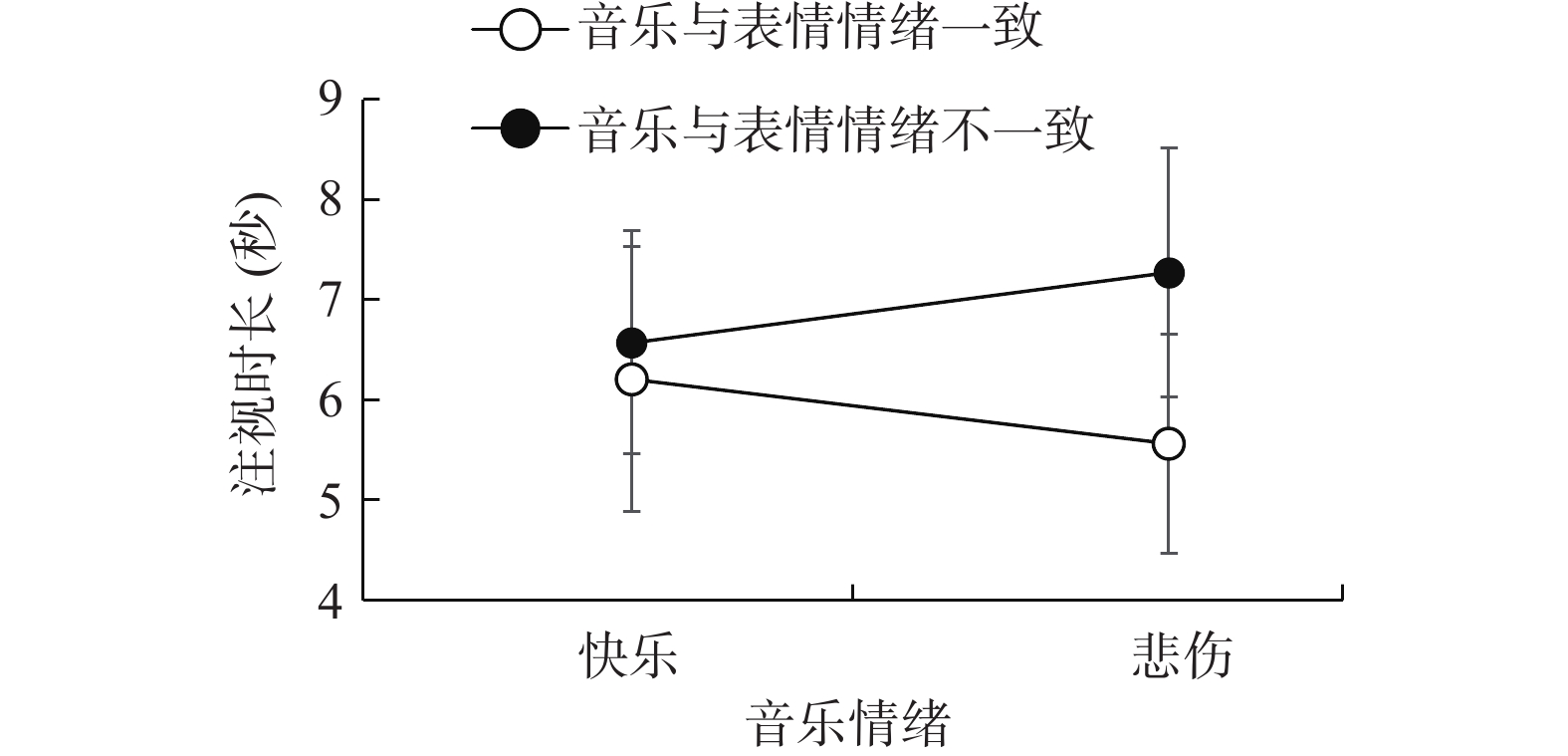
图2 婴儿被试听音乐后对表情的注视时长 注:误差线表示95%置信区间,以下同。
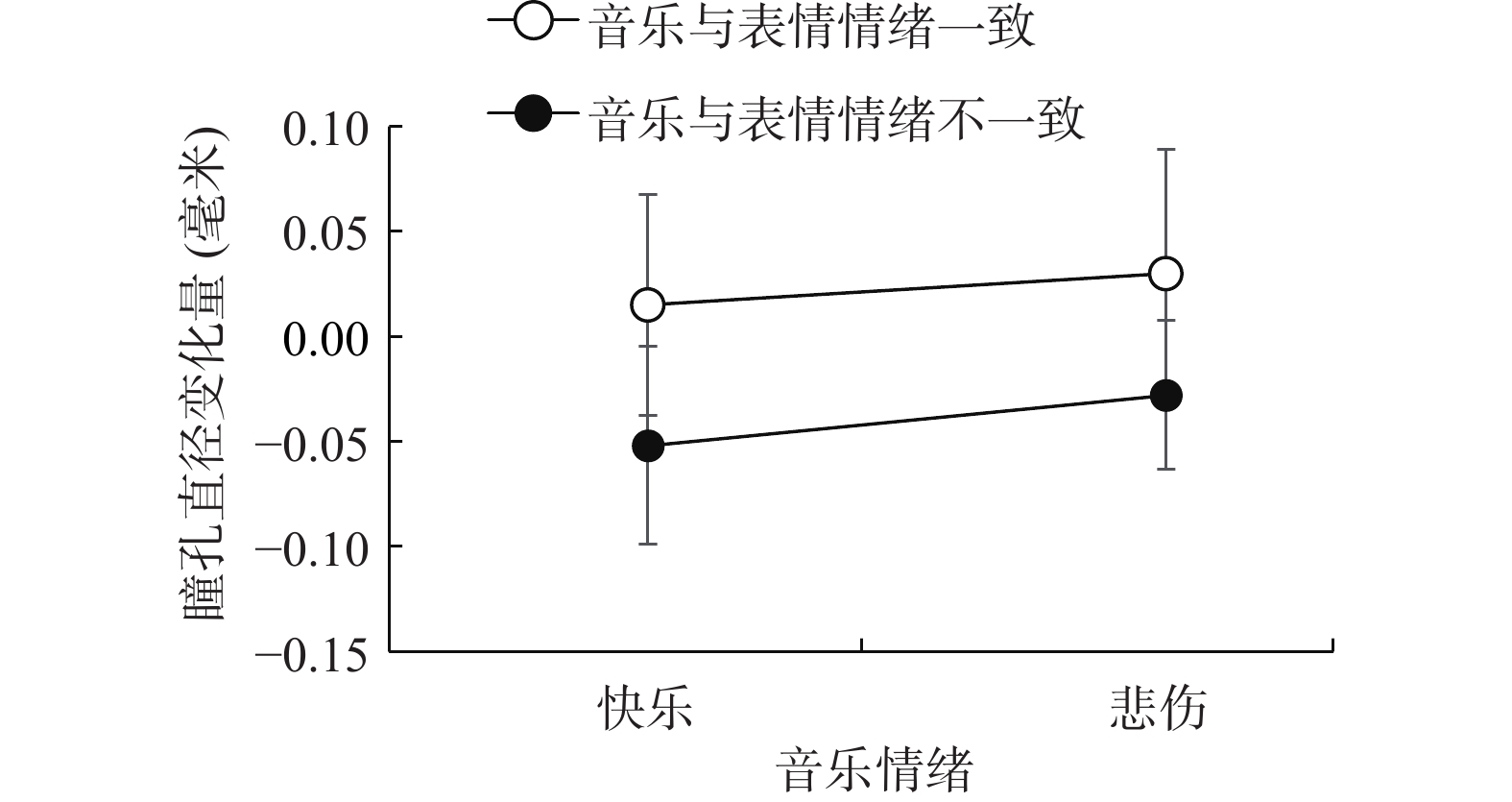
图3 婴儿被试听音乐后对表情的瞳孔直径变化量
|
龚栩, 黄宇霞, 王妍, 罗跃嘉. 中国面孔表情图片系统的修订. 中国心理卫生杂志, 2011, 25 (1): 40- 46.
DOI |
|
|
马谐, 陶云, 白学军. 儿童对中-西方音乐情绪感知的发展研究. 心理与行为研究, 2017, 15 (2): 233- 239.
DOI |
|
|
孟昭兰. (2005). 情绪心理学. 北京: 北京大学出版社.
|
|
|
徐琴美, 何洁. 儿童情绪理解发展的研究述评. 心理科学进展, 2006, 14 (2): 223- 228.
DOI |
|
|
周玉, 张丹丹. 婴儿情绪与社会认知相关的听觉加工. 心理科学进展, 2017, 25 (1): 67- 75.
|
|
|
Beatty, J., & Lucero-Wagoner, B. (2000). The pupillary system. In J. T. Cacioppo, L. G. Tassinary, & G. G. Berntson (Eds.), Handbook of psychophysiology (2nd ed., pp. 142–162). Cambridge: Cambridge University Press.
|
|
|
Bergeson, T. R., & Trehub, S. E. Signature tunes in mothers’ speech to infants. Infant Behavior and Development, 2007, 30 (4): 648- 654.
DOI |
|
|
Brady, S. M., Ogren, M., & Johnson, S. P. Effects of conflicting emotional cues on toddlers’ emotion perception. British Journal of Developmental Psychology, 2024, 43 (3): 376- 391.
|
|
|
Caron, A. J., Caron, R. F., & MacLean, D. J. Infant discrimination of naturalistic emotional expressions: The role of face and voice. Child Development, 1988, 59 (3): 604- 616.
DOI |
|
|
Cohen, J. A power primer. Psychological Bulletin, 1992, 112 (1): 155- 159.
DOI |
|
|
Deutsch, D. (2013). The psychology of music (3rd ed.). Amsterdam: Elsevier Academic Press.
|
|
|
Eerola, T., & Vuoskoski, J. K. A comparison of the discrete and dimensional models of emotion in music. Psychology of Music, 2011, 39 (1): 18- 49.
DOI |
|
|
Fawcett, C., & Kreutz, G. Twelve-month-old infants’ physiological responses to music are affected by others’ positive and negative reactions. Infancy, 2021, 26 (6): 784- 797.
DOI |
|
|
Flom, R., Gentile, D. A., & Pick, A. D. Infants’ discrimination of happy and sad music. Infant Behavior and Development, 2008, 31 (4): 716- 728.
DOI |
|
|
Flom, R., & Pick, A. D. Dynamics of infant habituation: Infants’ discrimination of musical excerpts. Infant Behavior and Development, 2012, 35 (4): 697- 704.
DOI |
|
|
Geangu, E., Hauf, P., Bhardwaj, R., & Bentz, W. Infant pupil diameter changes in response to others’ positive and negative emotions. PLoS One, 2011, 6 (11): e27132.
DOI |
|
|
Juslin, P. N. From everyday emotions to aesthetic emotions: Towards a unified theory of musical emotions. Physics of Life Reviews, 2013, 10 (3): 235- 266.
DOI |
|
|
Kisilevsky, B. S., Hains, S. M. J., Jacquet, A. Y., Granier-Deferre, C., & Lecanuet, J. P. Maturation of fetal responses to music. Developmental Science, 2004, 7 (5): 550- 559.
DOI |
|
|
Luo, Y. Y. Three-month-old infants attribute goals to a non-human agent. Developmental Science, 2011, 14 (2): 453- 460.
DOI |
|
|
Moog, H. (1976). The musical experience of the pre-school child. London: Schott.
|
|
|
Nagy, E., Cosgrove, R., Robertson, N., Einhoff, T., & Orvos, H. Neonatal musicality: Do newborns detect emotions in music. Psychological Studies, 2022, 67 (4): 501- 513.
DOI |
|
|
Nakata, T., & Trehub, S. E. Infants’ responsiveness to maternal speech and singing. Infant Behavior and Development, 2004, 27 (4): 455- 464.
DOI |
|
|
Nawrot, E. S. The perception of emotional expression in music: Evidence from infants, children and adults. Psychology of Music, 2003, 31 (1): 75- 92.
DOI |
|
|
Ogren, M., & Johnson, S. P. Intermodal emotion matching at 15 months, but not 9 or 21 months, predicts early childhood emotion understanding: A longitudinal investigation. Cognition and Emotion, 2020, 34 (7): 1343- 1356.
DOI |
|
|
Perani, D., Saccuman, M. C., Scifo, P., Spada, D., Andreolli, G., Rovelli, R., ... Koelsch, S. Functional specializations for music processing in the human newborn brain. Proceedings of the National Academy of Sciences of the United States of America, 2010, 107 (10): 4758- 4763.
|
|
|
Plate, R. C., Jones, C., Steinberg, J., Daley, G., Corbett, N., & Waller, R. Children’s knowledge and feelings align in response to emotional music. Developmental Psychology, 2024, 60 (2): 265- 270.
DOI |
|
|
Porter, G., Troscianko, T., & Gilchrist, I. D. Effort during visual search and counting: Insights from pupillometry. Quarterly Journal of Experimental Psychology, 2007, 60 (2): 211- 229.
DOI |
|
|
Reschke, P. J., Walle, E. A., Flom, R., & Guenther, D. Twelve-month-old infants’ sensitivity to others’ emotions following positive and negative events. Infancy, 2017, 22 (6): 874- 881.
DOI |
|
|
Ruba, A. L., Meltzoff, A. N., & Repacholi, B. M. How do you feel? Preverbal infants match negative emotions to events. Developmental Psychology, 2019, 55 (6): 1138- 1149.
DOI |
|
|
Ruba, A. L., Meltzoff, A. N., & Repacholi, B. M. The development of negative event-emotion matching in infancy: Implications for theories in affective science. Affective Science, 2020, 1 (1): 4- 19.
DOI |
|
|
Ruba, A. L., & Pollak, S. D. The development of emotion reasoning in infancy and early childhood. Annual Review of Developmental Psychology, 2020, 2, 503- 531.
DOI |
|
|
Sauter, D. A., Panattoni, C., & Happé, F. Children’s recognition of emotions from vocal cues. British Journal of Developmental Psychology, 2013, 31 (1): 97- 113.
DOI |
|
|
Silk, J. S., Dahl, R. E., Ryan, N. D., Forbes, E. E., Axelson, D. A., Birmaher, B., & Siegle, G. J. Pupillary reactivity to emotional information in child and adolescent depression: Links to clinical and ecological measures. American Journal of Psychiatry, 2007, 164 (12): 1873- 1880.
DOI |
|
|
Siu, T. S. C., & Cheung, H. Infants’ sensitivity to emotion in music and emotion-action understanding. PLoS One, 2017, 12 (2): e0171023.
DOI |
|
|
Smith-Flores, A. S., Flores -Guevara, I. A., & Powell, L. J. Infants expect friends, but not rivals, to be happy for each other when they succeed. Developmental Science, 2024, 27 (1): e13423.
DOI |
|
|
Squires, J., & Bricker, D. (2009). Ages & stages questionnaires® (3th ed., pp. 257–182). Baltimore, MD: Paul H. Brookes Publishing Co.
|
|
|
Swaminathan, S., & Schellenberg, E. G. Current emotion research in music psychology. Emotion Review, 2015, 7 (2): 189- 197.
DOI |
|
|
Trehub, S. E. The developmental origins of musicality. Nature Neuroscience, 2003, 6 (7): 669- 673.
DOI |
|
|
Vaillant-Molina, M., Bahrick, L. E., & Flom, R. Young infants match facial and vocal emotional expressions of other infants. Infancy, 2013, 18 (S1): E97- E111.
|
|
|
Valentine, C. W. (1962). The experimental psychology of beauty. London: Routledge.
|
|
|
Walker-Andrews, A. S., & Grolnick, W. Discrimination of vocal expressions by young infants. Infant Behavior and Development, 1983, 6 (4): 491- 498.
DOI |
|
|
Zekveld, A. A., Koelewijn, T., & Kramer, S. E. (2018). The pupil dilation response to auditory stimuli: Current state of knowledge. Trends in Hearing, 22, 2331216518777174.
|
|
|
Zentner, M., & Eerola, T. Rhythmic engagement with music in infancy. Proceedings of the National Academy of Sciences of the United States of America, 2010, 107 (13): 5768- 5773.
|
| [1] | 王娅珂, 张雨轩, 冯琳琳, 卡明芳, 梁菲菲. 小学三到五年级儿童阅读眼动模式的发展及其与阅读理解的关系[J]. 心理与行为研究, 2026, 24(2): 161-169. |
| [2] | 丁晓茜, 刘华语. 社会排斥影响个体社交行为的双路径机制:消极完美主义与注意偏向的作用[J]. 心理与行为研究, 2026, 24(1): 51-59. |
| [3] | 王怀勇, 徐田田, 叶青. 过程追踪视角下焦虑情绪对延迟选择的影响及机制:任务框架的调节作用[J]. 心理与行为研究, 2026, 24(1): 122-129. |
| [4] | 王旭瑛, 邵杨, 阴晓娟, 金晓康, 金花. 恐惧诉求下希望类健康错误信息的更正:来自行为和眼动的证据[J]. 心理与行为研究, 2025, 23(6): 813-821. |
| [5] | 李文静, 孙雯, 朱海迪. 流行背景音乐对休闲阅读的影响:来自眼动的证据[J]. 心理与行为研究, 2025, 23(4): 448-455. |
| [6] | 杜宇菲, 张志超, 张慢慢, 臧传丽. 语义优先于世界知识参与句子理解过程:来自眼动的证据[J]. 心理与行为研究, 2025, 23(2): 153-160. |
| [7] | 王永胜, 韩洋, 李馨, 何立媛. 词间空格在维吾尔族大学生不同文本呈现方向的汉语句子阅读中的促进作用[J]. 心理与行为研究, 2025, 23(1): 41-48. |
| [8] | 陈相文, 王泷歌, 胡惠兰, 张志超, 王梦思, 汪强, 张慢慢. 中文阅读词频效应个体差异的脑结构基础:基于眼动指标的分析[J]. 心理与行为研究, 2024, 22(6): 721-729. |
| [9] | 赵光, 陈佳欢, 李林璇, 张吉超, 吴镕涛. 背景线索效应的动态眼动模式:基于隐马尔可夫模型[J]. 心理与行为研究, 2024, 22(5): 594-601. |
| [10] | 贾宇晴, 高彤琪, 闫国利. 一年级小学生汉语默读和朗读差异的眼动研究[J]. 心理与行为研究, 2024, 22(5): 633-641. |
| [11] | 周广东, 刘爽, 俞美硕. 反应性和主动性攻击儿童情绪面孔的注意差异[J]. 心理与行为研究, 2024, 22(5): 642-649. |
| [12] | 常敏, 张阔, 孙悦, 李莎, 王敬欣. 汉语阅读中的语义相似度效应:语义预测的证据[J]. 心理与行为研究, 2024, 22(4): 442-449. |
| [13] | 王永胜, 张娜, 杜小普, 郭紫璐, 李馨. 语素意识在汉语二语学习者阅读过程中的作用[J]. 心理与行为研究, 2024, 22(4): 450-456. |
| [14] | 张锦坤, 赖廷明, 昝晓琪, 李莎, 连坤予, 张俐娟. 多媒体学习中的不流畅效应:线索与流畅性的平衡[J]. 心理与行为研究, 2024, 22(4): 545-552. |
| [15] | 张文, 阚超, 郭丽敏, 刘知和, 刘阳. 排球运动员接扣球知觉预测认知加工特征研究:来自眼动和fNIRS的关联证据[J]. 心理与行为研究, 2024, 22(4): 562-569. |
| 阅读次数 | ||||||
|
全文 |
|
|||||
|
摘要 |
|
|||||
